Fiberglass Pool Resurfacing and Repair in League City, TX
League City Pool Resurfacing does fiberglass pool resurfacing and repair in League City, Texas: refinishing a worn gelcoat with a sprayed polymer coating or an epoxy pool paint, and fixing spider cracks, blisters, chips and stains. River Pools, a fiberglass pool maker, describes gelcoat as the colored resin sprayed onto the shell at the factory, the smooth surface you see, touch and walk on, and Latham's care manual puts its thickness at seven to eight times that of an ordinary coat of paint.
A free estimate, booked by phone or through the form, covers whether the surface needs a refinish or only a repair, which coating suits it, and what draining a fiberglass shell safely involves.
Call or request a free estimate any time, 24/7
No charge · answered 24/7
Get free estimates
When a fiberglass pool needs resurfacing
How gelcoat wears
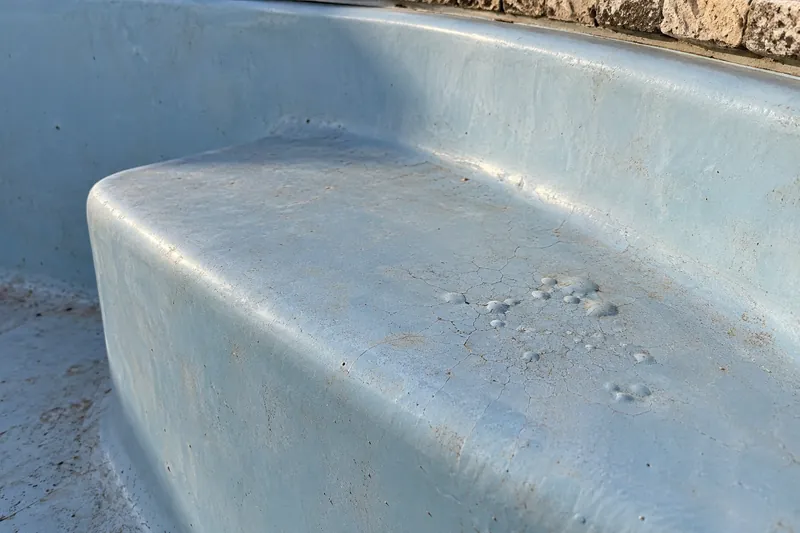
River Pools expects sun fading on a fiberglass pool to be even and gradual, often too slow to notice, and says most fiberglass pools never need resurfacing at all unless the water chemistry is neglected or the surface isn't cleaned. ecoFINISH, which makes a coating sold for refinishing fiberglass, describes the signs of a worn shell: a once-glossy surface going chalky, losing color and feeling rough as its protective gelcoat breaks down.
Water chemistry and the gelcoat
Tallman Pools, another fiberglass maker, says incorrect chemistry can discolor, chalk, fade, etch or scale the gelcoat and may void its warranty. The makers don't agree on calcium: Latham's warranty lists calcium hardness of 250 to 350 ppm, River Pools wants it under 120 ppm with pH at 7.2 to 7.4, and Tallman keeps it at 80 to 120 ppm. Tallman and River Pools both rule out calcium hypochlorite, shocking with liquid chlorine or a non-chlorine oxidizer instead, while Latham's older manual allows cal-hypo if it is dissolved first. League City's 2025 water report gives total hardness, 124 mg/L as calcium carbonate, for its Houston-plant supply only, with no calcium figure on its own, so the pool maker's own range is the one to follow.
Why the factory gelcoat isn't redone in the ground
At River Pools the gelcoat goes on in three passes that add up to 25 to 30 mils; any thinner, it warns, and an improper cure can blister it, any thicker and it can crack. Gelcoat takes time to dry and has to cure at a consistent temperature, it says, a precision that can't be duplicated outdoors, so gelcoat suits smaller repairs but not a whole resurface. A re-gelcoat also narrows the color choice to pale shades such as white, baby blue, tan or light grey, according to ecoFINISH, though some gelcoat sellers do show whole pools redone with their product.
Call or request a free estimate any time, 24/7.
(281) 694-4352Fiberglass pool resurfacing options: polymer coatings and epoxy paint
Sprayed polymer coatings
ecoFINISH is River Pools' standard recommendation for refinishing a fiberglass pool: a polyethylene powder sprayed on with a compressed-air gun and set in place with heat. River Pools describes the steps as sandblasting if paint or residue is stuck to the surface, cleaning and inspecting, coating the whole pool with epoxy, spraying the powder onto the still-tacky epoxy, heat-curing it and building it up in a few layers. ecoFINISH says its polyFIBRO coating lets the pool be filled immediately, where a gel-coat cure means waiting over a week, and that pools with its coatings need no start-up and may be heated right after filling.
Epoxy pool paint on fiberglass
The paint makers that allow fiberglass specify epoxy: for fiberglass shells Insl-x by Benjamin Moore recommends nothing but its epoxy pool paint, Ramuc points to its Hi Build or HB31 epoxies, and Olympic calls for two coats of POXOLON 2 or one of ZERON over GUNZITE primer. Insl-x doesn't recommend its waterborne or rubber-based paints on fiberglass. Prep differs by maker: Insl-x has bare fiberglass cleaned, scuffed with 150-to-180-grit paper, rinsed and left 24 hours to dry, Ramuc abrades it to a #80 grit profile, and Olympic sands in straight lines with coarse paper, with no orbital sander and no acid wash, whereas Ramuc's Hi Build guide acid-washes mineral deposits off first. ecoFINISH, a competing coating maker, argues that paint bonds poorly to smooth, non-porous gel coat. Paint types and cure times are covered under pool painting.
Call or request a free estimate any time, 24/7.
(281) 694-4352Fiberglass pool repair: spider cracks, blisters and stains
Spider cracks
Spider cracks are small hairline cracks in the gelcoat, typically cosmetic rather than structural, River Pools says. They appear where pressure on the shell is more than the gelcoat can bend with, most often from improper installation, an uneven base or debris underneath, poor manufacturing, or shipping and handling. Latham calls hairline gelcoat cracks not uncommon and points owners to patch and repair kits from an authorized dealer. FGCI's gelcoat putty repair, sold mainly for boats, roughs up the crack, overfills it with putty catalyzed with 1.5 percent MEK-P, cures 12 to 24 hours and is sanded flat.
Osmotic blisters
River Pools explains a blister as water seeping in through the gelcoat, reacting with contaminants into a molecule too large to leave the way it came, and pressing outward until the gelcoat lifts from the laminate behind it. Barrier Reef Pools ties it to the surface layer eroding under a chemical imbalance, and River Pools blends a vinyl ester resin layer as a watertight barrier against it. A blister guide written for boats by Gougeon Brothers, maker of WEST SYSTEM epoxy, warns that blister fluid is acidic and frequently under as much as 200 psi, and calls thorough drying the most crucial step once the blisters are opened. River Pools stresses that osmotic blisters are cosmetic, not structural, and makers' blister warranties differ: Latham's runs as long as the original buyer owns the pool, Glimmerglass's ten years and Barrier Reef's 15.
Stains, scale and matching a repair
Tallman Pools reads stains by color: organic ones green, brown or tan; iron orange, brown or tan; copper green, blue or teal; manganese brown, black or purple. Black cobalt spots, it says, are a reaction with the resin under the gelcoat rather than a true stain. White calcium carbonate foams under a drop of muriatic acid, while calcium silicate shows no reaction and is a job for a fiberglass technician. Tallman allows only stain removers made for fiberglass and no sanding, polishing or buffing unless a professional directs it; Latham's older manual restores dull spots with a body compound and fiberglass boat wax. Most repairs won't be completely invisible, River Pools says, especially on multi-layer metallic or flake finishes, and Latham's warranty accepts a visible shade difference after one.
Bulging walls and structural cracks
River Pools traces bulging walls to sand backfill that becomes saturated and liquefies against the shell, and recommends gravel; Tallman adds that too much hydrostatic pressure against the shell can shift it, make it bulge or even make it fail. Why a fiberglass shell cracks right through, most often from how it was installed, is explained under pool crack repair, though no fiberglass maker we read publishes a repair for the laminate itself, and water lost through a crack or fitting is traced under pool leak detection and repair. League City Pool Resurfacing will talk through which repair the pool needs.
Call or request a free estimate any time, 24/7.
(281) 694-4352Draining a fiberglass pool for resurfacing or repair in League City
Why draining is the risky step
Drain a fiberglass pool without first relieving the hydrostatic pressure on its shell and the shell will buckle and crack, Latham's manual warns; draining also voids Latham's warranty unless a dealer handles it. Tallman requires written authorization and lists the pool floating or shifting and the gelcoat blistering or cracking among the risks, and River Pools says that for most makers an authorized dealer must drain the pool.
The steps the makers give
River Pools' order of work is to confirm dry weather for the full job, check for groundwater and pump it away, brace the walls, and only then empty the pool, watching that the floor doesn't lift; it typically sets three braces 18 to 24 inches down the side walls. Before any service that lowers the water, Tallman has the groundwater inspection port checked, and any water found there is pumped out slowly so the soil, sand or gravel underneath isn't disturbed. Under Latham's warranty, draining, bracing and removing groundwater around the pool fall to the buyer during a repair.
League City ground, rain and drought rules
NRCS soil data for League City's Census center point show Bernard clay loam, saturated from roughly 12 to 18 inches below the surface through December, January and February. Along League City Parkway on the west side, the Leton soil stays wet from about 9 inches down for eight months of the year, October to May. NOAA's League City station records September as the wettest month, with 7.34 inches. Once Stage 2 of the drought plan is in force, the City may forbid draining and refilling except where the structure, normal operation and maintenance, or public safety requires it. On October 4, 2026, the official pages read for this site showed no stage in effect; ask again before the water comes out.
Call or request a free estimate any time, 24/7.
(281) 694-4352Fiberglass pool resurfacing and repair questions
How much does it cost to resurface a fiberglass pool?
A Houston fiberglass pool company's 2025 guide puts the average at $5,000 to $15,000: basic gel coat resurfacing $5,000 to $8,000, an epoxy or polymer coating $7,000 to $12,000, and full replacement of the fiberglass layer $12,000 to $20,000; the work takes 5 to 10 days. National 2026 ranges run $6,000 to $15,000 for fiberglass resurfacing or recoating. Both are published figures rather than prices from League City Pool Resurfacing, which looks at the shell and prices the job free.
How much does it cost to repair a fiberglass pool?
National 2026 averages put a gel coat repair of dings, scratches and cracks at $300 to $400, with another $800 if the surface is repainted afterward. For structural repairs such as cracks and leaks, the same Houston fiberglass company's 2025 guide gives $1,000 to $5,000. Spider cracks, blisters and stains each take a different fix, so the price follows what is wrong with the shell.
Can I gel coat my fiberglass pool?
For small repairs, yes. For the whole pool, River Pools says gelcoat is meant to be applied and cured in a factory and isn't suitable for resurfacing a pool already in the ground, and ecoFINISH notes that a re-gelcoat limits the color to light shades. River Pools recommends a sprayed polymer coating for a full refinish instead, and the paint makers sell epoxy for fiberglass shells.
Can fiberglass pools be repaired?
Yes. Hairline spider cracks are typically cosmetic, and Latham says patch and repair kits are available from an authorized dealer. Osmotic blisters are cosmetic too, in River Pools' words, and the marine repair guide's method is to open them, remove the damaged material and dry the laminate thoroughly. Expect a slight difference in shade, which Latham's warranty treats as acceptable.
What is the average life expectancy of a fiberglass pool?
The figures the makers publish are for the surface, not the shell. By River Pools' account, most fiberglass pools reach 20 or 30 years of age before refinishing becomes necessary, ecoFINISH says most start showing wear after 10 to 15 years of regular use, and the Houston fiberglass pool company's guide says resurfacing comes every 15 to 30 years on average. Water chemistry is the variable the makers keep returning to.
Book a free fiberglass pool resurfacing or repair estimate
Tell League City Pool Resurfacing what the surface looks like, whether it is chalky, cracked, blistered or stained, and roughly how big the pool is. Calls and estimate requests are answered 24/7.