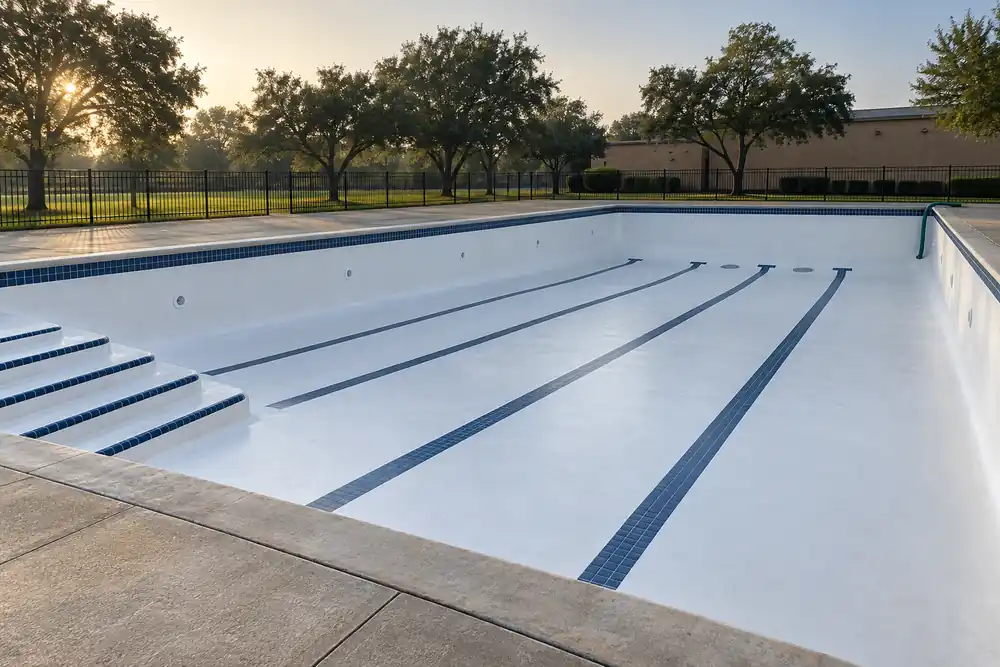
League City Pool Resurfacing: Commercial and Residential Pool Remodeling, Pebble Finishes and Plastering
Serving League City, Texas
League City Pool Resurfacing is a commercial and residential pool resurfacing contractor in League City, Texas, working on HOA, apartment, hotel and club pools as well as backyard pools: full pool remodels and renovations, pebble and quartz finishes, and new white or colored plaster. We also replace waterline tile and coping, resurface pool decks with spray deck and cool deck coatings, and repair plaster, cracks, leaks and skimmers. The National Plasterers Council rates white plaster a 5 to 8 year surface and pebble 12 to 18 years, and the Census Bureau's 2024 American Community Survey counts 14,009 League City homes built from 1980 to 1999 and 15,991 more from 2000 to 2009.
League City buys treated Brazos River water from the Gulf Coast Water Authority and Trinity River water from the City of Houston and disinfects it with chloramines, and the NRCS soil database maps Bernard clay loam at the city's Census center point, wet from 12 to 18 inches down from December through February. Both bear on a resurfacing job, so we'll talk them through along with the finish and what it costs. The estimate is free, and the phone and the form are answered 24/7.
Call or request a free estimate any time, 24/7
No charge · answered 24/7
Get free estimates
Why pool owners call League City Pool Resurfacing for plastering, pebble and remodel work
What a call or an estimate request covers, for a backyard pool, an HOA pool or an apartment pool.
Free estimates on resurfacing and remodels
Send the pool's rough size, its current finish and what you want changed. Pricing the job costs nothing, with no obligation to go ahead.
Estimate requests answered 24/7
Call or use the form at any hour, weekends included.
Backyard, HOA, apartment and hotel pools
Texas counts HOA, apartment, condominium and hotel pools as Class C public pools, which the Galveston County Health District permits each year. A pool serving one home or a duplex is residential.
A fill-water test before the finish is chosen
League City reports mineral readings for one of its water sources only, so we'll talk through testing the fill water for pH, alkalinity, calcium hardness and metals before the start-up.
City, HOA and drought rules checked before the drain
The City's pool code, the HOA's approval and the drought plan's limits on draining and refilling all come before any water comes out, and we'll go through each one with you.
Specs and prices with their sources
Figures here name their source: the National Plasterers Council, finish makers, the City of League City, NOAA, the Census Bureau. Prices are typical Houston-area or national figures, never quotes.
Call or request a free estimate any time, 24/7.
(281) 694-4352Commercial pool resurfacing for HOAs, apartments, hotels and clubs
The Texas Department of State Health Services classes pools at apartments, condominiums, hotels, HOAs, clubs and schools as Class C public pools, each run under a certified pool operator. In League City the Galveston County Health District inspects and permits every public and semi-public pool yearly. The City's own Hometown Heroes pool, 400,000 gallons and 10 years old, was replastered in spring 2025, its deck partly replaced and recoated and its splash pad refinished.
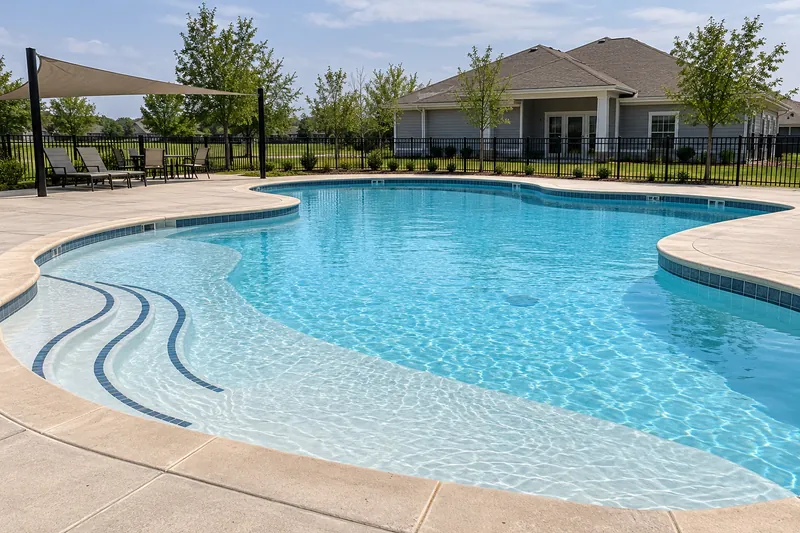
HOA and community pools
The Health District permits HOA neighborhood pools as semi-public pools, at $135 a year each. South Shore Harbour's 2021 reserve study gave its community pool's 4,920 square feet of plaster an 8 to 12 year useful life.
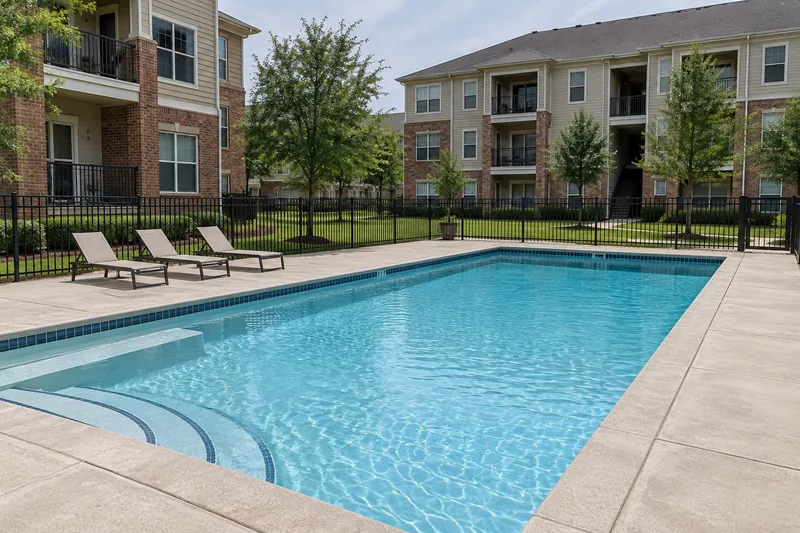
Apartment and condominium pools
State law wants a 48-inch enclosure around apartment and HOA pools, with self-closing, self-latching gates opening outward and latches at least 60 inches up, with narrow exceptions. For sales tax these pools count as residential, so remodeling labor on them isn't taxed.
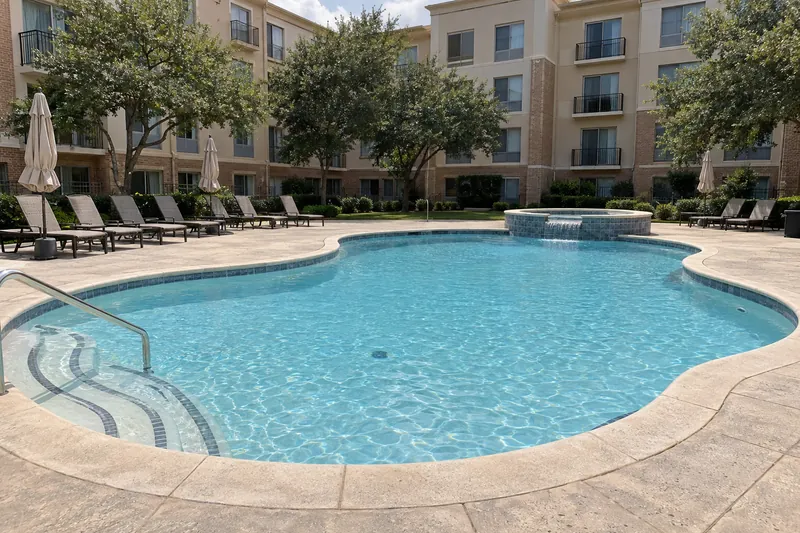
Hotel and resort pools
Hotel pools are semi-public too, but the full charge for remodeling or repairing one is taxable in Texas, at 8.25 percent in League City. While a public pool is closed for renovation, users stay out of the pool yard behind a closed sign.
Club, school and city pools
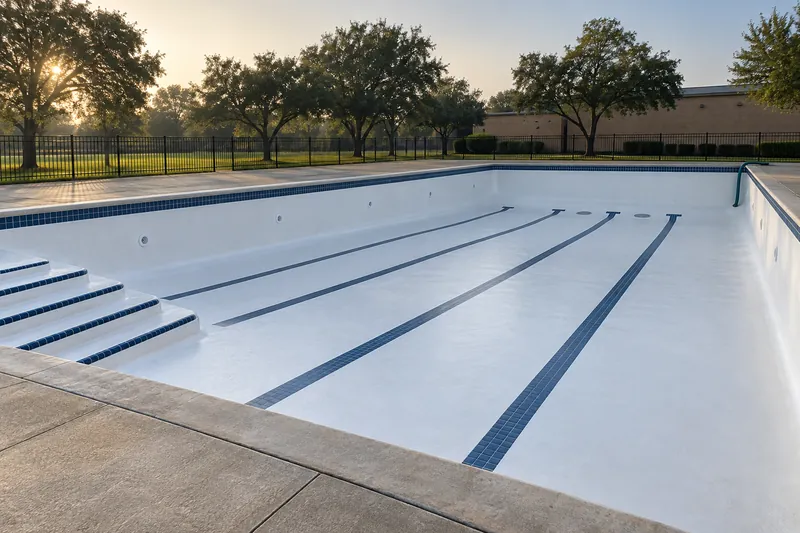
The state adopts the 2021 International Swimming Pool and Spa Code for commercial pool renovation and repair. It wants public pool finishes light enough that nothing in the water is hidden: 6.5 or higher on the Munsell color value scale.
Depth markers and safety tile
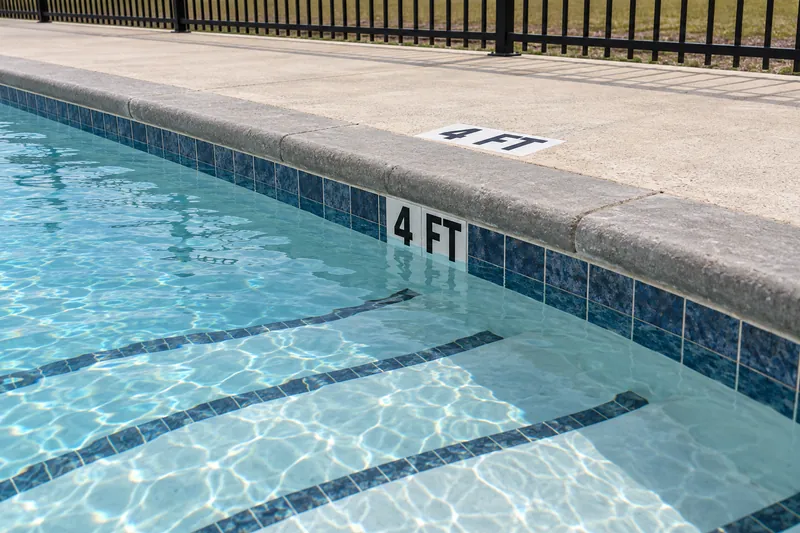
Every Texas public pool needs two or more depth markers within the top 4-1/2 inches of wall below the coping, lettered at least 4 inches tall and 25 feet apart at most. Class B and C pools deeper than 5 feet also mark the slope change with a contrasting band, such as a 4-inch row of floor tile.
Call or request a free estimate any time, 24/7.
(281) 694-4352Pool remodeling, renovation and additions
Pebble Technology International notes that a remodel usually does the finish and the waterline tile together. The 2021 International Swimming Pool and Spa Code, which League City adopts, treats an addition or alteration as new work but doesn't make the untouched rest of an existing pool meet today's rules. Our page on pool remodeling covers permits, the drain-down and cost.
Tanning ledges and beach entries
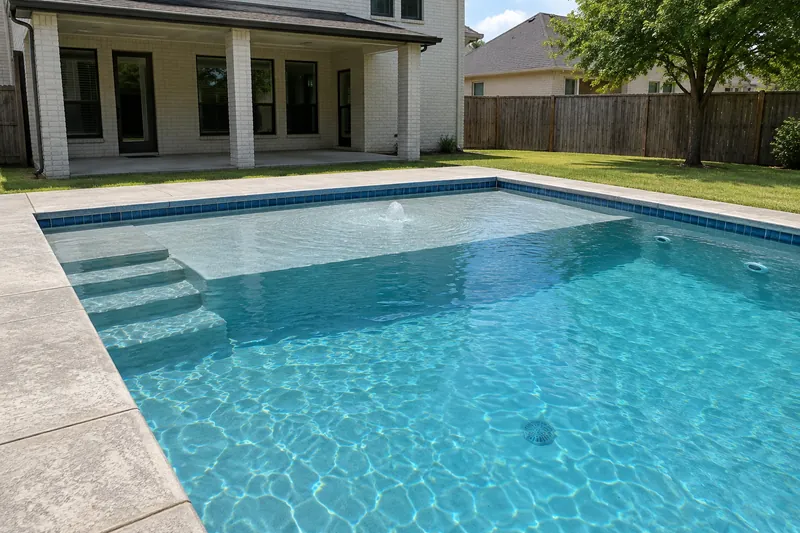
A sun shelf usually sits 6 to 9 inches under the water, by in-pool furniture maker Ledge Lounger's count. In a backyard pool the code allows beach entries no steeper than 1 in 7 and benches no deeper than 20 inches.
Spas added to an existing pool
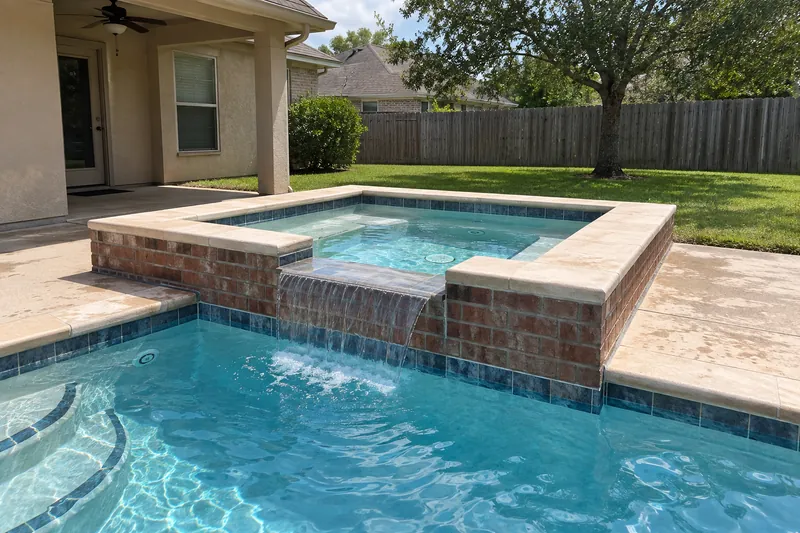
League City's permit list includes spas deeper than 24 inches. The code allows a residential spa no more than 4 feet of water, seats down to 28 inches and makeup water up to 104°F.
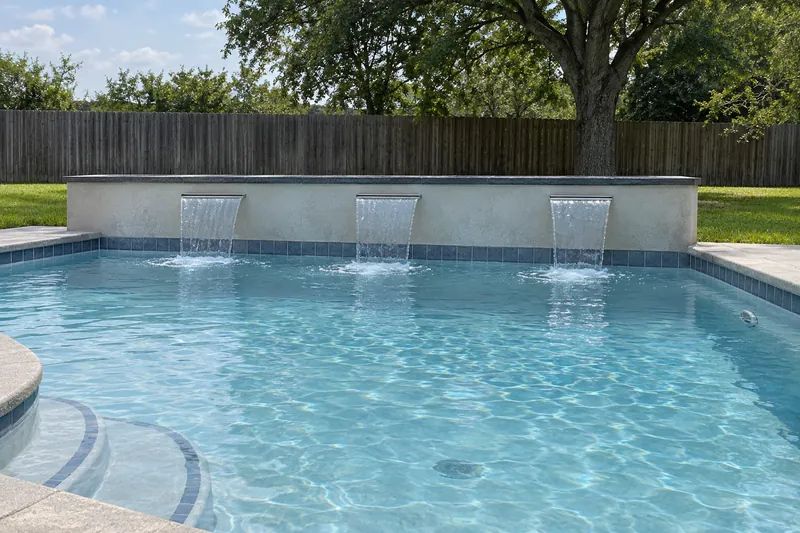
Water features and waterfalls
Pentair plans about 15 gallons a minute per foot of waterfall and tops sheet falls out at 3 feet, where the sheet breaks apart. Some HOAs set limits: Brittany Lakes caps slides and waterfalls at 6 feet.
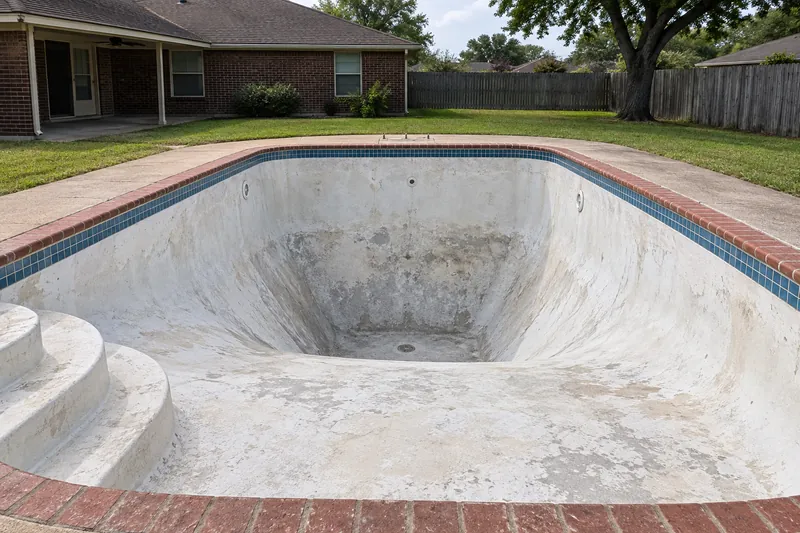
Diving pool conversions
Filling in a deep end makes a diving pool what the code calls Type O, a nondiving pool with no diving equipment and a shallow end 33 inches to 4 feet deep.
Call or request a free estimate any time, 24/7.
(281) 694-4352Pebble, quartz and plaster pool finishes
The National Plasterers Council describes each of these as a special cement mix made for pools, placed and finished in one single application, and says the finish chosen at the planning stage strongly affects how well a pool keeps its looks.
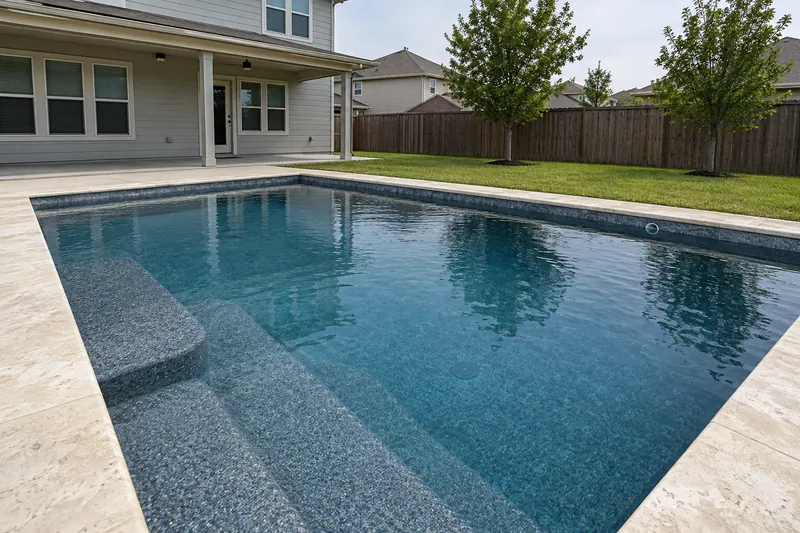
Pebble finishes
Pebbles, glass and other materials are troweled hard, compacted and exposed. River pebble is chemically inert, so the Council calls pebble the most durable surface available. Pebble Technology International's range runs from the coarse original PebbleTec to the smoothest PebbleFina. See pebble pool finishes.
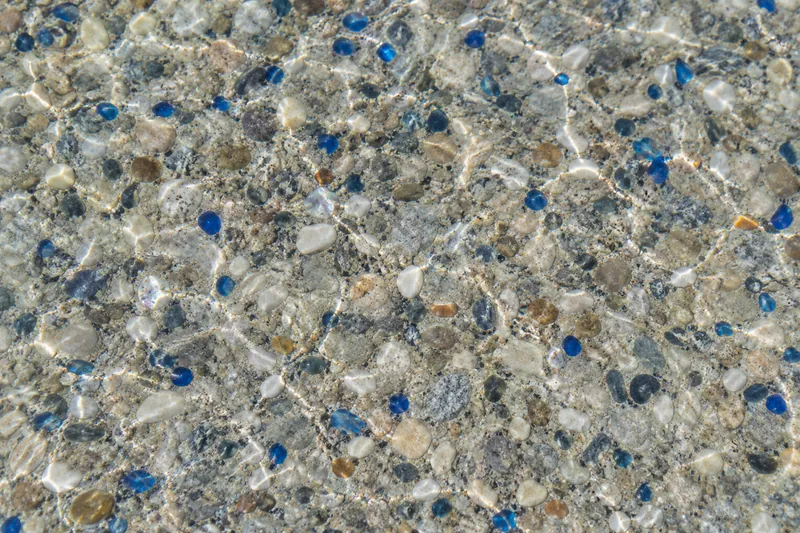
Polished pebble and glass bead
Polished finishes feel smooth but look like exposed aggregate, since polishing is the last step; the Council rates them 8 to 12 years. Pebble Technology International's PebbleBrilliance adds glass beads for foot comfort and sparkle.
Quartz finishes
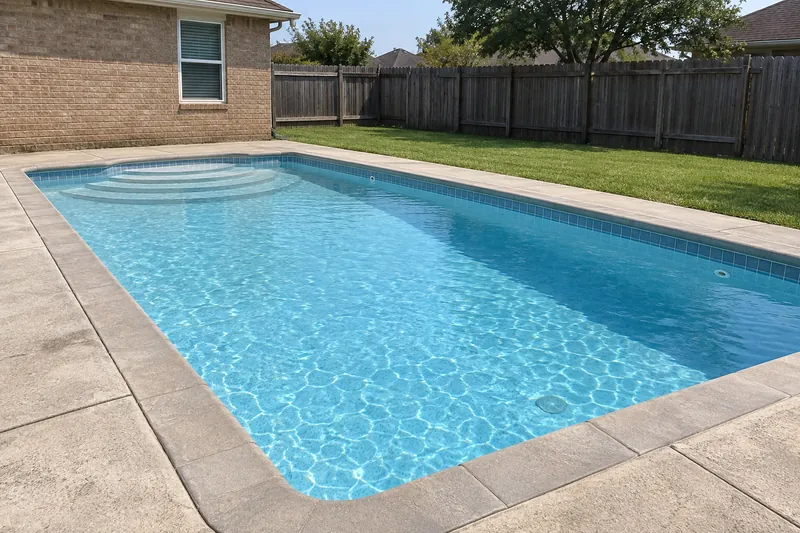
Quartz, a silicate mineral among the hardest in nature, is inert to pool chemicals, and the Council rates it 10 to 15 years. SGM, which makes its Diamond Brite quartz finish in Dallas and in Florida, says quartz stays insoluble even in strong acid, unlike marble.
White and colored plaster
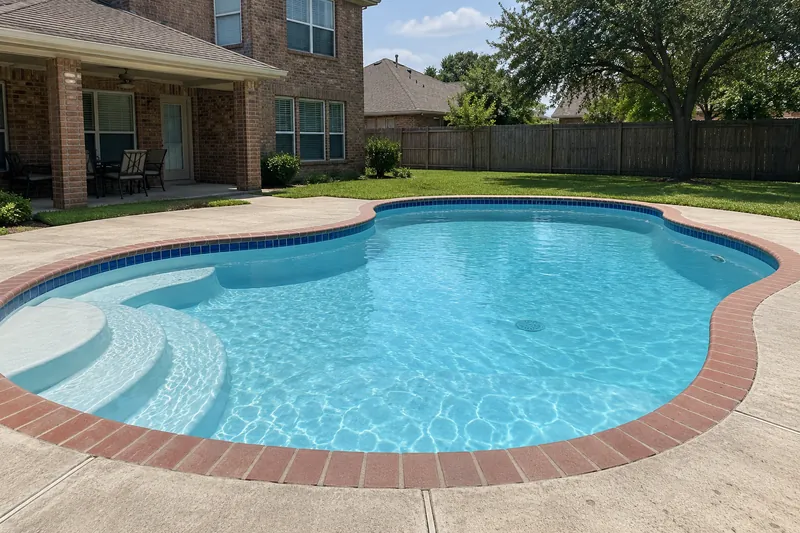
White cement, white marble aggregate and water: the most affordable finish, light blue and smooth underwater. Colored plaster shows more mottling and crazing, which the Council doesn't count as a defect. More on pool replastering.
Call or request a free estimate any time, 24/7.
(281) 694-4352Fiberglass, glass tile, spa and painted pool resurfacing
Four surfaces that follow their own makers' rules rather than the plaster trade's.
Fiberglass pool resurfacing and repair
River Pools, a fiberglass maker, says most fiberglass pools are 20 or 30 years old before they need refinishing, and recommends a sprayed coating such as ecoFINISH, which lets the pool refill the same day.
Glass tile pool interiors
LATICRETE calls submerged glass tile typically more expensive and more demanding to install. Lightstreams requires a waterproof membrane under submerged tile and 21 days after grouting before the fill.
Spa and hot tub resurfacing
Concrete spas follow the same plastering standard as pools. In the National Plasterers Council's saturation-index math, the temperature factor goes from 0.6 at 76°F up to 0.9 at 105°F, so hot spa water leans toward scaling.
Pool painting
Olympic rates epoxy pool paint at 5 to 8 years and acrylic or rubber-based paint at 2 to 3, and Kelley Technical Coatings says never to recoat a rubber-base coating with epoxy.
Call or request a free estimate any time, 24/7.
(281) 694-4352Pool tile replacement, coping and calcium removal
The waterline goes through wet and dry cycles as a pool is used, evaporates and is topped up, which is why it's lined with tile. South Shore Harbour's 2021 reserve study budgets full tile and coping replacement at every other replastering.
Waterline tile
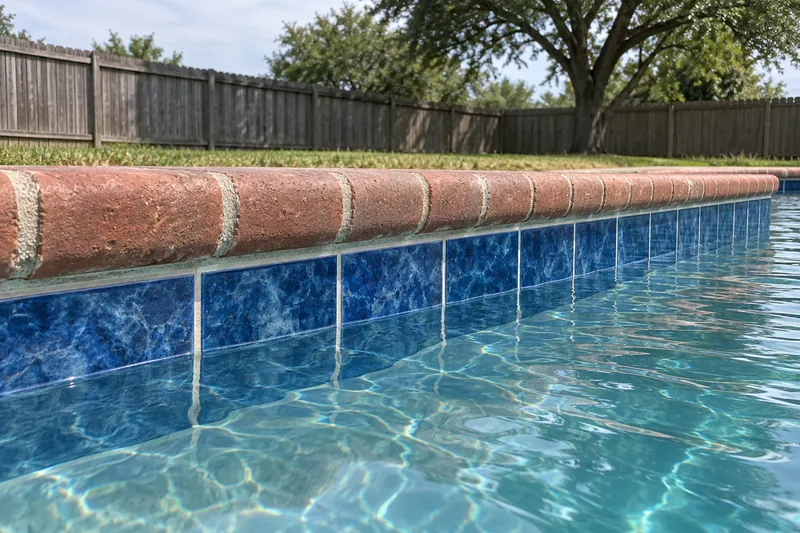
LATICRETE limits pool tile to impervious grades (under 0.5 percent water absorption) or vitreous ones (under 3 percent), and wants cement grout cured at least 14 days at 70°F before the refill.
Pool coping
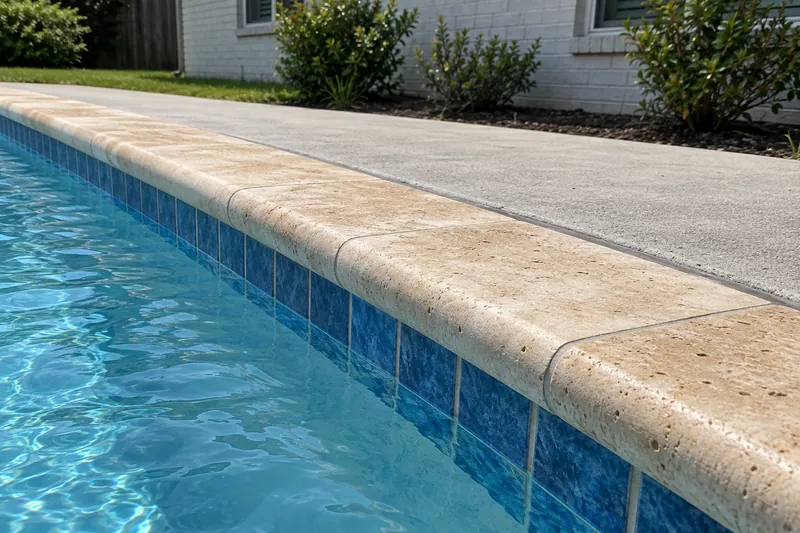
Coping keeps water from getting behind the shell. The code wants a watertight isolation joint where it meets a concrete deck, and NRCS rates the Kemah silt loam at City Hall "very limited" for houses, shrink-swell among its reasons.
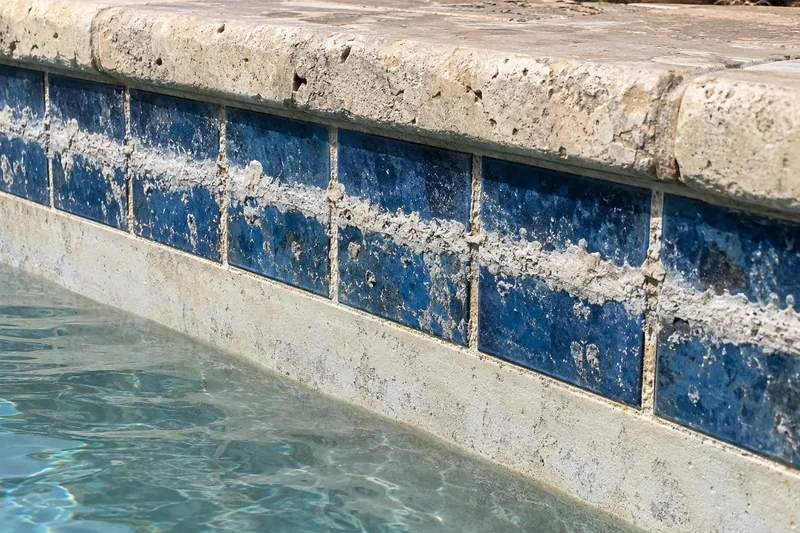
Tile cleaning and calcium removal
The white waterline is scale left as water evaporates off the tile. Kramer Industries lowers the water about 6 inches and blasts with glass beads, while Lunada Bay Tile advises against blasting glass or ceramic tile at all.
Call or request a free estimate any time, 24/7.
(281) 694-4352Pool deck resurfacing, spray deck and cool deck
The code caps a pool deck's slope at 1/2 inch per foot and asks that standing water be no deeper than 1/8 inch 20 minutes after water stops being added. South Shore Harbour's reserve study plans repairs and a new textured coating on its 6,800-square-foot deck every 8 to 12 years.
Acrylic deck coatings and overlays
SUNDEK's coating goes on just under 1/4 inch thick in 4 to 8 layers and needs about 2 to 8 clear, dry days, and NOAA's station in League City averages 60.20 inches of rain a year.
Spray deck and cool deck
Mortex's Kool Deck, invented in 1962, is splashed on to 1/8 inch and troweled to about 40 percent smooth and 60 percent void. A spray-texture deck is sprayed, knocked down with a trowel and finished with two acrylic coats.
Deck repair and leveling
Contraction joints, by the National Ready Mixed Concrete Association's rule, sit no farther apart than 24 to 36 times the slab's thickness. Prime Resins lifts sunken slabs by injecting structural polyurethane foam beneath them, without excavating.
Travertine, pavers and sealing
The Natural Stone Institute counts travertine among the acid-sensitive stones that want mild cleaners, and the Interlocking Concrete Pavement Institute says silane and siloxane sealers help pavers resist salt air and chlorine.
Call or request a free estimate any time, 24/7.
(281) 694-4352The pool resurfacing process in six steps
Every finish goes through the same stages; the maker's instruction at each stage is what changes.
A look at the pool and a sound check
The estimate starts with the pool's size, finish, tile and coping. Universal White Cement calls tapping the simplest reliable test: bonded plaster sounds crisp, delaminated plaster dull or drum-like, clearest with the pool drained.
Permit, HOA, drought stage and groundwater
Ask League City's Building Department whether the job needs a permit, get HOA approval in writing and check the drought stage. The Pool & Hot Tub Alliance's committee warns that high groundwater can push a drained pool out of the ground.
Surface prep: bond coat or chip-out
SGM saws out each hollow spot 3 inches beyond its edge, patches it and chlorine-washes the shell; sound old plaster then takes a bond coat. Pebble Technology International strips the old surface for its remodels instead.
Tile, coping and repairs while the pool is empty
Pebble Technology International says remodels usually redo the finish and waterline tile in one job, and South Shore Harbour's reserve study calls removing a finish the chance to inspect and repair the concrete beneath.
The finish, in one application
The National Plasterers Council sets the average thickness at 3/8 to 3/4 inch, and finds wind the dominant cause of shrinkage cracking: on a 100°F day the critical drying rate is crossed once sustained wind tops 5 mph.
The fill and the 28-day start-up
The fill runs nonstop to mid-skimmer, which NPT says can take 18 to 36 hours. The Council's start-up then runs the filter for seven days straight, brushes twice a day and adds no chlorine for 48 hours.
How long it takes. A Houston builder puts a straight replaster at 5 to 7 days and one with new waterline tile and coping at 7 to 10 days.
Call or request a free estimate any time, 24/7.
(281) 694-4352Pool finish comparison: surface life, feel and water color
The National Plasterers Council rates each surface's life, and says any of them can give years of reliable performance in a well-built, well-kept pool.
Plaster that's properly hard-troweled feels like 220-grit sandpaper or finer; exposed-aggregate finishes get judged on texture instead. Color comes mostly from the pigment: CL Industries says white, blue, black or gray finishes give blue water and green, brown or tan ones green water.
Call or request a free estimate any time, 24/7.
(281) 694-4352How much does pool resurfacing cost in League City?
No contractor or cost guide publishes League City prices, so these are typical Houston-area prices and national averages, each with its year. They are published figures, not prices from League City Pool Resurfacing.
- Standard white plaster
- $4,500–$6,000
- Quartz blend
- $6,000–$8,000
- Pebble finish
- $7,500–$10,000
Typical Houston-area prices for a 12,000–18,000 gallon pool, 2026. Not a quote.
- Pool remodel, Greater Houston
- $8,000–$40,000+
- Coping replacement, Houston
- $3,000–$10,000
- Tile replacement, Houston
- $3,000–$8,000
- Resurfacing a 1,000 sq ft pool, national average
- $11,000
- 20,000-gallon refill at City water rates
- $154.80
Typical Houston-area prices (2026), a national average (2026) and League City's April 2026 residential water rates. Not a quote.
What moves the price
A Houston builder names the pool's size and shape (benches, steps and ledges get finished too), the shell's condition, a raised spa with a spillover, which it calls basically a second small pool, and access. It says quotes differ mostly in what they include, so compare itemized ones.
The refill sits outside the finish price: at League City's April 2026 residential rates, $107.30 for 15,000 gallons or $154.80 for 20,000 as the month's only use, before the base charge. Texas charges no sales tax on labor to remodel or repair a home.
Call or request a free estimate any time, 24/7.
(281) 694-4352Plaster, crack, leak and skimmer repair, plus drain and acid washes
Repairs that come before a resurface, or stand in for one while the finish still has life in it.
Pool plaster repair
Universal White Cement has three tiers: isolated hollow spots, which can sometimes be patched; spreading hollow patches, a sign the bond is failing pool-wide; and widespread separation, which means a full replaster.
Structural crack repair
The American Shotcrete Association says small shrinkage cracks may be plugged or patched, but cracks from structural movement need an investigation of cause and remedy before any injection.
Leak detection and repair
The EPA treats a loss of more than 2 inches a week, or 3 in hot, dry areas, as a likely leak. League City's water report says an uncovered average-sized pool can lose about 1,000 gallons a month.
Skimmer replacement
The code bans equalizer lines on skimmers, and Custom Molded Products wants a skimmer in a concrete shell wrapped in at least 4 inches of structural concrete.
Drain and acid wash
Frequent drain-and-acid washes take years off plaster, Universal White Cement warns, and the EPA expects a well-maintained pool to need draining only every 3 to 7 years.
Call or request a free estimate any time, 24/7.
(281) 694-4352Resurfacing a pool in League City: water, clay, weather and City rules
The local conditions that shape a resurfacing job here, each from the agency that publishes it.
Fill water from two rivers
The City's 2025 water report lists Brazos River water from the Gulf Coast Water Authority's Thomas Mackey plant, Trinity River water from the City of Houston's Southeast plant and eight City wells, disinfected with chloramines at an average 2.39 mg/L. It prints mineral readings only for the Houston plant's entry point: total hardness of 124 mg/L as calcium carbonate and pH 8.1. With no calcium-hardness figure on its own, the start-up begins with the fill-water test the National Plasterers Council recommends.
Clay ground and a winter water table
The USDA's 1988 Galveston County soil survey describes Bernard clay loam, the soil at the city's Census center point, as very slowly permeable, with a high water table within 2 feet of the surface for most of the winter and high shrink-swell potential. At two west-side schools along League City Parkway, NRCS maps Leton soils wet from about 9 inches down for eight months a year.
Heat, rain, freezes and storms
NOAA's station inside League City averages 75.8 days a year at 90°F or above and 60.20 inches of rain, September the wettest month at 7.34 inches (1991–2020 normals). Freezes are short, 9.3 nights a year, but February 2021 brought a low of 15°F. Hurricane Harvey left 43.92 inches at the station over the readings of August 25 to 30, 2017.
Drought stages and the refill
Under League City's 2024 drought plan, from Stage 2 the City may prohibit draining and refilling existing pools except for structural soundness, proper operation and maintenance, or safety, and the plan doesn't say whether a resurface counts. As of October 4, 2026, no official page we read announced a stage, so check the City's current stage before the pool is drained.
Permits, HOA review and the Health District
Swimming pools, hot tubs and spas over 24 inches deep are on League City's permit list, and its code, last amended March 25, 2025, adopts the 2021 International Swimming Pool and Spa Code for pool alteration, renovation and repair. No City page says whether resurfacing an existing pool needs a permit, so ask the Building Department first. The City leaves deed restrictions to HOAs, and the Galveston County Health District requires 48-inch fencing with lockable, self-closing gates even around backyard pools.
Pool age across League City neighborhoods
The median League City home was built in 2004. The City's planning records date the oldest master-planned communities to The Wharf's 1978 covenants, South Shore Harbour's creation in 1981 and Bay Colony's in 1988, while the newest community pools are on the west side, at Coastal Point, Samara and Legacy.
Pool resurfacing service area
We take resurfacing, remodeling and repair work in League City, Webster, Nassau Bay, Dickinson, Friendswood, Clear Lake Shores, Kemah, Clear Lake, Taylor Lake Village, El Lago, Santa Fe, Bacliff, Alvin, Hillcrest Village, San Leon, Seabrook, Shoreacres, La Marque, Pasadena, La Porte, Pearland, Texas City, South Houston, Deer Park, Morgan's Point and Brookside Village.
Call or request a free estimate any time, 24/7.
(281) 694-4352League City pool resurfacing questions and answers
What is pool resurfacing?
Resurfacing replaces a pool's worn interior finish. On a concrete pool the old surface is repaired and bond-coated or stripped, and a new plaster, quartz or pebble finish goes on, which the National Plasterers Council describes as a special cement mix averaging 3/8 to 3/4 inch thick. Fiberglass pools are refinished with coatings instead.
What is the average cost to replaster a pool in Texas?
No source gives a statewide figure. In typical Houston-area 2026 figures, standard white plaster runs roughly $4,500 to $6,000 for a 12,000 to 18,000 gallon pool, and the 2025 national average for a standard-plaster replaster is $6,000 to $8,000. Repairs found once the pool is drained add to either, so a firm price needs a look at the pool, which League City Pool Resurfacing gives free.
How much does it cost to resurface a 20,000 gallon pool?
The closest local figures assume a typical Houston pool of 12,000 to 18,000 gallons: about $4,500 to $6,000 in white plaster, $6,000 to $8,000 in quartz and $7,500 to $10,000 in pebble (typical Houston-area prices, 2026). A 20,000 gallon pool is larger, and the builder behind those figures says size moves the number. Refilling 20,000 gallons at League City's April 2026 rates costs $154.80 as the month's only use, before the base charge.
What is the cheapest way to resurface a pool?
Paint. National averages for 2026 put pool paint at $1 to $2 per square foot against $4 to $8 for standard white plaster, but paint wears out soonest: Olympic rates epoxy pool paint at 5 to 8 years and acrylic at 2 to 3. Among the cement finishes, the National Plasterers Council calls white plaster the most affordable.
Is it worth resurfacing a pool?
Usually, once the finish shows the end-of-life signs Universal White Cement lists: rough, pitted areas with aggregate showing, widespread etching or soft spots, large hollow sections, and deep stains that no longer respond to treatment. Delaminated plaster is a bond failure, the maker adds, that sooner or later turns into pop-offs and bigger tear-outs.
What time of year is best to resurface a pool?
No standard limits the air temperature for plastering, the National Plasterers Council notes. Here the limits are heat, rain and the odd freeze: NOAA's station in League City averages 75.8 days a year at 90°F or above, September is the wettest month, and in half of all years the first freeze comes by December 14. Houston-area builders say winter calendars are easier to book.
Do pool contractors need to be licensed in Texas?
Texas has no state license for pool builders, pool contractors or pool plasterers; the Texas Department of Licensing and Regulation lists none. Electrical work needs licensed electricians, and plumbers are licensed by the Texas State Board of Plumbing Examiners. League City requires contractors to register before any work is permitted, with at least $250,000 of insurance naming the City and a $150 yearly fee.
Is it risky to drain a pool in League City?
It can be. The Pool & Hot Tub Alliance's water-quality committee warns that high groundwater can pop an inground pool out of the ground when it's drained, and advises a working hydrostatic relief valve and a professional's opinion first. The 1988 Galveston County soil survey puts the water table in Bernard clay loam, the soil at the city's Census center point, within 2 feet of the surface for most of the winter.
Can League City's drought stages stop a drain and refill?
Yes. The 2024 drought plan lets the City prohibit filling, draining and refilling existing pools in Stage 2, with exceptions for structural soundness, operation and maintenance, and safety; Stage 3 allows topping up but no drain and refill; Stage 4 prohibits adding water to any pool. Breaking the plan is a Class C misdemeanor with a fine of $100 to $2,000.
Where can pool water go when a pool is drained in League City?
League City's stormwater code bans anything but stormwater in the City's storm sewers, lists "dechlorinated swimming pool discharges" among its defenses, without defining "dechlorinated", and names filter backwash a pollutant, with fines of $250 to $2,000 per violation. Under TCEQ rules, drain water can be reused on the property, for irrigation say, but not within five days of shock or acid treatment and not so it runs across property lines.
Is an HOA or apartment pool a public pool in Texas?
Yes. Under the state health rules, pools run with apartments, condominiums, hotels, property owner associations, clubs or schools are Class C public pools, each under a certified pool operator, and in League City the Galveston County Health District permits them every year at $135 per permit. A pool serving only a single-family home or duplex is residential.
How long before you can swim after a pool is resurfaced?
Not until the water is balanced and properly sanitized, says the Pool & Hot Tub Alliance. The National Plasterers Council's start-up adds no chlorine for the first 48 hours, and it calls a new finish especially susceptible to staining, scaling and discoloration through day 28.
Should waterline tile and coping be replaced along with the plaster?
Often, while the pool is empty anyway. Pebble Technology International notes that a remodel usually does the finish and the waterline tile together, and South Shore Harbour's 2021 reserve study gives plaster an 8 to 12 year useful life against 15 to 25 years for tile and coping.
Should I drain my pool before a hurricane?
No. River Pools says a drained pool can bulge, split or pop up out of the ground in rain, and the Florida Swimming Pool Association's first storm rule is to keep the pool full. River Pools also advises turning off gas and electricity to the pool beforehand. The National Hurricane Center reported catastrophic flooding in League City in Hurricane Harvey.
Do I need HOA approval to resurface a pool in League City?
Ask the association first; the City says HOAs, not League City, enforce deed restrictions. South Shore Harbour wants prior written approval for exterior and structural changes, which can take up to thirty days, and Brittany Lakes' committee treats an application it hasn't approved in 30 days as denied. Under Texas law, an owner in an association of more than 40 lots, once the developer no longer controls the committee, can appeal a written denial to the board.
Get a free pool resurfacing estimate in League City
Whether it's a replaster, a new pebble finish or a full remodel, start with the pool's size, its current finish and your timing. League City Pool Resurfacing answers calls and estimate requests 24/7.