Pool Tile Replacement and Repair in League City, TX
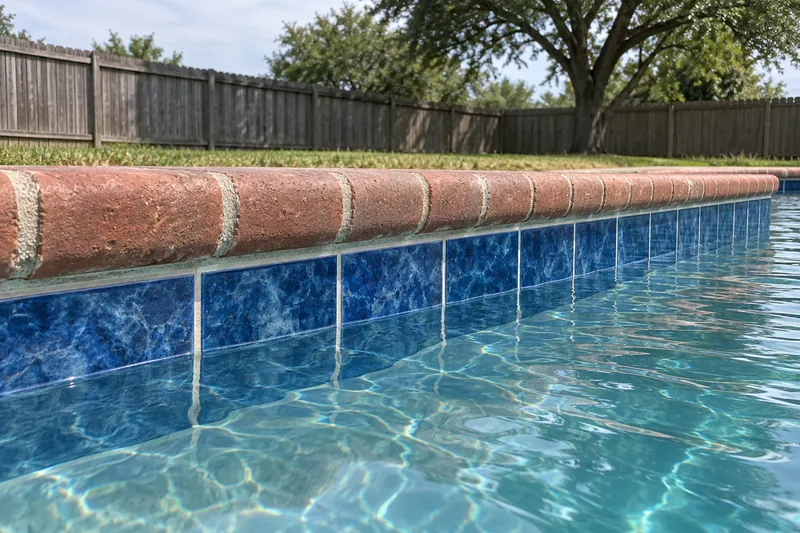
League City Pool Resurfacing does pool tile replacement and repair in League City, Texas: the band of waterline tile at the top of the pool wall, replaced in full or cut out and reset a tile at a time, plus regrouting and the sealant joint under the coping. The National Plasterers Council's glossary calls it simply the perimeter tile, and it sits where the water rises and falls as a pool is used, evaporates and is topped up.
Call or send the form for a free estimate; we'll go over the tile, whether the water is lowered or the pool drained, and how long the grout cures before the refill.
Call or request a free estimate any time, 24/7
No charge · answered 24/7
Get free estimates
Pool tile replacement: choosing tile, sheets and mortar
Tile rated for a pool
The International Swimming Pool and Spa Code points tile in pool shells to the ANSI A108, A118 and A136.1 standards. LATICRETE's pool guide allows only impervious tile, below 0.5 percent water absorption, or vitreous tile, below 3.0 percent, since tile that soaks up more than 3 percent may expand permanently from moisture. For glass, Custom Building Products asks for tile that meets ANSI A137.2 and that its maker recommends for pools, warning that glass expands with heat very differently from ceramic and cracks more easily from thermal shock outdoors; see glass tile pool finishes.
Sheets and how they're mounted
LATICRETE recommends paper face-mounted mosaics and urges caution with back-mounted sheets held by PVC dots or adhesive mesh, whose bond can end up very low once pool water has soaked and attacked it. The glass maker Interstyle requires face- or dot-mounted glass under water, saying mesh backing can lead to delamination. The two makers differ on dots, so the tile maker's approval for submerged use is what to check.
Setting mortar and the specification
Pool tile goes on mortars made for continuous submersion: LATICRETE says latex-fortified mortars improve adhesion, resist chemical attack and flex with moisture expansion and shrinkage. MAPEI's specification for pools, which Daltile publishes with it, is built on Tile Council of North America method P602, and its minimums are epoxy grout to ANSI A118.3 or cement grout to A118.6 or better, a cement bond coat meeting A118.4 or better, movement joints to TCNA EJ171 and an ASTM C920 flexible sealant.
Call or request a free estimate any time, 24/7.
(281) 694-4352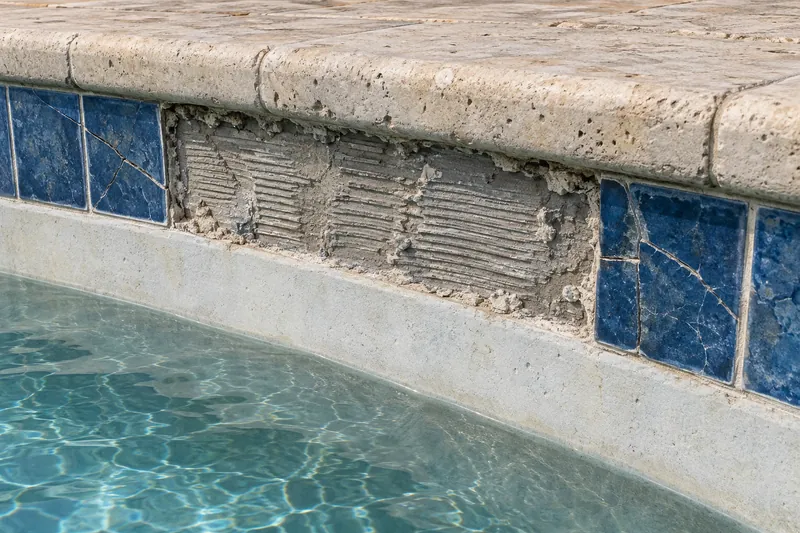
Pool tile repair: cutting out, resetting and regrouting
Finding the cause first
LATICRETE's advice is to find out what made a repair necessary before doing it, so the cause gets corrected and later repairs are fewer, and to look over every tiled surface on a regular, frequent schedule. A tile that sounds hollow has delaminated, the National Plasterers Council's word for a material separating from itself or from what it is bonded to.
Cutting out and resetting tiles
To replace a loose or cracked tile, LATICRETE's repair sheet has it cut free around its edges with an angle grinder or a circular saw on a dustless attachment, the old thin-set ground off down to the concrete, and the new tile set in an adhesive rated for submersion, without harming any waterproofing membrane below. Before setting, the shell must be clean, with no dirt, dust, curing compound, sealer or other bond-breaking residue on it and no standing water. LATICRETE advises against acid-cleaning it when another method will do, because poorly diluted or rinsed acid leaves chlorides that can weaken the bond.
Regrouting
Regrouting starts by taking the old grout out, either with a medium- to high-pressure washer where the water won't do harm or with a diamond-bladed saw, as deep as the sound grout or bedding mortar below; the joints are vacuumed, rinsed and allowed to dry fully first. For cracked grout along the waterline, the repair is described as lowering the water below the tile line, clearing the loose grout with a grout saw or an oscillating tool, pressing in new grout, sponging the tile clean and letting the grout set before the water goes back up.
New tile over old
LATICRETE allows new tile over existing pool tile with a suitable thin-set, but only when the pool is in good condition and the old tile is well bonded: the old tile is scrubbed and rinsed, loose or damaged pieces repaired, a thin skim coat applied, then more mortar combed on and the new tile beaten into it. League City Pool Resurfacing will talk through which route fits your pool.
Call or request a free estimate any time, 24/7.
(281) 694-4352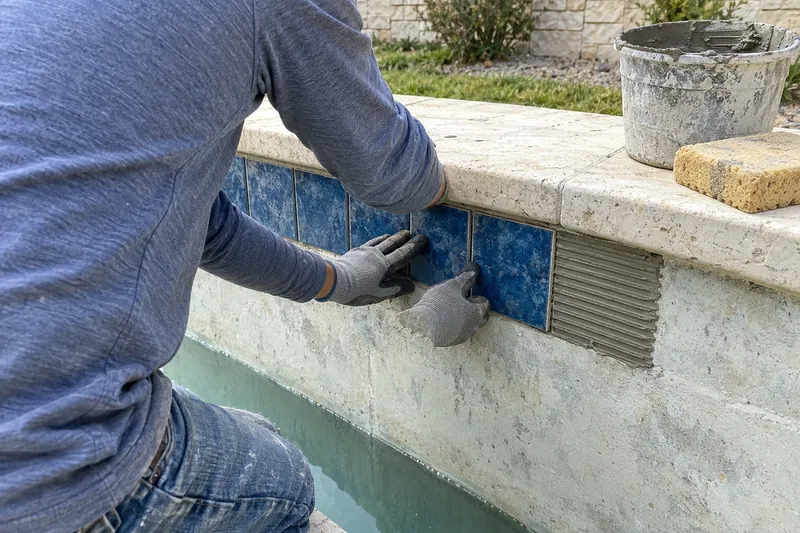
Grout and movement joints in pool tile
Epoxy or cement grout
LATICRETE says epoxy grouts contain no portland cement, aren't affected by pool water treatment and may discolor in sunlight without losing performance, and that cement grouts break down under water more often than a good epoxy. Custom Building Products is warier outdoors: most epoxy grouts aren't UV stable and yellow in ordinary sunlight, a high-performance cement grout meeting ANSI A118.7 holds up for years submerged with proper water care, and some cement-grout pigments change color in treated water, so it says to check the color with the grout maker. On glass tile, Oceanside Glass & Tile accepts sanded cement grout, while LATICRETE and Interstyle warn that sand may scratch the glass.
Movement joints and the coping line
Where tile meets the coping or deck, at inside corners and over any joint in the shell, Oceanside Glass & Tile calls for a flexible sealant rated for submerged use rather than grout, and it spaces in-field movement joints no more than 8 feet apart in glass tile and 12 feet in porcelain or ceramic. LATICRETE's spacing is every 8 to 12 feet each way, so the tile can take years of moisture expansion and the shrinkage that comes when the pool is drained. The coping side of that joint is covered under pool coping replacement.
Call or request a free estimate any time, 24/7.
(281) 694-4352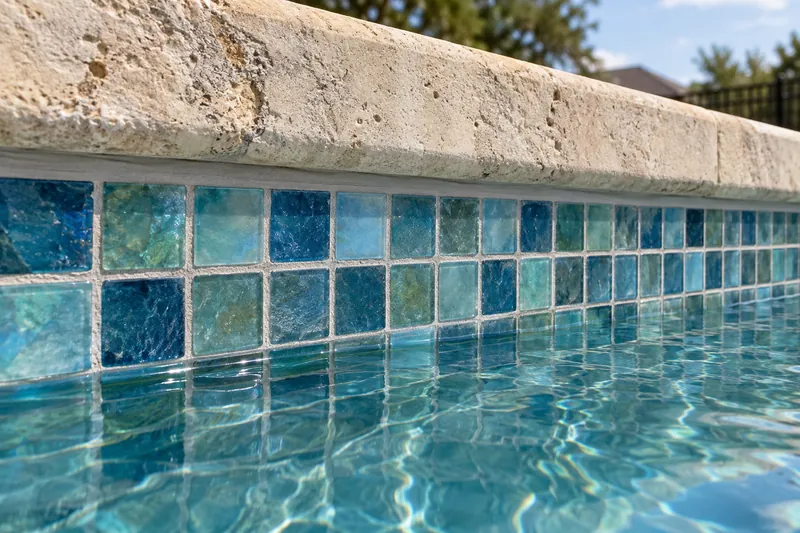
Curing, refilling and League City water after pool tile replacement
Cure before the water comes back
LATICRETE wants latex-fortified cement grout cured at least 14 days at 70°F before the pool is filled, and epoxy grout 10 days at the same temperature, noting that heat and humidity can move those figures either way. Oceanside Glass & Tile asks for at least 21 days for any submerged tile unless the thin-set and grout maker says otherwise, so the materials used set the wait.
Filling and draining a tiled pool
A tiled pool is refilled at about 2 feet per 24 hours and drained at the same rate, LATICRETE says, so water pressure can't pop tiles or mortar loose; MAPEI's figure is 24 to 30 inches a day. LATICRETE also warns against running very cold water into a shell heated by days of sun, keeping the fill within 10°F of the shell, and notes that a full pool keeps groundwater pressing from behind the shell off the tile bond. The 1988 Galveston County soil survey describes a high water table within 2 feet of the surface through most winters in Bernard clay loam, mapped at League City's Census Bureau center point.
Working temperatures
MAPEI's specification holds surface and air temperatures to a 50°F to 95°F range while tiling and for a minimum of 7 days afterward, and Oceanside Glass & Tile protects curing tile from direct sun, excessive heat, wind and rain. At NOAA's station in League City the normal June-to-August high is 91.4°F, peaking at 92.3°F in August.
Fill water and the white line
By LATICRETE's account, high-pH water drops mineral deposits on tile and grout, mostly at the waterline, and deposits that build up behind tile can loosen it; low-pH water etches grout until it turns rough or falls apart. LATICRETE also warns that with calcium below 200 to 250 ppm, chlorine draws calcium out of cement grout and mortar. Only the Houston-plant entry point has mineral readings in League City's 2025 water report, total hardness 124 mg/L and pH 8.1, so League City Pool Resurfacing will talk through a fill-water test, and the white band itself is covered under pool tile cleaning and calcium removal.
Beyond League City, we also handle pool tile replacement in South Houston.
Call or request a free estimate any time, 24/7.
(281) 694-4352Pool tile replacement questions
How much does it cost to replace pool tiles?
Typical Houston-area prices in 2026 put replacing pool tile at $3,000 to $8,000, depending on the tile material and the pool's size. For a few broken tiles, national 2026 averages come to about $25 per square foot, or $20 to $30 per tile. These are published figures, not prices from League City Pool Resurfacing, which looks at the pool and prices it free.
Can you replace pool tile without draining the pool?
For work at the waterline, the water can come down below the tile line instead, which is how the repair of cracked waterline grout is described. New tile still has to go onto a clean surface with no standing water and cure before the water rises over it again; LATICRETE's cement-grout minimum is 14 days at 70°F. Where a tiled pool is drained, LATICRETE wants it emptied no faster than about 2 feet per 24 hours.
What causes swimming pool tiles to fall off?
LATICRETE's list of why cement grout fails in pools runs to six: water chemistry that isn't maintained, an early refill, no room for movement, the wrong grout, poor prep before grouting, and poor grout or tile installation. Mineral deposits forming behind tile can push it loose, back-mounted sheets can lose their bond once soaked, and filling or draining too fast lets water pressure pop tiles off. Without a working flexible joint between deck and coping, the deck's movement is also described as dislodging coping and tile and cracking the waterline tile horizontally.
What type of tile is best for around a pool?
At the waterline, the impervious or vitreous grades LATICRETE allows, in paper face-mounted sheets where possible. Glass tile is described as more prone to fracturing, cracking and chipping than porcelain, so keeping spare tiles for later is advised. On the deck around the pool, the tile maker Crossville says deck tile should have a textured surface with an elevated DCOF rating, and that no tile is slip proof.
Should you fix the missing tiles on the pool?
Yes, once the cause is known, since LATICRETE's point is that a repair made without correcting the cause tends to be followed by more of them. The code wants pool materials to form a watertight structure with a smooth, easily cleaned surface, and a replacement tile is cut in, set on a submersion-rated adhesive and cured before the water goes back over it.
Book a free pool tile replacement estimate
Tell League City Pool Resurfacing how many tiles are loose or missing, or whether the whole band needs replacing, and roughly how big the pool is. Calls and estimate requests are answered 24/7.