Pool Plaster Repair in League City, TX
League City Pool Resurfacing does pool plaster repair in League City, Texas: finding hollow, peeling or stained plaster, cutting out and patching isolated spots, and telling patch work apart from damage that needs a full replaster. Universal White Cement, a white cement maker, calls delaminated plaster a bond failure rather than a cosmetic issue, one that sooner or later turns into pop-offs, hollow areas and bigger tear-outs.
Ask for a free estimate by phone or through the form. Expect questions about where the damage is, how old the plaster is, and whether the pool can be drained for a closer look.
Call or request a free estimate any time, 24/7
No charge · answered 24/7
Get free estimates
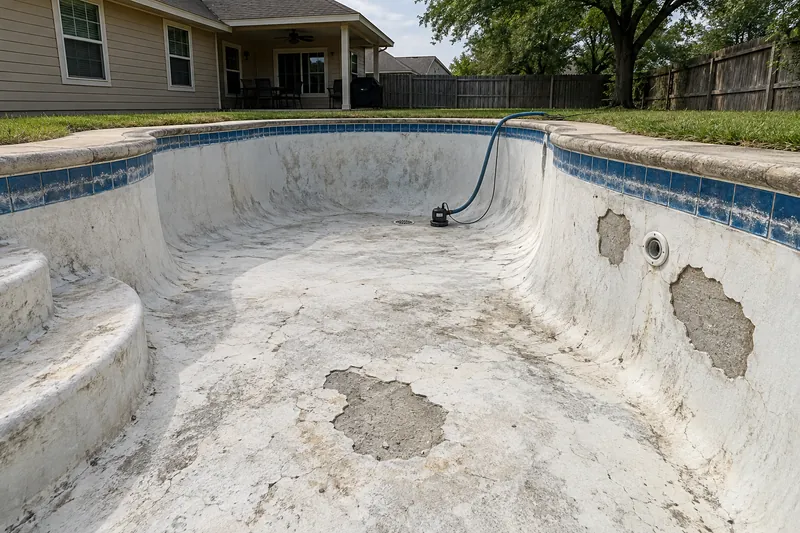
Pool plaster damage: hollow spots, spalling, etching and scale
Hollow and delaminated plaster
The National Plasterers Council defines delamination as a material separating from itself or from what it sits on, and debonding as one material separating from another, and notes that the two aren't the same thing. Universal White Cement's warning signs include puffed-up, dome- or volcano-shaped spots, damage around lights, returns, steps and benches, and circular or spider cracks centered on one patch. Its field check is listening. Tap in a grid with a plastic screwdriver handle or a rubber mallet: well-bonded plaster gives a crisp, tight sound, and plaster that has let go sounds dull, hollow or like a drum.
Spalling, etching and calcium nodules
Not every rough patch is a bond failure. Universal White Cement separates surface spalling, where the top cream layer breaks away but the plaster beneath stays bonded, from etching, which feels soft, chalky or pitted, and from calcium nodules, small mounds that exude calcium and may or may not sit over a real void. A straight crack running through the shell, rather than spider cracks around one spot, is pool crack repair work.
Scale and metal stains
The Council describes scale as a white or light-colored film that can dull or hide a finish's color, and ties stains to metals in the water: copper and manganese to blue, green or black, iron to red, orange or black.
Call or request a free estimate any time, 24/7.
(281) 694-4352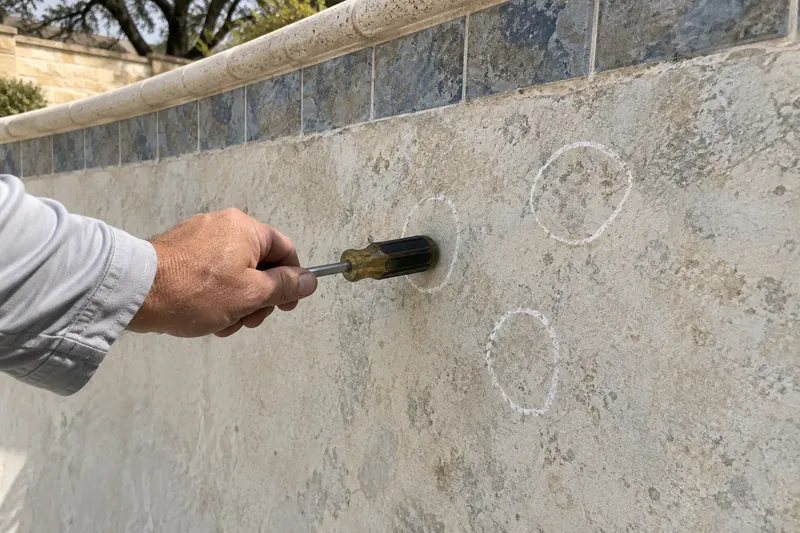
Patch or replaster: how far a pool plaster repair goes
Three degrees of delamination
Universal White Cement sorts delamination by how far it has spread. A few small, isolated spots can sometimes be chipped out and patched, especially when the rest of the surface is in good condition. Hollow areas that spread or form a pattern point to a bond problem across the pool, where patch work, in the maker's words, may just be kicking the can down the road. Once separation is widespread, the job is a full replaster.
Cutting out and patching
SGM's manual, in its steps for preparing a pool before a new finish, describes the cut-out: sound out every hollow and delaminated area, saw a cut 3 inches outside it, remove the loose plaster inside the cut and fill the hole with patching cement. Loose material and old patching come off, and algae, mold and mildew are killed with a chlorine wash, since SGM says leftovers cause discoloration and delamination. League City Pool Resurfacing will talk through which spots can be patched and which can't.
When a patch isn't enough
Universal White Cement counts mild mottling, color variation and light roughening in high-traffic areas as normal aging. Large hollow or debonding sections, widespread etching or soft areas, and deep stains that no longer respond to treatment are its signs that the plaster has reached the end of its life, and then the job is pool replastering.
Call or request a free estimate any time, 24/7.
(281) 694-4352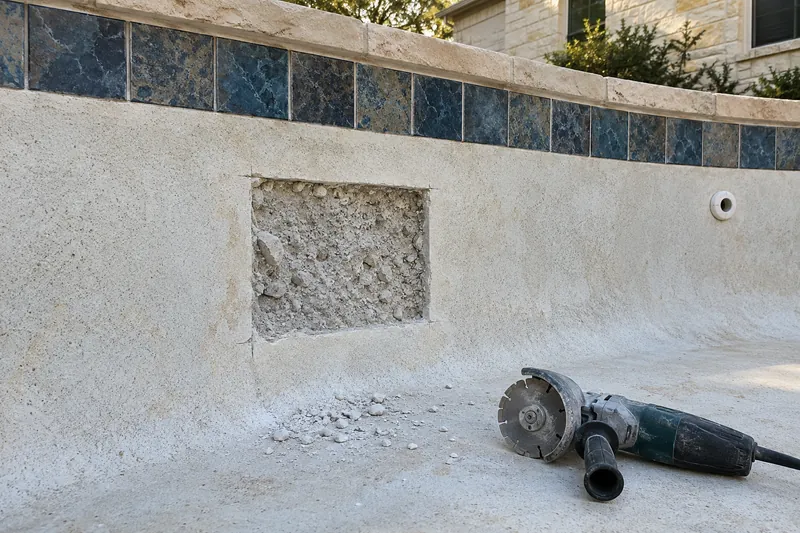
What causes pool plaster damage in League City
Bond and shell prep
Universal White Cement calls delamination usually a process problem, not a cement problem. The causes it lists start with the shell, where dust, paint, loose old plaster, algae or scale block the bond. Then come the wrong bond coat, poor coverage or a dirty surface under it, cold joints where work stopped and restarted, and over-troweling.
Water pushing from behind the shell
The National Plasterers Council warns that water collecting against the back of a pool shell, even from seasonal rain or a leaking irrigation pipe, can build enough pressure to debond a bond coat or interior finish. Bernard clay loam, the soil at League City's Census center point, holds a high water table no more than 2 feet down through most of the winter, according to the USDA's 1988 Galveston County soil survey. Voids behind loose plaster can also let water through, Universal White Cement adds, so a pool that keeps losing water may need pool leak detection and repair as well as a patch.
Water chemistry and soft water
The Council's chemical-etching bulletin ties low calcium hardness to dissolved calcium compounds and discoloration, low pH to general dissolving, high stabilizer to leaching and pigment fade, and direct contact with salt, stabilizer, granular chlorine or shock to discoloration. The one mineral reading in League City's 2025 water report, for the entry point fed by the City of Houston's southeast plant, shows a total hardness of 124 mg/L as calcium carbonate and a pH of 8.1, and the report prints no calcium hardness figure.
Freezes on steps and benches
NOAA's 1991–2020 normals give its League City station 9.3 nights a year at 32°F or below, and the February 2021 freeze dropped it to 15°F, the lowest reading on record there. The Council says freeze-thaw damage starts as white efflorescence just above the waterline and ends with thin surface layers cracking, lifting, spalling or peeling. Horizontal surfaces in the waterline zone, such as steps, benches and sun ledges, run the highest risk, the Council adds, and the damage is not a material or workmanship defect.
Call or request a free estimate any time, 24/7.
(281) 694-4352Draining a pool for plaster repair, stain torching and acid washes
Draining under League City's drought plan
A drained pool gives the clearest tap-test results, Universal White Cement says. League City's 2024 drought plan lets the City ban draining and refilling existing pools once Stage 2 begins, with exceptions for structural integrity, proper operation and maintenance, and public safety, and it doesn't say whether a plaster repair qualifies. No official page we read on October 4, 2026 announced a drought stage, so confirm the City's current stage before the water comes out. League City's code lets dechlorinated pool water go to the storm drains but counts filter backwash as a pollutant.
Torching stains out of plaster
The National Plasterers Council's answer to abnormal discoloration is torching: a propane torch worked over the drained plaster. The Council's article lists stains from inlet water, bathtub rings from a fill that stopped partway, drip marks, hardened plaster dust and etched areas among the marks it treats. The pool is fully drained and lightly acid washed first, and the work runs slowly over a number of days. Flat plaster and white quartz are the best candidates, glass-bead surfaces can't be torched safely, and the homeowner stays away while it's done.
Acid washing plaster
The Council's glossary gives an acid wash three meanings, from dissolving efflorescence, dirt and stains off a cement surface to a diluted wash that removes certain stains with little, if any, of the surface lost. Universal White Cement warns that frequent drain-and-acid washes may make a pool look whiter in the short term but strip years off the plaster. A pool drain and acid wash has its own page.
Call or request a free estimate any time, 24/7.
(281) 694-4352Pool plaster repair questions
Can pool plaster be repaired?
Yes, when the damage is limited. A Houston-area plasterer puts it simply: minor damage can sometimes be patched, but widespread deterioration usually requires full resurfacing. Spalling, scale and many stains are surface problems with their own treatments, and a straight crack through the shell is a structural repair rather than a plaster patch.
How much does pool plaster repair cost?
We found no published Houston-area price for a plaster patch. Nationally, 2025 figures run $200 to $1,200 or more for surface repair before a resurface, with the pool's size, its type and how much is damaged setting the price. On concrete and gunite interiors, small cracks run $100 to $200, while large or spiderweb cracks, bulges and divots run $700 to $1,000. These are published averages, not prices from League City Pool Resurfacing, and a look at the pool is free.
How urgent is a pool plaster repair?
It depends on the finish and the spot. Universal White Cement treats delamination in a young finish as a sign of deeper trouble than the same thing in plaster already near the end of its life. Spots that are actively popping off, leaving sharp edges or dropping debris into the system go to the top of its list, and voids behind loose plaster can carry water and lead to structural or rust problems.
Can pool plaster stains be removed without replastering?
Often, depending on the cause. The National Plasterers Council says chelating or sequestering chemicals can counter metal stains and scale, but once started they have to be used continuously, because fresh fill water keeps bringing metals in. Its torching method treats many kinds of abnormal discoloration on drained plaster. Color leached out of a pigmented finish by aggressive water is another matter: the Council says pigment can be lost up to 1/8 inch deep, and that loss is irreversible.
How do I keep pool plaster from deteriorating after a repair?
Keep the water balanced and the tools soft. The Council's owner guidance puts pH at 7.2 to 7.8, total alkalinity at 80 to 120 ppm and calcium hardness at 200 to 400 ppm, and calls soft, low-calcium water aggressive enough to pull calcium out of plaster. Universal White Cement warns that metal brushes, razor scrapers and aggressive scrub pads gouge white cement plaster and leave weak spots that stain and wear faster.
Book a free pool plaster repair estimate in League City
Tell League City Pool Resurfacing where the plaster is hollow, peeling or stained, roughly how old it is and whether the pool is full. Calls and estimate requests are answered 24/7.