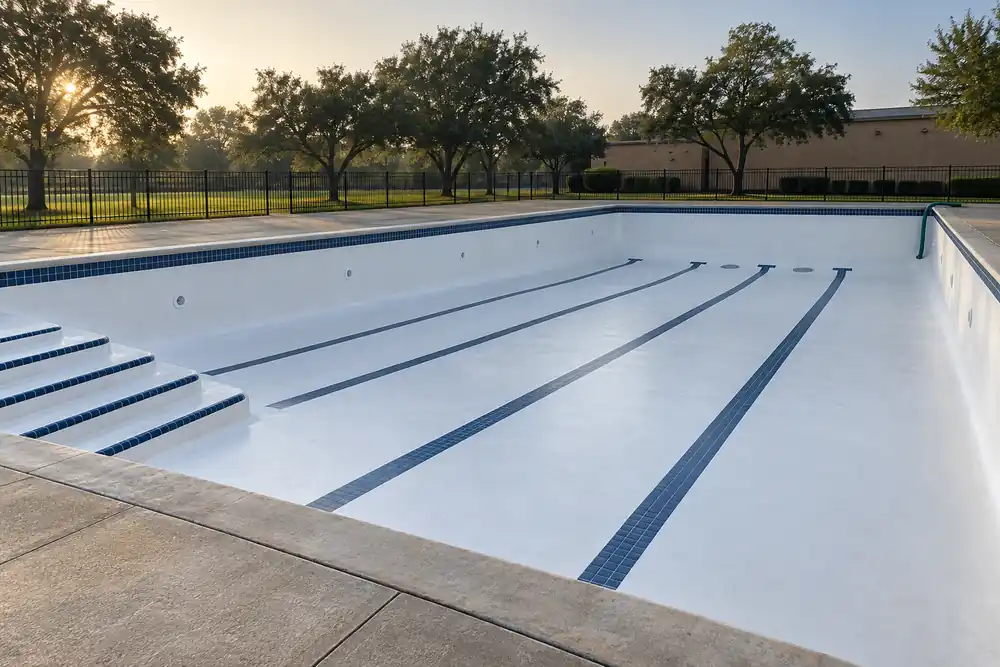
Pool Leak Detection and Repair in League City, TX
League City Pool Resurfacing handles pool leak detection and repair in League City, Texas: telling evaporation from a leak, tracing the loss to the shell, a drain, a fitting or the pipes, and sealing what turns up. Pools give up water in four ways, the EPA's WaterSense program says, through evaporation, cleaning, splashing and leaks, and a small leak left alone can quickly become a big one.
Estimates are free by phone or through the form. It helps to know roughly how far the water drops in a day or a week, whether an automatic fill is connected, and whether any ground near the pool stays wet.
Call or request a free estimate any time, 24/7
No charge · answered 24/7
Get free estimates
Pool leak detection: evaporation, the bucket test and the warning signs
How much loss is normal
Some water loss is only weather. An average-sized pool left uncovered can give up about 1,000 gallons a month, League City's 2025 drinking water report estimates. Its tips are a pool cover, to slow the evaporation, and a water level kept low so less splashes out. Past 2 inches a week, the EPA says, a leak is likely; in hot, dry areas where evaporation runs high, its line is 3 inches.
The bucket test
For the EPA's bucket test, choose a calm day with no rain. Turn off the filter, cleaners, automatic fill and every other pool system, and close the pool for 24 hours. A bucket of 2.5 to 5 gallons, filled to within about an inch of its rim, goes on a pool step deep enough to sink at least two-thirds of it. Mark the level inside the bucket and on the pool; after a day, a pool that has lost more water than the bucket may be leaking.
Signs beyond the waterline
Other clues on the EPA's list are damp patches around the pool and bubbles of air in the pump strainer or the return line. Every three months, it recommends turning an automatic fill off for a day to test for leaks, since a malfunctioning valve may be sending fill water straight to the overflow drain.
Call or request a free estimate any time, 24/7.
(281) 694-4352Where pool leaks start: the shell, the drains and the fittings
A shell that holds water on its own
Water should stay in a pool because of its shell. A well-built shotcrete shell is functionally watertight without help, in the American Shotcrete Association's view; the plaster and tile added later don't make it so. The Association isn't aware of any pool-specific water-loss standard. The nearest is ACI 350.1-10, for open structures that hold liquid: after 3 days filled and saturating, they may lose up to 0.05 percent of their volume per day across a 72-hour test. When a shell fails a test like that, the Association suspects the placement, with sand pockets, overspray and rebound, more than the material, and suggests cores examined by petrographic analysis. A crack through the shell is pool crack repair, and plaster that has gone hollow over it is pool plaster repair.
Main drains and suction fittings
Opening a main drain or a suction line for a repair brings the code's entrapment rules with it. The International Swimming Pool and Spa Code requires suction entrapment protection under ANSI/PHTA/ICC 7, with suction outlet fitting assemblies listed and labeled to APSP 16. The Consumer Product Safety Commission's inspection checklist looks for drain covers that are intact, with no loose or missing screws and no cracks or breaks, and the Commission recommends replacing a cover once it passes the expiration date marked on it, even where the drain itself complies.
Call or request a free estimate any time, 24/7.
(281) 694-4352Pool leak repair: water-stop cement, pressure tests and the trades
Plugging a leak in the shell
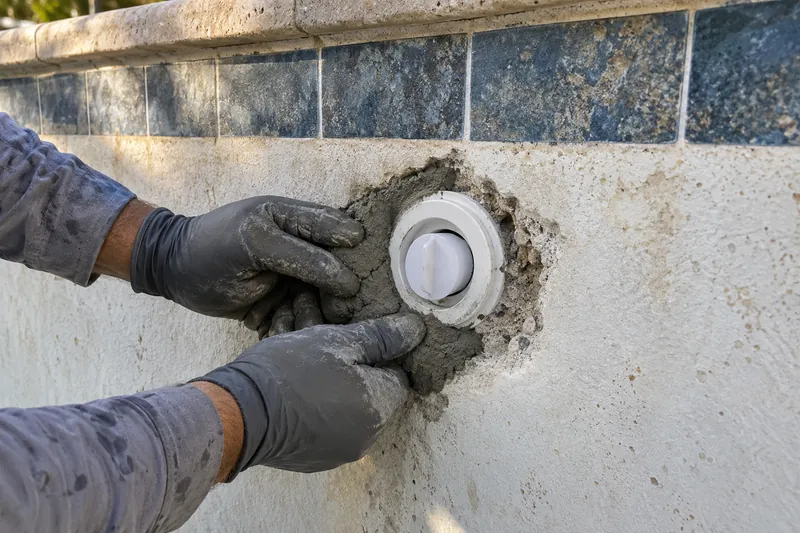
QUIKRETE's Hydraulic Water-Stop Cement, which mixes portland and calcium aluminate cement with silica sand, is sold to stop running water and plug leaks in concrete and masonry, swimming pools, fountains and cisterns included. Final set comes in under 5 minutes, and there is a special white version for pool patching. The maker's directions: clear the patch area of loose material, dirt, algae and mildew, open up small cracks and holes without cutting a V, then work the cement in from the top downward, keeping light pressure on it until it sets and the water stops. Batches stay small, no more than 2 to 3 minutes' worth. Xypex makes Patch'n Plug, a fast-setting hydraulic cement compound that stops flowing water in seconds, for cracks, tie holes and other defects in concrete.
Pressure-testing the pipes
Circulation piping, apart from any built into the pool itself, has to pass a hydrostatic pressure test under the International Swimming Pool and Spa Code: 25 psi, held for 15 minutes or more. Compressed air is ruled out for testing plastic water piping.
Who works on the plumbing
League City's pool page has the electrical and plumbing trades, each licensed and registered with the City, pulling separate permits on its pool projects. Under Texas's Plumbing License Law, plumbing includes piping that supplies, circulates or recirculates water, yet the law is silent on swimming pools, so the City's code official is the one to ask whether a given repair to pool pipes counts as licensed plumbing work. The same law lets property owners do plumbing in their own homestead without a license. We found no City page that says whether a leak repair needs a permit; the Building Department can tell you. League City Pool Resurfacing will talk through which part of a leak repair needs which trade.
Call or request a free estimate any time, 24/7.
(281) 694-4352Pool leaks, top-ups and League City's drought stages
Topping up during a drought
Under League City's 2024 drought plan, a pool is any basin of water 2 feet deep or more somewhere in it, and that includes hot tubs. Stage 1 sets no pool rule. In Stage 2, existing pools can still take on water to replace what normal use and evaporation take out. Stage 3 lets them add water to hold their level but bars draining and refilling, and Stage 4 rules out water for filling, refilling or topping up any pool. None of the official pages checked on October 4, 2026 named a stage in force, so ask the City which one applies before relying on a top-up.
What lost water costs
League City's residential water rates from April 2026 run $3.25 per 1,000 gallons for the first 3,000, $7.15 per 1,000 from 3,001 to 10,000, $9.50 from 10,001 to 25,000 and $11.53 beyond that, plus a base charge of $9.69 a month on 3/4-inch and 1-inch meters. The City's billing FAQ lists a pool fill among the reasons for a high bill, and caps sewer charges at 10,000 gallons because water for a pool or an irrigation system never reaches the sewer.
Call or request a free estimate any time, 24/7.
(281) 694-4352Pool leak detection and repair questions
How much should pool leak detection cost?
Typical Houston-area prices in 2026 put underground leak detection at $250 to $500 for the diagnostic. The same 2026 figures put an above-ground fitting or valve leak at $150 to $350 and underground pipe repair at $500 to $2,000 or more, depending on where the leak is, how deep and how easy it is to reach. Nationally, in-ground leak repairs ran $350 to $2,700 in 2026, labor and materials only, with any draining, refilling or water treatment on top. None of these is a price from League City Pool Resurfacing, and the estimate itself is free.
Where is the most common place for a pool leak to occur?
The EPA doesn't rank them. It lists pump seals, the liner, pipes and pipe joints, the points where pipes meet the pool, and the pool's edges. A 2026 Houston-area repair price list singles out a cracked skimmer body, or a skimmer pulling loose from the wall, as needing specialized repair, and those are pool skimmer replacement jobs.
Why is my pool losing 1 inch of water a day?
An inch a day is 7 inches a week, more than three times the EPA's 2-inch weekly line for a likely leak, and more than double its 3-inch line for hot, dry places with high evaporation. By the EPA's measure, a loss that size likely means a leak. Its bucket test separates evaporation from a leak over 24 hours, and because an automatic fill valve that malfunctions can send water to the overflow drain, the fill stays off while the test runs.
Can you fix a pool leak without draining?
It depends on the leak. National 2025 cost figures note that an in-ground leak repair often means emptying the pool, fixing the leak and filling it again, but some products are made to set against running water: QUIKRETE's water-stop cement blocks it, and Prime Resins injects a water-reactive polyurethane into cracks that are actively leaking. No maker's instructions we read cover patching underwater in a full pool, so whether yours has to come down depends on where the leak is and what it runs through.
Should a pool leak be fixed before it is resurfaced?
Yes. The National Plasterers Council doesn't treat plaster as waterproofing at all, the American Shotcrete Association reports: it requires its finishes to go on a concrete shell that is already watertight, because water getting past the plaster moves more easily through a porous shell. SGM, the maker of Diamond Brite, won't plaster over weepers, its word for groundwater pushing through the shell; they have to be stopped first, using hydraulic cement on the leaks and around the fittings.
Book a free pool leak detection and repair estimate in League City
Tell League City Pool Resurfacing how much water the pool loses in a day or a week and whether an automatic fill is connected. Calls and estimate requests are answered 24/7.