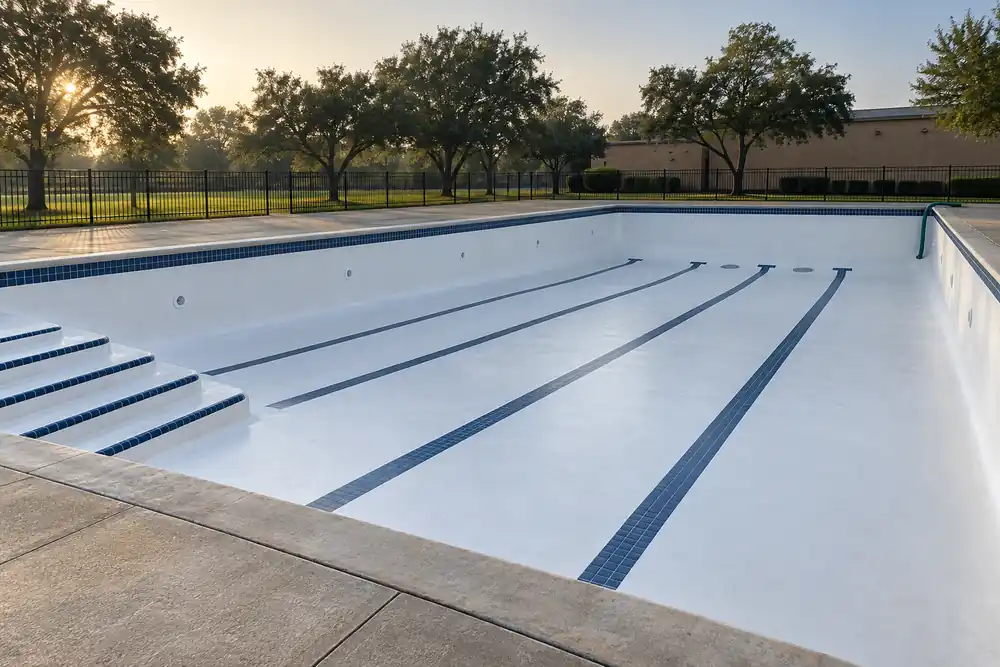
Commercial Pool Resurfacing in League City, TX
League City Pool Resurfacing does commercial pool resurfacing in League City, Texas, for swim clubs, gyms, schools and city pools, and for the HOA, apartment and hotel pools that Texas also treats as public. Under the Texas Department of State Health Services rules, a pool open to the general public, with or without a fee, is a Class B pool, and one kept for members, occupants or students and their guests is Class C, whether it is publicly or privately owned.
A free estimate, by phone or through the form, is where we settle when the pool can close, how the drain-down fits League City's rules, and which finish suits the way the pool is used.
Call or request a free estimate any time, 24/7
No charge · answered 24/7
Get free estimates
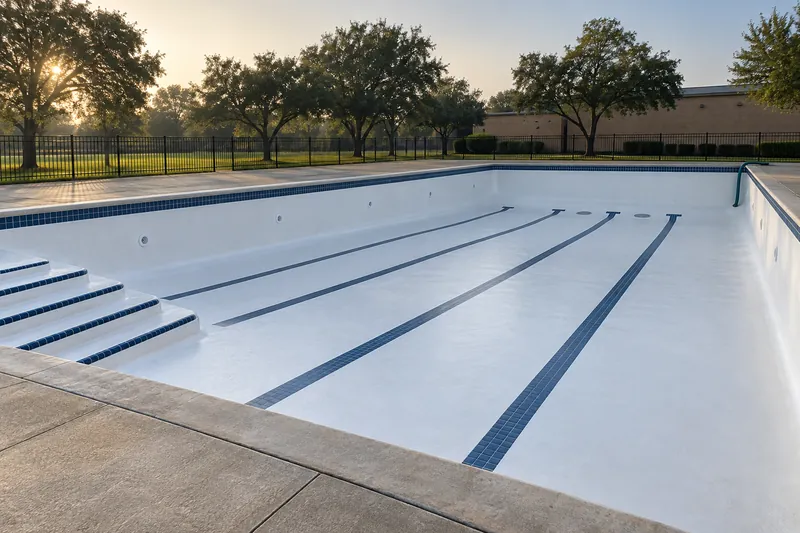
Commercial pool resurfacing for swim clubs, schools, gyms and city pools
Which pools Texas treats as public
The state's Class C list covers pools run with lodging such as hotels, apartments and condominiums, with youth camps, property owner associations, private organizations or clubs, and with schools. A Class C pool that is opened to the public, generally or for particular occasions, has to meet the Class B operating standards instead. The exception is the residential pool, at a single-family home or duplex, used by two resident families at most and their guests. The Galveston County Health District, which serves League City, names country clubs and health clubs among the semi-public pools it permits.
League City's own public pools
The City runs two outdoor pools: Walker Street, with a 50-metre lap course, diving boards and a separate fenced kiddie pool, and Hometown Heroes, set for 25-yard lap swim beside a kiddie pool with features. In March 2025 the City reported construction under way on the Hometown Heroes pool, then 10 years old and holding 400,000 gallons, with the goal of reopening for Memorial Day weekend; its 2025 Annual Report lists new plaster, a slip-resistant deck and an upgraded splash pad coating.
HOA, apartment and hotel pools
Each of these carries rules of its own, so each has its own page: HOA and community pool resurfacing, apartment and condo pool resurfacing and hotel and resort pool resurfacing. The state's pool-yard enclosure law, for one, reaches only pools run by a multiunit rental complex or a property owners association. League City Pool Resurfacing gives free estimates on all of them.
Call or request a free estimate any time, 24/7.
(281) 694-4352
Texas rules for resurfacing a public pool
The code the state adopts
For commercial pools and spas, the Texas Department of State Health Services has adopted the 2021 edition of the International Swimming Pool and Spa Code to govern their construction, alteration, renovation, enlargement and repair, together with the ANSI/APSP-16 drain-fitting standard and the ANSI/PHTA/ICC-7 suction entrapment standard. It takes the code's general, public pool, public spa and aquatic recreation chapters, not the residential ones, and the code sends pool plastering to the APSP/NPC/ICC-12 plastering standard. State law also requires the state's public-pool safety standards to be at least as strict as the federal Virginia Graeme Baker Pool and Spa Safety Act.
Repairs to the standard the pool was built under
A minor addition, alteration, renovation or repair to an existing public pool may follow the construction standard in place when the pool was built, and for the state rules a pool's date of construction is the day its building permit was issued. A pool that complied with state law on August 31, 2021 may keep being used, maintained and repaired under the law of that date. The department may review plans, and it tells the owner in writing when it intends to.
The Health District and the City
Here the permitting body is the Galveston County Health District: each public or semi-public pool in League City needs its own permit from it, at $135 a year, with a named certified operator and a passed inspection, and its order takes in the state rules. Local health authorities may set standards that differ from the state's only if they are equal or stricter. When the City permits a pool, its application asks commercial pools for a copy of the Health District application; no City page read for this site says whether resurfacing an existing pool needs a City permit, so ask the Building Department before work begins. League City Pool Resurfacing will go through both with you before the pool closes.
Call or request a free estimate any time, 24/7.
(281) 694-4352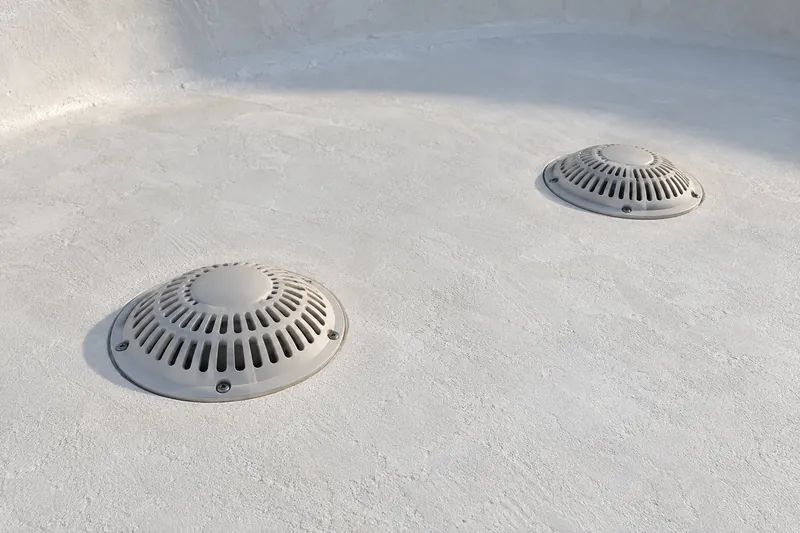
Commercial pool finishes: color, slip resistance and safety tile
How light the finish must be
For any pool that isn't residential, the 2021 code the state adopts says interior colors, patterns and finishes must not hide objects or surfaces in the water, and sets a floor of 6.5 on the Munsell color value scale. The 2024 edition goes further, requiring floors and walls in white or a light color at no less than 8.0 on the Munsell gray scale, though the Texas rules name the 2021 edition. Competitive lane markings, step and bench edge markings, waterline tile and pools shallower than 24 inches sit outside the color rule.
Footing and cracks
Surfaces that swimmers stand on in a public pool must be slip resistant and must not cause injury in normal use. The CDC's Model Aquatic Health Code, which is a model and not Texas law, goes on to make cracks part of a pool's daily inspection: cracks under 1/8 inch wide are documented and watched for movement, and any sharp edges are removed or repaired.
Depth markers and the slope line
Every Texas public pool needs at least two depth markers in the top 4-1/2 inches of wall under the coping, with figures at least 4 inches tall and no more than 25 feet apart, and a Class C pool deeper than 5 feet needs a permanent contrasting line where the floor turns from shallow to deep. The code also wants the leading edges of public-pool stair treads outlined in slip-resistant contrasting tile 1 to 2 inches wide. League City Pool Resurfacing covers pool depth markers and safety tile on a page of their own, and white plaster finishes under pool replastering.
Call or request a free estimate any time, 24/7.
(281) 694-4352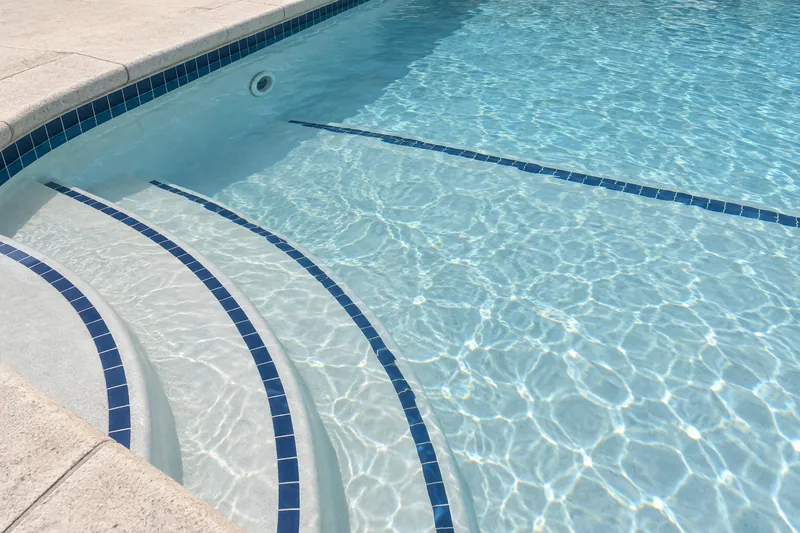
Closing and draining a commercial pool for resurfacing
Closing the pool yard
While a Texas public pool is closed for construction or renovation, the state rules keep users and anyone else unauthorized out of the pool yard and require a closed sign on its entry gates. A gate may be propped open only while the owner's agent, employee or contractor is there doing work that reasonably needs it, and the closed pool must not give off odors, breed insects or create any other nuisance. Once the water level drops below the operating range of the rim, gutter or skimmer system, the rules say the pool must be closed in any case.
Draining under League City's rules
Public-pool drain water that isn't reused goes out under the Texas Commission on Environmental Quality's or the local authority's rules, with no hard connection to a sewer or septic system. League City's stormwater code lists dechlorinated swimming pool discharges among its defenses for water reaching the storm drains, while filter backwash counts as a pollutant, at $250 to $2,000 a violation. The City's drought plan lets it bar draining and refilling from Stage 2, with exceptions for a pool's structural integrity, its proper operation and maintenance, or a public safety risk, and at Stage 3 existing private and public pools may top up their level but not be drained and refilled. No official page read on October 4, 2026 announced a stage in force, so confirm the City's current stage before the drain-down. League City Pool Resurfacing will talk through the timing with you.
Call or request a free estimate any time, 24/7.
(281) 694-4352Commercial pool resurfacing questions
What is the best pool resurfacing material?
For a commercial pool no single finish is best, but the rules narrow the choice: the 2021 code the state adopts wants public-pool finishes at 6.5 or higher on the Munsell color value scale. Within that, the National Plasterers Council's surface ratings run 5 to 8 years for white plaster, 10 to 15 for quartz and 12 to 18 for pebble, and the Council says colored quartz aggregates make a harder surface, far more resistant to changing water chemistry, at a higher cost than standard plaster. NPT markets its QuartzScapes for commercial as well as residential pools, and SGM's registered warranty on Diamond Brite, pro-rated and for materials only, runs 5 years on a commercial pool against 10 on a residential one, or 10 on both for its Diamond Brite Commercial White.
How much does commercial pool resurfacing cost?
No published source found for this site prices commercial, HOA, apartment or hotel resurfacing in Texas. National averages in 2025 put typical plaster at about $5,000 per 1,000 square feet with labor and materials, Diamond Brite quartz closer to $6 to $7 per square foot and Pebble Tec or PebbleSheen closer to $10, with costs higher for larger pools, in larger cities and coastal areas, and where structural repairs are needed. The Texas Comptroller taxes the total charge for remodeling or repairing nonresidential property, while pools an HOA or apartment complex owns for its residents count as residential; League City's combined rate is 8.25 percent as of October 2026. These are published figures, not prices from League City Pool Resurfacing, and a firm number needs a look at the pool.
Can a commercial pool be resurfaced outside the swim season?
Yes, within the finish maker's weather limits. League City's two City pools open only in summer, with the 2026 season pass running May 23 to September 7, and South Shore Harbour's community pool doesn't open until Memorial Day weekend and closes on Labor Day. For Diamond Brite, SGM wants materials and work areas kept warmer than 50°F and cooler than 100°F from 24 hours before placement until 72 hours after. At NOAA's League City station, nights at 32°F or below average 9.3 a year, and half of all years see the first freeze by December 14 and the last by January 31.
What has to happen before a resurfaced public pool reopens?
The Galveston County Health District's order says a public or semi-public pool must hold a permit to operate before it opens for use; permits last one year or until the pool changes hands, and the district inspects every year and on complaint. The state rules let a pool open only when its bottom and any submerged suction outlets are clearly visible in still water, with an 8-inch black disk on the floor at the deepest point clearly and immediately seen. Every Class A, B and C pool must also be maintained under a trained, certified operator, who need not be on site.
Does a public pool need new drain covers when it is resurfaced?
The rules turn on the covers' condition and date rather than on the resurfacing. Federal law has required anti-entrapment drain covers meeting the federal standard on every public pool and spa since one year after December 19, 2007, and even a compliant drain should get a new cover once the date printed on the old one has passed, the Consumer Product Safety Commission recommends. A pool with a single blockable main drain, or drains on the same plane less than three feet apart, needs a second anti-entrapment system as well. Texas won't let the pump run with a drain grate or suction outlet cover missing, broken or loose, and wants documentation kept on site showing each suction outlet meets ANSI/APSP-16.
Get a free commercial pool resurfacing estimate
Tell League City Pool Resurfacing what kind of pool it is, roughly how big, and when it can close. Calls and estimate requests are answered 24/7.