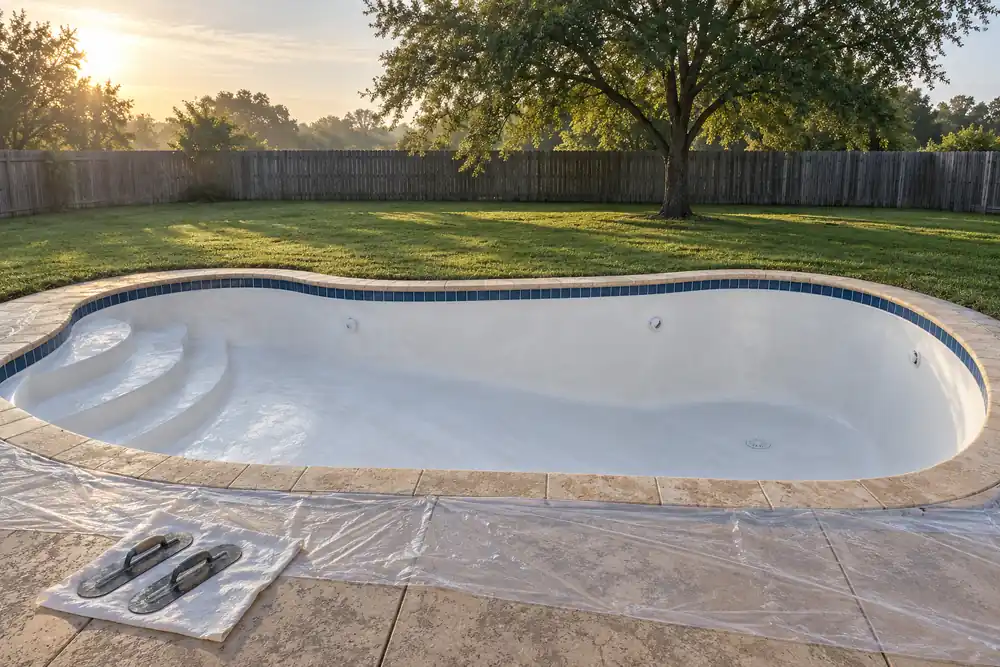
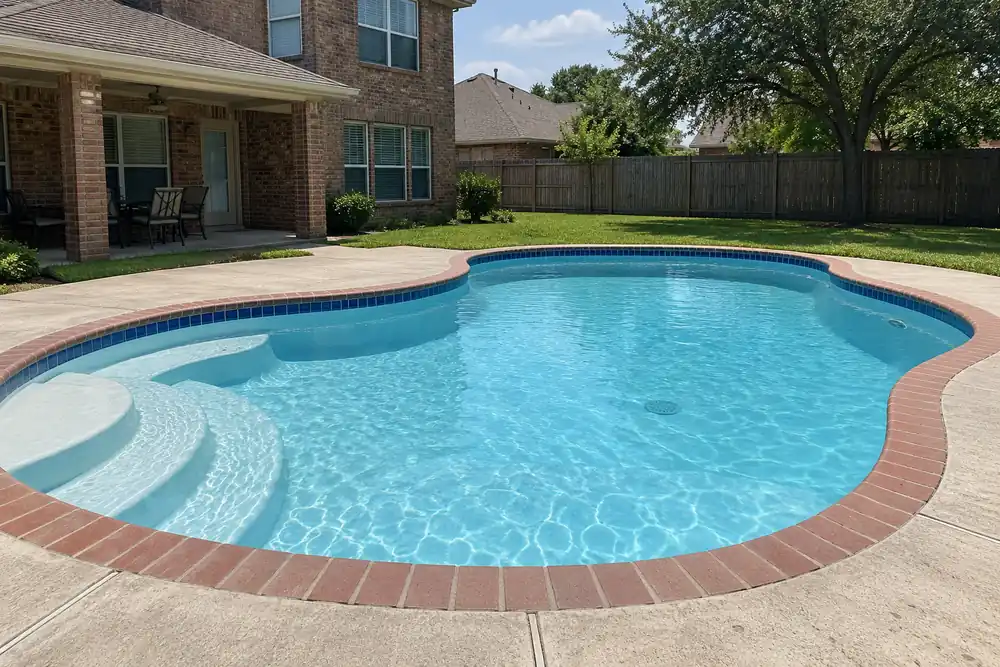
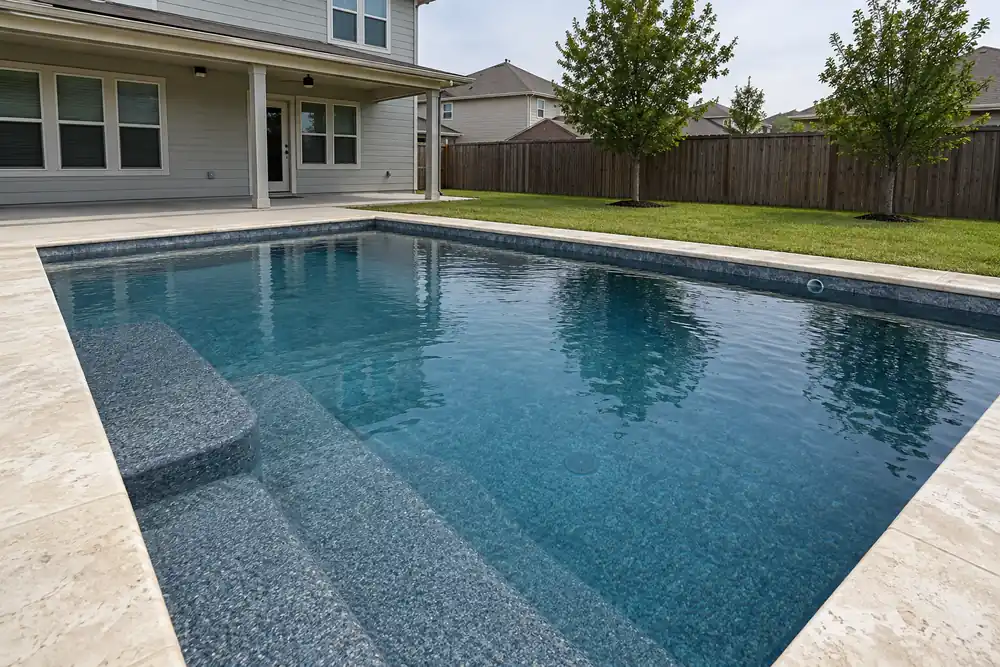
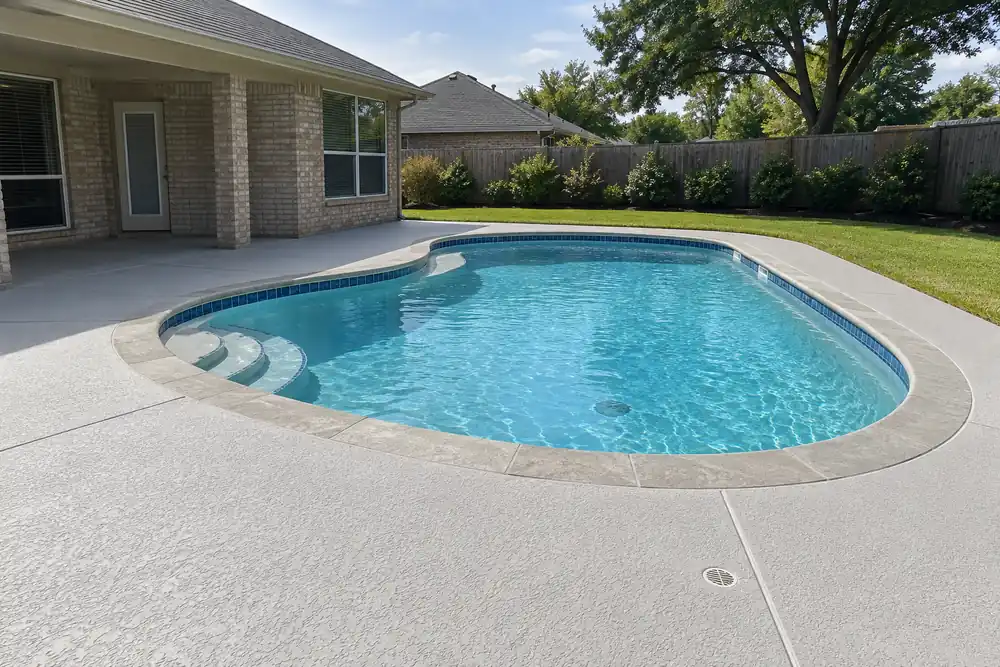
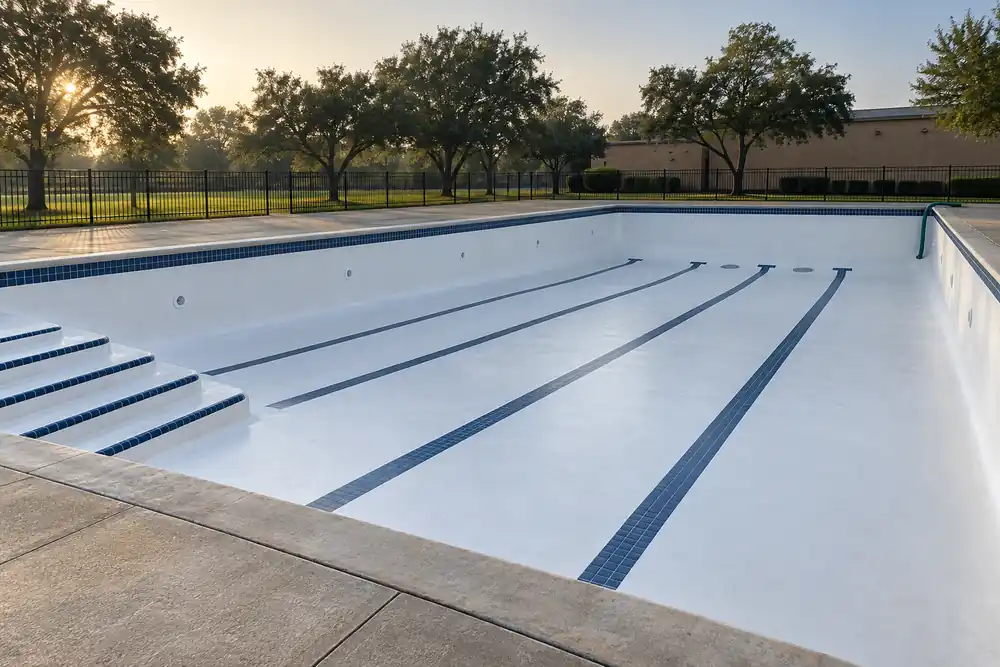
Pool Painting in League City, TX
League City Pool Resurfacing does pool painting in League City, Texas: epoxy, acrylic or rubber-based pool paint rolled onto a plaster, concrete or fiberglass pool, matched to whatever coating is on it now. Ramuc, a pool paint maker, counts paint as a real alternative when old plaster has grown rough, aged and stained enough that replastering is under consideration, and Kelley Technical Coatings says its ZERON epoxy can refinish rough, stained or worn-out white plaster.
A free estimate starts with a call or the form, and it covers what's on the pool now, how much prep the surface needs and how long the paint cures before the fill.
Call or request a free estimate any time, 24/7
No charge · answered 24/7
Get free estimates
Pool paint types: epoxy, acrylic and rubber-based
Epoxy
Insl-x by Benjamin Moore describes its epoxy as a two-component polyamide coating for concrete, marcite, gunite, fiberglass and steel pools, resistant to common pool chemicals including chlorine, though like any epoxy it chalks and fades over time in sunlight. Ramuc calls that chalking a natural breakdown of the film's top surface from UV and water chemistry, and Kelley Technical Coatings says an epoxy coat erodes slightly each year until it turns thin and somewhat transparent in spots, which is when it is ready to recoat.
Acrylic, or waterborne
Insl-x's waterborne acrylic can be rolled over most existing pool coatings that are still sound, or onto bare concrete or plaster. Olympic's HYDROLON acrylic, being water-reducible, can go straight onto a damp surface with no drying-out time after cleaning. Insl-x doesn't recommend its waterborne paint on fiberglass.
Rubber-based
Rubber-based paint from Insl-x is meant for concrete pools, new or old, and dries to a durable low sheen that suits fresh or salt water. Chlorinated rubber is harder to find: Insl-x says its CR2600 series isn't available in many areas because of VOC restrictions, and Ramuc suggests moving from traditional chlorinated rubber to newer synthetic rubber paints.
Call or request a free estimate any time, 24/7.
(281) 694-4352Repainting a pool over existing pool paint
Identifying the paint already there
Olympic's chip test sorts an old coating by what dissolves it: denatured alcohol for water-based acrylic, a 75/25 blend of mineral spirits and solvent for synthetic rubber, full-strength solvent or xylol for chlorinated rubber, and nothing at all for epoxy. Ramuc publishes a field test guide and analyzes chips mailed to it.
What can go over what
Under Insl-x's compatibility rules, epoxy goes only over solvent-based epoxy and chlorinated rubber only over chlorinated rubber, while synthetic rubber may go over either kind of rubber paint and the waterborne paint over any earlier pool paint. Olympic recommends the same type of coating on a recoat and converts old rubber base to epoxy only after a FUSION PLUS conversion coat, while Kelley's epoxy bulletin says flatly that a rubber-base coating is never recoated with an epoxy.
Stripping old pool paint
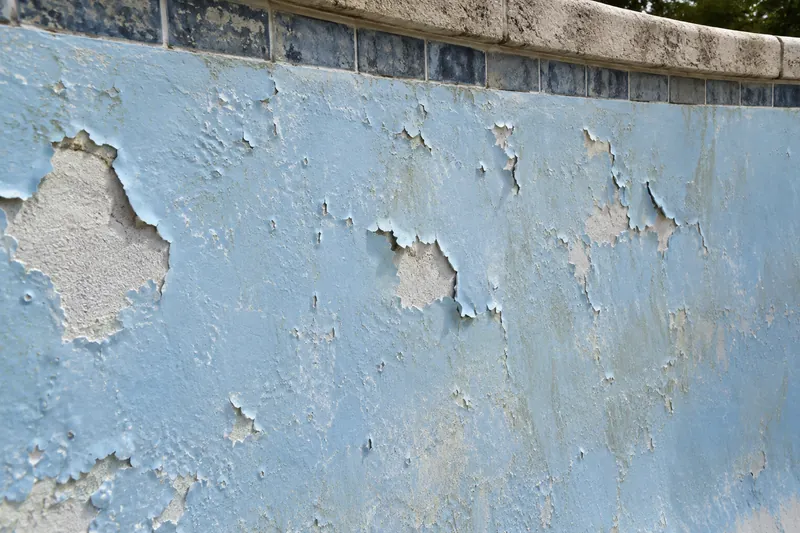
Insl-x says stripping the old paint entirely deserves consideration when it blisters and peels or is already more than four coats deep. Kelley never recoats a pool that is scaling, peeling or blistering unless only a few small spots are affected, which can be sanded and primed. Old paint can carry lead, too: Insl-x warns that scraping or sanding it may release lead dust, and wants a NIOSH-approved respirator worn and the dust picked up with a HEPA vacuum and a wet mop. League City Pool Resurfacing will talk through whether your pool's paint can be recoated.
Call or request a free estimate any time, 24/7.
(281) 694-4352Pool painting prep: sound plaster, etching and a dry shell
Sound plaster first
Ramuc checks aged plaster for hollow, weak or crumbling areas, with a ball-peen hammer or something like it, and repairs them before painting; in its words, its coatings are no fix for a weak surface. Joints and cracks get hydraulic cement or a polyurethane sealant, and Ramuc rules out silicone products, which keep paint from adhering. Where the plaster itself has failed, pool replastering is the job instead of paint.
Etching bare plaster, or sanding old paint
For bare marcite, gunite or Diamond Brite, Insl-x etches with a 10 percent muriatic acid solution until it stops reacting, triple-rinses and lets the pool dry three days, and new plaster or concrete waits until its surface pH is 9 or less, or 30 to 60 days. On a previously painted pool the makers split: Insl-x scuff-sands with 150 to 180 grit and forbids acid etching, while Olympic recommends an acid wash even on coated pools to lift chalky residue and mineral deposits. Olympic washes the pool with trisodium phosphate, never a soap-type detergent, whose film ruins adhesion. On fiberglass, the paint makers specify epoxy and their own sanding steps, set out under fiberglass pool resurfacing.
Dry enough to paint
For Ramuc's condensation test, squares of clear plastic 2 feet on a side are taped to the deep-end wall, the floor and elsewhere after five dry, sunny days; if moisture beads under them within about 4 hours, the shell gets another 24 hours before a retest. Olympic calls a 100 percent dry surface critical for its rubber-base paint, since water trapped under the film ends in blisters. NOAA's League City station normally gets 60.20 inches of rain a year, with September the wettest month at 7.34 inches, so we'll talk through timing around the weather.
Call or request a free estimate any time, 24/7.
(281) 694-4352Applying pool paint in League City heat and rain
Temperature and sun
Insl-x keeps its pool paints to a 50°F-to-85°F window and away from direct sun, doing the east wall in the morning while it lies in shadow and the west wall late in the day. Ramuc's EP epoxy goes on between 50°F and 90°F, and if the night falls below 50°F it fails to cure correctly, leaving an oily feel on top. At NOAA's League City station the normal June-to-August high is 91.4°F, above both ceilings, and the normal January low is 45.7°F.
Two thin coats
Insl-x always applies two coats, two thin ones rather than one heavy one, with a short-nap roller, since over-application causes early failure and long naps can lead to blistering. Ramuc's list of blister causes is a roller nap thicker than 3/8 inch, paint laid on too thick, a damp surface, direct sun, filling before the paint has cured and incompatible paints, and it blames poor surface preparation, more than anything else, for blistering and other paint failures. At 70°F to 80°F, Insl-x recoats its epoxy and waterborne paints in about 4 to 6 hours and its rubber paints after 24. Steps, shallow water and wading areas get silica sand sifted very lightly onto the wet coating so they aren't slippery, Kelley says.
Cure before the fill
Insl-x waits at least 7 days after the final coat before filling, Ramuc's EP epoxy 5 to 7 dry days outdoors plus an extra day for each day of rain, and Olympic times its epoxy by temperature, from 3 days at 75°F to 85°F up to 6 days at 60°F to 65°F. Insl-x never covers a curing pool with a tarp or solar blanket, which traps solvent in the coating, and pumps out any rain that gets in as soon as possible.
Call or request a free estimate any time, 24/7.
(281) 694-4352Pool painting questions
Is painting a pool a good idea?
It can be, as long as the surface underneath is sound. Ramuc treats paint as a coating, not a fix for hollow or crumbling plaster. The guide pool finishes compared sets paint's cost and service life beside plaster, quartz and pebble, and a free estimate will show whether your pool's surface can take paint.
Can I paint my pool without draining it?
No. The makers' preparation steps, etching or sanding, rinsing and drying the walls and floor, all assume an empty pool: Insl-x lets etched plaster dry three days, Ramuc runs its condensation test after five dry, sunny days, and Olympic calls a fully dry surface critical for rubber-base paint. Even Olympic's acrylic, which tolerates a damp surface, skips only the drying-out time after cleaning. In League City, check the City's drought stage before draining, since Stage 2 lets the City restrict draining and refilling.
How much does it cost to paint a pool?
National averages for 2026 put pool paint at roughly $1,000 to $2,000, or $1 to $2 per square foot. For scale, Insl-x estimates a 30-by-10-foot pool averaging 5 feet deep at about 730 square feet of paintable surface. A national 2025 guide notes that costs run higher when the pool isn't already drained and the walls need repairs first. No Houston-area source publishes a usable pool-painting price, and none of these figures is a price from League City Pool Resurfacing, whose estimates are free.
How long does pool paint last?
Each maker gives its own figures. Olympic rates acrylic enamel and synthetic or chlorinated rubber at 2 to 3 years of service and epoxy at 5 to 8. Ramuc gives up to 2 years for its DS Acrylic, up to 4 for EP Epoxy, up to 8 for Hi Build and HB31 Epoxy and up to 5 for A-2 Chlorinated Rubber, and says the life depends on preparation and application. Insl-x won't predict a life but tells owners to plan on repainting after roughly 3 to 5 years, with the number of coats, the climate, chlorine strength, water balance, direct sun, the color, how hard the pool is used and how it is cleaned all moving that figure.
Which pool paint suits an HOA or other public pool?
Insl-x says public pools tend to run higher chlorine levels, which makes its epoxy or chlorinated rubber paints the better choice for their higher chemical resistance. Color is limited too, for public pools only: the 2021 International Swimming Pool and Spa Code, which Texas adopts for commercial pools, says a public pool's interior finish must not hide objects in the water and must measure at least 6.5 on the Munsell color value scale. A backyard pool is exempt from that rule.
Book a free pool painting estimate
Tell League City Pool Resurfacing what the pool is made of, whether it has been painted before and roughly how big it is. Calls and estimate requests are answered 24/7.