Pool Tile Cleaning and Calcium Removal in League City, TX
League City Pool Resurfacing handles pool tile cleaning and calcium removal in League City, Texas, taking the white line of scale off the waterline tile by blasting, acid-free removers or hand brushing, matched to what the tile's maker allows. Scale, in the National Plasterers Council's glossary, is the minerals or metals that leave the water and cling to tile and other pool surfaces as rough, unsightly stains, with calcium carbonate as one of its main ingredients.
Ask for a free estimate by phone or with the form. We'll look at the tile and how thick the scale is, which cleaning method the tile can take, and how far the water has to come down for the work.
Call or request a free estimate any time, 24/7
No charge · answered 24/7
Get free estimates
Calcium on pool tile: how scale forms and what it isn't
The evaporation line
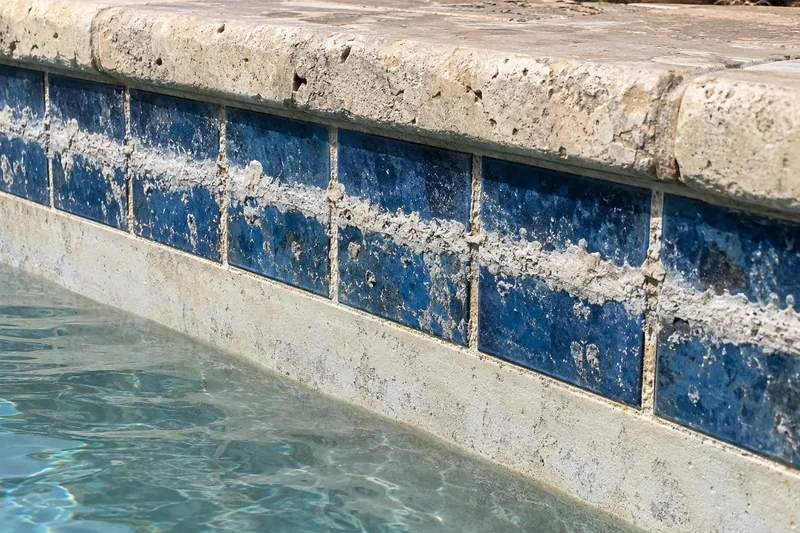
Evaporation lines are a common kind of scale, according to the pool chemical maker Orenda. As water dries off the tile its calcium stays behind, and as the pool's level drops, the water left in it carries a heavier load of calcium. Lunada Bay Tile, a tile maker, says every drying leaves minerals behind, which is why it wants overflow features running continuously, sunrise to sunset at the least, rather than switching on and off. League City's 2025 water report puts the loss from an uncovered, average-sized pool at about 1,000 gallons a month and suggests a cover to slow it.
The saturation index
To predict whether water will lay down calcium carbonate or dissolve it, the Pool & Hot Tub Alliance uses the Langelier Saturation Index, built from five readings: pH, temperature, total dissolved solids, alkalinity and calcium hardness. A reading over zero leans toward scale and one under zero toward etching cement surfaces; the Alliance gives -0.3 to +0.5 as the range for proper balance and cautions that the index shows a tendency, not an amount. Orenda adds that hardness on its own rarely drives scale, and that it usually takes high pH, warm water or carbonate alkalinity to push the calcium out.
White deposits that aren't scale
Orenda's test is where the white shows up. True scale coats everything the water touches, tile and plastic fittings, metal ladders and lights alike, so a white crust on the cement finish alone points to another problem: etching, mottling or plaster dust. Orenda also singles out calcium silica scale, which can form on cement surfaces in rounded bumps that look like rice kernels, appears to resist muriatic acid, and has no chemical remover Orenda knows of.
Call or request a free estimate any time, 24/7.
(281) 694-4352Pool tile cleaning methods: bead blasting, soft media and hand removers
Glass bead blasting
Kramer Industries, which makes blasting equipment and media, lowers the water level to about 6 inches beneath the tile and then blasts the band with glass beads at low pressure. By its account the beads leave tile and glaze unharmed, then settle to the floor for the pool's own cleaning equipment to collect. The blaster wears gloves, goggles and protective clothing, and people and pets stay out of the pool and off the deck until the work is done. Crews that do this work describe blasting machines with a vacuum built in that draws the deposits back as they come loose, a hand wipe and polish once the tile dries, and a final vacuum of the spent media, after which the water is left cloudy and low for a while, until the filter catches up.
Baking soda and mineral salt
Oceanside Glass & Tile lines blasting media up from mild to aggressive, baking soda at one end and glass bead at the other. In its view baking soda, or something of similar hardness such as the mineral salt kieserite, takes scale off without harming tile, glass tile included, and every method should be tried first on a spot nobody will see. Crews explain that the salt bursts on impact and that burst knocks the calcium loose.
Acid-free removers and hand tools
Hand cleaning has its own limits. Oceanside rules out pumice stones and wire brushes, which can mar tile, and has calcium taken off with an acid-free remover worked in by a nylon brush, never an abrasive or acidic cleaner. The company that makes the Pumie scouring stick keeps it off glass, fiberglass and other plastics, cautions that some decorative tile and colored porcelain can be damaged by abrasive cleaning, and tells users to try a small area first.
Call or request a free estimate any time, 24/7.
(281) 694-4352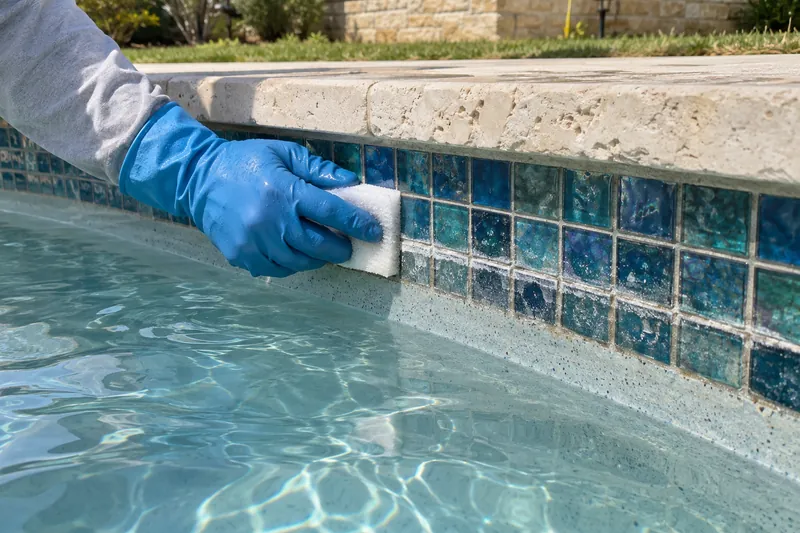
Keeping calcium off pool tile in League City
Brushing and sealing
A weekly scrub with a soft brush or non-abrasive pad is Lunada Bay Tile's advice, aimed mostly at the waterline, where evaporation runs highest. It also suggests sealing new tile once it is set and before the pool fills, with a sealer it calls sacrificial, meaning it wears away and needs redoing now and then; Oceanside adds that sealers benefit cement grout, natural stone and masonry such as coping. Water balance matters as much as the brush: LATICRETE notes that balanced water can fall out of balance within 24 hours.
League City's fill water and summer heat
The City's 2025 water report carries mineral readings for only one of its supplies, the water entering from the City of Houston's plant: total hardness 124 mg/L as calcium carbonate, pH 8.1 and total dissolved solids 240 mg/L. Those are three of the index's inputs, and the report has no matching figures for the Gulf Coast Water Authority's water. Temperature is another input, and summers here run long: NOAA's 1991–2020 normals give the League City station an average of 75.8 days a year at or above 90°F. League City Pool Resurfacing will talk through testing your own pool's water before the tile is cleaned.
When cleaning isn't the whole job
If cleaning turns up loose, hollow or cracked tiles, the fix is pool tile replacement and repair. Stains across the whole interior finish are a different job: the National Plasterers Council defines an acid wash as cleaning the finish itself by dissolving a little of its surface, done on an emptied pool under pool drain and acid wash. A newly plastered pool has its own start-up chemistry, covered in the guide to new pool plaster start-up.
Call or request a free estimate any time, 24/7.
(281) 694-4352Pool tile cleaning questions
What is the best way to clean pool tile?
There isn't one answer, because tile makers disagree. Kramer Industries holds that low-pressure glass bead won't hurt tile or glaze; Oceanside Glass & Tile counts glass bead as aggressive and prefers baking soda or kieserite, which it calls safe on glass; and Lunada Bay Tile advises against blasting or any mechanical abrading of glass or ceramic tile, sending owners with stubborn buildup to a pool professional. Between cleanings, Lunada Bay's weekly scrub with a soft brush keeps the line from building up.
Will muriatic acid remove calcium deposits from pool tile?
Tile makers say not to try it. Oceanside Glass & Tile keeps any product with hydrofluoric, hydrochloric, muriatic or phosphoric acid off its tile, since some acids attack glaze and iridescent glass, and says to neutralize accidental contact right away with baking soda and water. Lunada Bay Tile's rule is never to put muriatic acid straight onto glass or ceramic tile. Orenda advises against acid directly on scale too, observes that calcium silica scale seems to shrug off muriatic acid, and says scale tends to return unless the saturation index is put right. Oceanside's own answer is an acid-free calcium remover and a nylon brush.
How to remove calcium from a pool without draining?
Lower the water instead. Kramer Industries' blasting method brings the level down to about 6 inches under the tile, and blasting crews describe taking it just below the calcium line rather than emptying the pool. National 2025 pricing treats dropping the water a few inches as normally part of a tile-cleaning price, while a full drain and refill raises the bill and can bring local discharge rules into play.
How much should pool tile cleaning cost?
Typical Houston-area prices for 2026 put waterline bead blasting at $900 to $2,400 for 3 to 6 hours with no draining, acid washing at $600 to $1,100, pumice by hand at $150 to $400 and power washing at $800 to $1,200. Nationally, 2025 pricing runs by the linear foot: light scale cleaned chemically or with pumice at $3 to $6, moderate scale blasted with glass bead or soda at $6 to $8, the tier most jobs fall in, and heavy scale at $8 to $12, with minimum charges of $400 to $1,000 a job. Neither is a quote from League City Pool Resurfacing, whose estimate is free.
How often should pool tiles be cleaned?
Weekly, for brushing: Lunada Bay Tile's routine is a soft brush or non-abrasive pad once a week. How often the line needs blasting depends on how fast it comes back, and Orenda ties that to the water: while the saturation index stays off, the scale keeps returning. With LATICRETE noting that balance can be lost within 24 hours, test the water often.
Book a free pool tile cleaning estimate
Tell League City Pool Resurfacing what kind of tile your pool has, glass, porcelain or stone, and how heavy the white line is. Calls and estimate requests are answered 24/7.