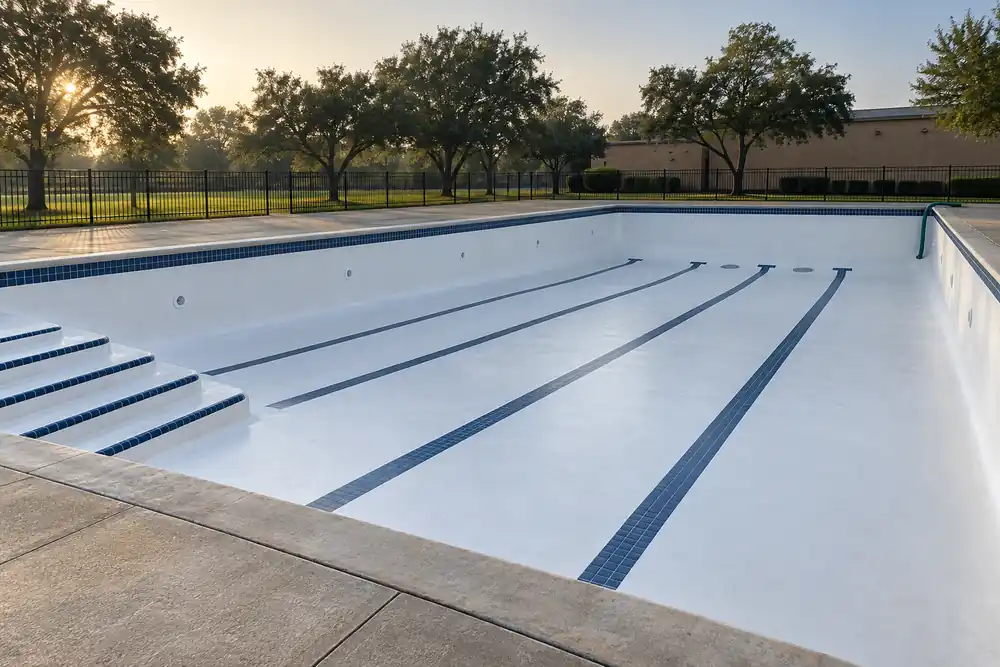
Pool Tile Replacement in South Houston, Texas
League City Pool Resurfacing handles pool tile replacement in South Houston, Texas, from resetting a few loose waterline tiles to stripping and replacing the whole row, in the small city next to Pasadena two miles southeast of the junction of Interstate 45 and State Highway 3.
The Handbook of Texas names Hobby Airport, the San Jacinto battleground and the Johnson Space Center as the attractions nearby, and South Houston's own story runs from strawberry fields to a circus mayor. A call or the form gets a free estimate, which begins with the tile itself: loose, cracked, scaled or just dated.
Call or request a free estimate any time, 24/7
No charge · answered 24/7
Get free estimates
Pool tile replacement where the median home dates from 1969
Most of South Houston's housing predates 1980. The Census Bureau's 2020–2024 survey puts about 3,799 of the city's 5,487 housing units (69.2%) before that year and about 2,907 (53.0%) before 1970; the 1960s alone account for about 1,382 units (25.2%) and the 1950s for about 1,035 (18.9%), while only about 804 (14.7%) went up in 2000 or later. The median year built is 1969, within two years either way.
About 3,768 units (68.7%) are detached houses. Owners live in 2,767 of 4,998 occupied homes (55.4%), and the median value of an owner-occupied home is $189,300. The city covers 3.046 square miles of land and no water, and the Census Bureau's estimate for July 1, 2025 is 16,407 residents.
Call or request a free estimate any time, 24/7.
(281) 694-4352Waterline tile and the Southeast plant's water
South Houston's water comes from the Trinity and San Jacinto rivers through the City of Houston's Southeast Water Purification Plant, and from City wells drilled into the Gulf Coast aquifer; the 2025 report says the two "are sometimes mixed", and it lists the chloramine residual at a 2025 average of 3.3 ppm, between 1.2 and 4.0.
The same report reprints Houston's 2025 readings for the Southeast plant's entry point. Water from that plant measured 124 mg/L of total hardness as calcium carbonate, with a pH of 8.1, total dissolved solids of 240 mg/L, chloride of 30 mg/L and sulfate of 48 mg/L. Those figures belong to the purchased water; the report prints none for the City's wells, so they describe the plant's water rather than every South Houston tap, and the fill for a retiled pool gets its own test.
Cleaning around new grout
Once new tile is set, the cleanup follows the grout maker. LATICRETE says no acid-based cleaner should touch its grouts at any point during installation, during the cure or before the pool is filled, and it names neutral-pH cleaners for that stretch instead.
Call or request a free estimate any time, 24/7.
(281) 694-4352Cracked pool tile on Lake Charles clay
The USDA maps South Houston's Census center point as a Lake Charles-Urban land complex: 55 percent Lake Charles soil and 40 percent "urban land", ground covered by buildings and pavement. The Lake Charles part sits in the very high shrink-swell class, with a linear extensibility of 11 percent at the surface and up to 13.1 percent within 5 feet, and shrink-swell earns it a very limited rating as a base for house foundations. Soils differ by street, so that describes one mapped point.
When deck movement reaches the tile line
Where a cantilevered deck was poured without a bond breaker or slip joint over the leveled bond beam, the waterline tile can end up partly bonded to the deck and crack in a horizontal line, or the deck's movement can shear off the leveling mortar or the top of the beam. LATICRETE adds that poor preparation and cleaning are a primary cause of failure in the waterproofing membranes and leveling mortars under pool tile, which is why a retile begins with the surface behind the old tile, not only the tile.
Call or request a free estimate any time, 24/7.
(281) 694-4352Lowering the water for tile work under the sewer rule
Waterline tile work usually means taking the water down below the tile, and in South Houston the City's code decides where that water may go. Its sewer ordinance bars anyone from putting "swimming pool drainage" into the City's sewage treatment system "unless specifically authorized by the City of South Houston", in the same list as storm water, roof runoff and other clean water, and it counts swimming pool and spa drains among the sources of inflow into the sewer. Ask the City before any pool water is pumped toward a sewer line.
Scheduling tile work around winter freezes
Freezes are few. At NOAA's Houston Hobby Airport station, about 3.6 miles from South Houston's Census center point, only 4.2 nights a year dropped to 32°F or lower over 1991–2020; half of all years see the first freeze by December 28 and the last by January 30. Tile makers set temperature windows for setting and curing their mortars and grouts, so winter tile work is booked around the cold snaps.
Call or request a free estimate any time, 24/7.
(281) 694-4352Permits for pool tile and deck work
South Houston's code adopts the 2015 International Building Code, without appendix chapters A through L, for the "alteration, repair, location, relocation, replacement" of structures. The building fee schedule has no line for pools; it lists "Repair/remodel $20.00 + sq. ft.", "Concrete $20.00 + sq. ft." and a general miscellaneous permit at $50.00, and the plumbing schedule charges $20.00 for pool "P" traps and $20.00 for each swimming pool or spa heater. Neither the code adoption nor the fee schedules say whether a retile needs a permit, so ask the City's permit office before the work starts.
The City's swimming pool article
The pool article in the City code, adopted by Ordinance No. 95-002 on February 7, 1995, takes in the state's pool-yard enclosure law and sets local rules for other pool enclosures, construction, operation and maintenance in an Exhibit A that is held on file with the city secretary rather than printed in the code.
Call or request a free estimate any time, 24/7.
(281) 694-4352Dumont, strawberries and circus elephants
C. S. Woods of the Western Land Company founded the town in 1907 and named it Dumont, the Handbook of Texas records; it had a post office by 1910 and was incorporated as South Houston by 1913, with Walter Tharp as its first elected mayor. Early growers shipped strawberries, figs and vegetables on the Galveston, Houston and Henderson Railroad, and the hurricane of 1915 wiped out the town's first industries. Growth came quickly from the 1940s to the early 1960s. George Christy, mayor in 1949–1951 and again in 1960–1964, owned a circus whose elephants helped build Spencer Highway, and by 1960 makers of asphalt, wire products, oilfield chemicals and concrete conduits had come to town. The population stood at 7,523 in 1960, 14,207 in 1990 and 16,983 in 2010.
Call or request a free estimate any time, 24/7.
(281) 694-4352Tile replacement with coping, grout and finish work
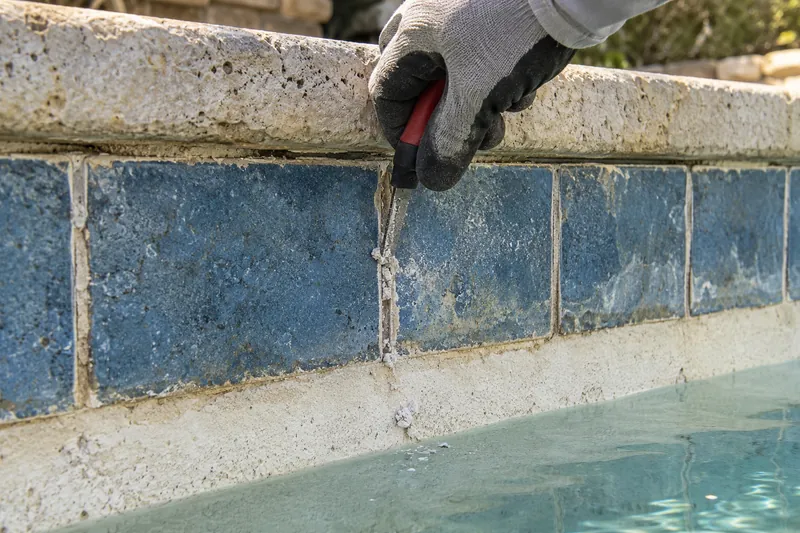
A tile job often takes in the coping above it, regrouting, calcium and scale removal on the tile that stays, a glass tile accent band, or a new plaster, quartz or pebble finish while the pool is down; deck repair joins it when the deck is part of the problem. National figures for 2026 put localized pool tile repairs mostly at $2,000 to $5,000 for section repairs, with simple fixes such as re-adhering loose tiles as low as $250, and labor at $30 to $120 an hour or $4 to $32 a square foot, as much as half of the total. Those figures are national; League City Pool Resurfacing gives the number for a given pool at no charge.
Next door and down the road, we also handle commercial and residential pool replastering in Pasadena and pebble pool resurfacing in Deer Park.
Call or request a free estimate any time, 24/7.
(281) 694-4352Replacing pool tile, step by step
A retile in the usual order, with South Houston's code in mind; the estimate sets out the specifics.
Tap, look and measure
We'll tap the tile for hollow spots, look over the grout and coping, and check the deck edge for movement.
Permit office and drain water
The City answers the permit question and says where the lowered water may go.
Water below the tile line
The water comes down far enough to work on the full row.
Old tile off, surface ready
Old tile and thin-set come off, and the surface behind them is cleaned and repaired.
Set and grout
New tile goes in with mortar and grout rated for submersion, and only neutral-pH cleaners touch the new grout.
Cure, then refill
The grout cures for the time its maker sets before the water goes back up.
Call or request a free estimate any time, 24/7.
(281) 694-4352South Houston pool tile questions
What materials can a pool fence be in South Houston?
Wood, chain link, wrought iron or masonry, under the City's fence rules. A fence also needs its own permit: no fence may be put up, moved, repaired, added to or structurally altered without a permit from the building official, the application comes with a survey and scale plans, the fence is staked out before the permit is issued and it is inspected once it's built. Rules for pool enclosures themselves sit in the pool article's Exhibit A, on file with the city secretary.
Free pool tile replacement estimates in South Houston
Tell League City Pool Resurfacing how many tiles are loose or cracked and whether the coping moves. We take calls and form requests 24/7.