Pool Finishes Compared: Plaster, Quartz, Pebble and Glass Tile
League City Pool Resurfacing compares pool finishes for League City, Texas: white and colored plaster, quartz, pebble, polished and glass-bead blends, and glass tile, set side by side on surface life, chemistry, feel, water color, care and Houston-area cost.
Every finish spends its working life in treated water, the National Plasterers Council notes, so its appearance changes over time, and the choice made while planning a resurface decides much of how well a pool keeps its looks. Its advice is to learn each finish's strengths and weaknesses before choosing, since any of them can last for years when the pool is built and kept properly.
Call or request a free estimate any time, 24/7
Pool finishes at a glance
Surface-life ratings are the National Plasterers Council's. Prices are typical Houston-area figures for 2026 on a 12,000 to 18,000 gallon pool, or other published figures where no such price exists.
White and colored plaster
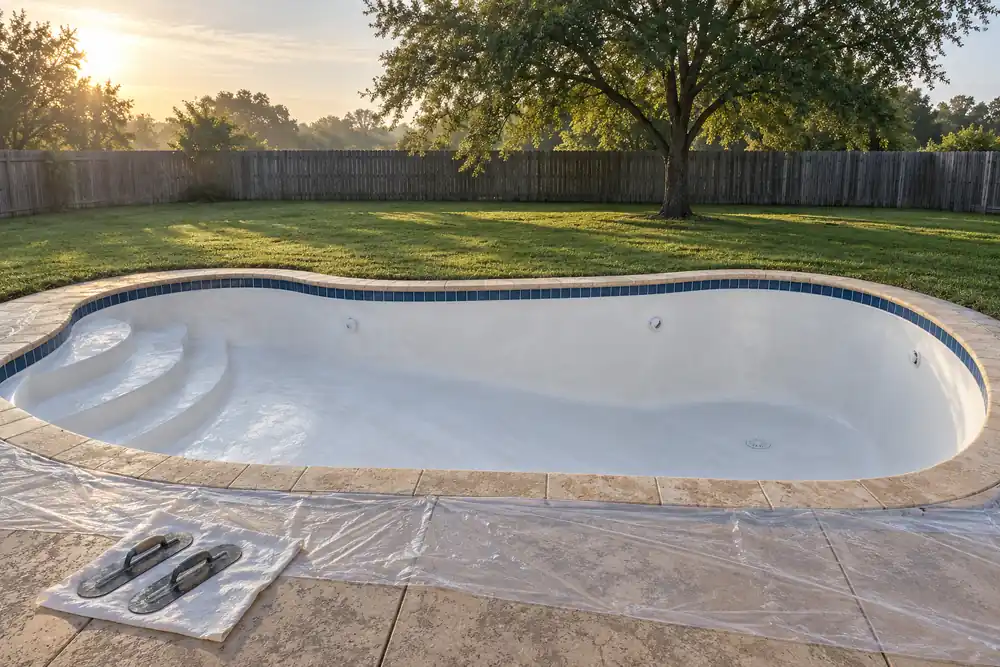
White cement, white marble and water, hard-troweled smooth: the Council's most affordable finish and a 5 to 8 year surface, softer than newer finishes and quicker to react to water chemistry. Pigment makes mottling and streaks show more. About $4,500 to $6,000 for pool replastering in white plaster.
Quartz
Quartz aggregate, one of nature's hardest minerals and unreactive to pool chemicals, set in white cement: a 10 to 15 year surface that can range from smooth to textured. About $6,000 to $8,000 for a quartz blend; more under quartz pool finishes.
Pebble
Small pebbles, sometimes with glass or shell, troweled hard and then washed to bare the stone: the Council's most durable surface, rated 12 to 18 years, with a more textured feel and a higher price. About $7,500 to $10,000; more under pebble pool finishes.
Polished and glass-bead finishes
Mixed aggregates polished smooth as the last finishing step, an upgraded-cost finish rated 8 to 12 years, or glass beads in white cement, smooth to the touch. Typical Houston-area prices for 2025 put glass bead at about $8 to $12 a square foot.
Glass tile
Glass mosaic over a waterproof membrane and a movement-joint system, which LATICRETE finds handsome but costlier and more demanding to install. No tile maker states a lifespan in years; national 2026 ranges for tile resurfacing run $20,000 to $50,000 or more.
Call or request a free estimate any time, 24/7.
(281) 694-4352How each pool finish stands up to water chemistry
The surface ratings follow chemistry more than anything. The Council describes traditional white plaster as a relatively soft finish that water chemistry affects more than it does newer products; over the years its appearance can shift from faint shading or scaling to, at the extreme, staining, etching, cracking or delamination.
Quartz and pebble
CL Industries calls quartz a strong, nonporous, stain-resistant finish that resists erosion when the water's chemistry slips, and the Council finds colored quartz aggregates far more resistant to changing water chemistry than standard plaster, though not immune when it goes to extremes. Pebble goes further: the river stone itself is chemically inert, so the Council ranks it the most durable surface available, at risk only under the most extreme chemical conditions.
Polished finishes
CL Industries says its polished Hydrazzo resists spot etching, permanent scale and algae, and that the chance to polish the surface to an even luster all but ends complaints of roughness. Any cement finish goes on curing for up to a year, CL adds, which keeps care critical through the first 10 to 12 months.
Glass tile and its grout
In a tiled pool the weak point is what holds the glass. LATICRETE warns that water below 200 to 250 ppm of calcium hardness draws calcium out of cement-based grout and mortar, and it recommends epoxy grouts, which contain no portland cement and so aren't affected by water treatment.
For every cement finish, the Council's guide number is the saturation index: kept between 0.0 and +0.3, especially in the first six months, the water neither etches the surface, as it does below zero, nor scales and stains it, as it does above.
Call or request a free estimate any time, 24/7.
(281) 694-4352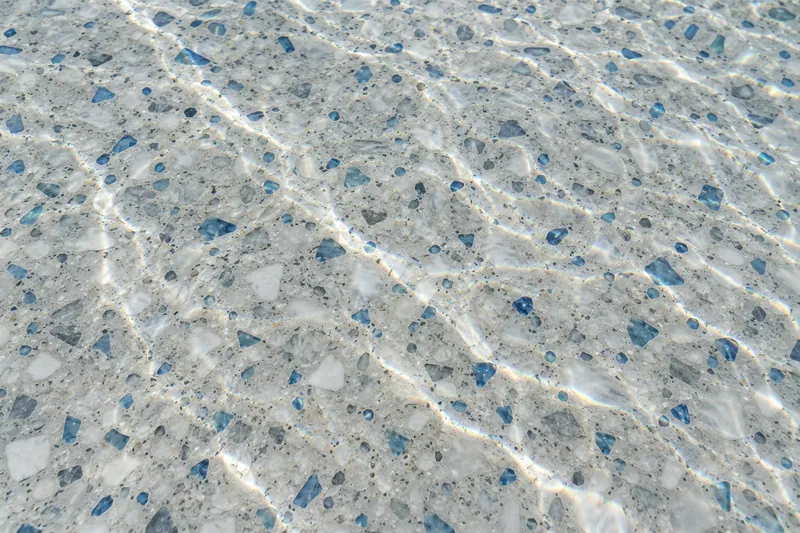
Pool finish texture, feel and water color
Underfoot
Hard-troweled plaster should feel no rougher than very fine sandpaper, like an eggshell, the Council says, though steps, benches and walk-out areas shouldn't be left so smooth that they turn slippery. CL Industries' rule of thumb is that the more polished a finish, the smoother it feels, while shell and quartz accents add texture, and it calls its polished marble line silky smooth yet non-slip. For exposed pebble, PebbleTec's wet dynamic coefficient of friction, tested to ASTM C1028, is 0.63 in its maker's published lab results.
Because every finish is troweled by hand, the Council adds, minor variation in thickness, levelness, texture and color can't be avoided, and no national standard yet measures how much is acceptable.
Water color, sun and heat
To preview a color, Premix-Marbletite suggests dropping a sample into 6 inches of water, bearing in mind that time of day, sun, clouds, tile and landscaping all change it. Darker colors tend to hold warmth, it adds, and lighter pools stay cooler, a trade-off that counts in League City, where NOAA's station averages 75.8 days a year at 90°F or above.
Judge a new finish fairly, too. The Council says to inspect it only once the pool is full of clean, balanced water, and in morning or afternoon light or under cloud; noon sun overhead, wind and pool lights at night all exaggerate imperfections. Pebble Technology International's guidance is to wait about 28 days before passing judgement on the final water and finish color.
Shared pools have less choice. For public pools, which in Texas include those run for apartment complexes, condominiums, hotels and property owners associations, the 2021 International Swimming Pool and Spa Code calls for light finishes, at least 6.5 on the Munsell color value scale; backyard pools are exempt.
Call or request a free estimate any time, 24/7.
(281) 694-4352Pool finish care: brushes, stains and draining
Brushes differ by surface. Pebble Technology International allows nylon, nylon-and-stainless or polypropylene brushes on its exposed pebble finishes but only nylon on its smoother PebbleFina and PebbleBreeze. In a tiled pool, LATICRETE keeps acid-based cleaners off its grouts and uses neutral-pH products for routine care.
Stain fixes differ as well. Quartz and polished surfaces leave the most room: SGM says its quartz Diamond Brite takes several acid washes over its life without permanent damage, NPT can re-polish its PolishedScapes to restore the luster, and Hydrazzo, CL Industries says, can take a second acid wash and polish after a poor start-up. The Council's torching method for stains, by contrast, can't be used safely on glass-bead surfaces.
Every finish is meant to stay underwater. The Council wants a finish kept fully submerged for its service life, except for limited servicing or repair; Pebble Technology International doesn't recommend PebbleTec for use out of the water; and LATICRETE caps the drain-down of a tiled pool at 2 feet per 24 hours, so that hydrostatic pressure can't loosen the tile or its leveling mortar. League City Pool Resurfacing will talk through the care your chosen finish needs at the free estimate.
Call or request a free estimate any time, 24/7.
(281) 694-4352Pool finish questions
What is the longest-lasting pool finish?
Among the cement finishes, pebble. The National Plasterers Council rates it a 12 to 18 year surface, against 10 to 15 for quartz, 8 to 12 for polished finishes and 5 to 8 for traditional white plaster. Other figures run longer: a Houston-area plasterer gives pebble 15 to 20 years or more, and SGM cites industry averages of 10 to 20 years without naming a source. No tile maker states a lifespan for an all-tile interior, and every figure assumes sound materials, sound workmanship and balanced water.
What are the different types of pool resurfacing materials?
On concrete pools, the cement-based finishes: white or colored plaster, quartz, pebble, and polished or glass-bead blends, each a special cement mix made for pools and, as the Council puts it, placed and finished in one single application. Beyond those come full tile set over a waterproof membrane, and pool paint, which Ramuc makes in rubber, epoxy and acrylic types for masonry pools. Fiberglass pools are a separate case: their surface is gelcoat, a colored resin sprayed on when the shell is made, and they're refinished with coatings rather than plaster.
Choose a pool finish with a free League City estimate
Tell League City Pool Resurfacing which finishes you're weighing, the pool's rough size and what it has now, and we'll talk through how each would look and wear on your pool. Calls and estimate requests are answered 24/7.