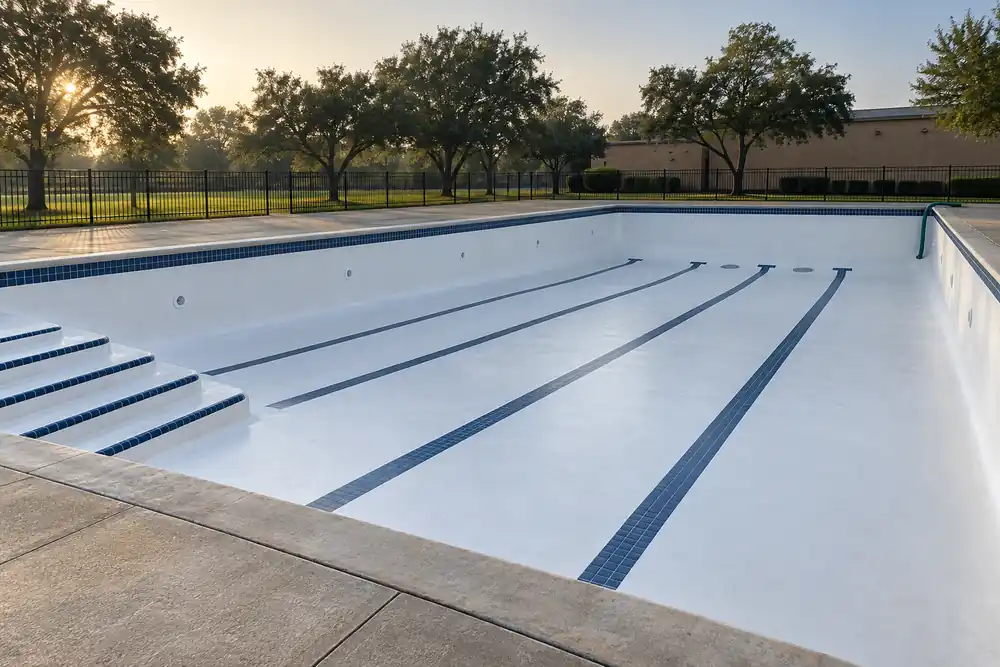
Pool Deck Repair in League City, TX
League City Pool Resurfacing does pool deck repair in League City, Texas: cracks, spalled edges and holes, broken sections of slab, and the sealant in worn or empty expansion joints around the pool. Concrete grows and shrinks a little with every change in its moisture and temperature, says the National Ready Mixed Concrete Association, and a slab cracks on its own wherever nobody planned room for that.
For a free estimate, call or send the form and tell us where the cracks run, whether any slab has dropped or rocks underfoot, what the joints between slabs look like, and what is on the surface now: bare concrete, a coating or Kool Deck.
Call or request a free estimate any time, 24/7
No charge · answered 24/7
Get free estimates
What causes pool deck cracks
How the slab was built
The concrete association blames most cracking on how a slab was designed and built. Its list: isolation or contraction joints that were never put in, or were put in the wrong place, a subgrade nobody prepared properly, a mix with too much water in it, careless finishing, and concrete allowed to dry too quickly or hardly cured at all. The slab, and so the ground under it, should also be sloped to drain. In its joint guide, contraction joints go at a spacing of 24 to 36 times the slab's thickness or less, and never more than 15 feet. League City's code takes in the International Swimming Pool and Spa Code, whose deck section wants joints that minimize visible cracks outside the control joints.
Settlement and early cracks
Settlement cracks are one of the common types on the association's list. Most random cracks that appear while the concrete is young look bad, it says, but seldom harm its strength or how long it lasts. So a fine crack across a sound slab and a crack along a slab that has sunk are different jobs; a sunken or rocking slab is the subject of pool deck leveling.
League City clay that cracks as it dries
NRCS maps Bernard clay loam at League City's Census center point and at Hometown Heroes Park, Bay Ridge Park, Lloyd R. Ferguson Elementary, Hyde Elementary and Creekside Intermediate. About 5 percent of that Bernard map unit is Lake Charles clay, which NRCS describes as cracking 1/2 to 2 inches wide and 12 inches or more deep when it dries, the cracks staying open 60 to 90 days in most years. The 1988 Galveston County soil survey defines shrink-swell as soil shrinking when dry and swelling when wet, and says it can damage roads, building foundations and other structures.
Call or request a free estimate any time, 24/7.
(281) 694-4352Pool deck crack and spall repair
Hairline cracks
A hairline crack in a sound slab still matters when the deck is getting a thin coating. Deck contractors describe spray deck as too thin to hide surface defects, so a crack left unrepaired shows straight through it; cracks under a planned coating are filled first, as part of pool deck resurfacing.
Spalled edges and hollow patches
Broken-away edges, holes and hollow spots under an old topping come out before anything new goes on. Deck contractors describe the work as scraping, grinding and patching hollow or damaged areas so the new material bonds to sound concrete, and taking loose or hollow Kool Deck back to sound material; they warn that painting over a failed coating traps the same weak layer under the new finish. They also name cracks around pool edges and steps among the usual signs a deck needs work. League City Pool Resurfacing gives free estimates on spall and patch repairs.
Broken sections
A Houston builder's advice for a deck on moving clay is to replace the sections where cracks keep moving with the soil, overlay the sound ones, and have the quote itemized area by area. Replacement paving is on League City's permit list, covered in the questions below.
Call or request a free estimate any time, 24/7.
(281) 694-4352Pool deck expansion joint repair
What the joints do
Isolation joints, usually called expansion joints, cut a slab off from walls, footings, steps and anything else that is fixed, letting each piece shift independently, the association says. The one that matters most at a pool sits between the deck and the coping. Under the code it has to be watertight and laid out to shield the coping and the mortar under it from a moving deck; when that joint stops working, a pushing deck can crack or loosen coping and tile, and in the worst cases the bond beam beneath them. The coping side is covered under pool coping replacement, and a crack that runs into the pool shell under pool crack repair.
Sealants made for pool deck joints
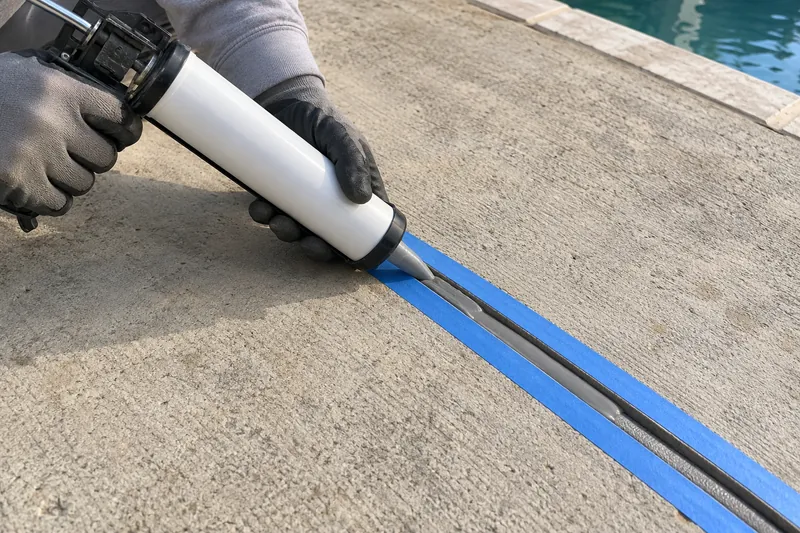
W. R. Meadows' DECK-O-SEAL, a two-component polysulfide, is poured into horizontal deck joints and finds its own level; once cured it flexes up to 25 percent either way. The maker's limits are application from 40°F up to 122°F, a firm, rubbery set inside 24 hours at 77°F, a full day clear of rain, no paint on top, and no use under water, where its DECK-O-SEAL 125 or Gun Grade takes over below the waterline. Sika builds its self-leveling polyurethane joints to the same 2:1 shape over closed-cell backer rod or bond-breaker tape, primes any joint that will be completely submerged, and caps chlorine exposure at 5 ppm.
Sizing a new joint
Before sealing, the joint has to be clean and dry and the concrete fully cured; W. R. Meadows cites 28 days as the industry's curing standard. A foam backer rod pushed into the joint controls how deep the sealant sits: half as deep as the joint is wide, and between 1/4 and 1/2 inch. Joints under 1/4 inch wide are too narrow for it, and its two parts are mixed for 10 minutes or more.
Plastic control joints
Mortex sells a PVC control joint for pool decks that gives the concrete a planned place to crack. Chlorine and pool chemicals barely touch it, the maker says, and fins on its sides keep water from flowing straight down to the soil. A Control Joint Replacement Top from the same maker slips over an old joint to repair it or give it a new color. League City Pool Resurfacing will talk through joint options at the estimate.
Call or request a free estimate any time, 24/7.
(281) 694-4352Questions about pool deck repair
How much does it cost to repair pool deck cracks?
National figures for 2025 put filling and sealing a crack at anywhere from $50 to more than $800 per crack. The same year's national averages run simple deck repairs $100 to $750 and a typical deck repair $750 to $2,500. No Houston-area price list for deck crack, spall or joint work turned up in the research for this site, so the national range is the guide. They are published figures rather than prices from League City Pool Resurfacing, and having your deck looked at costs nothing.
How can I repair cracks in my pool deck?
First work out which kind of crack it is. A fine crack across a sound slab is mostly cosmetic, and the coating maker decides how it is treated: SUNDEK, for one, gives hairline and shrinkage cracks no extra treatment before its coating and fills most larger cracks with urethane. A crack beside a slab that has dropped calls for lifting the slab first, a slab in pieces for replacing that section, and a crack that keeps reopening for a joint where the slab can move, since missing joints head the concrete association's list of causes.
How do I replace the expansion joint in my pool?
W. R. Meadows' care bulletin for DECK-O-SEAL treats it as one of two repairs. Sealant that is torn but still stuck to the concrete only needs the torn stretch cut away and refilled. Sealant that has let go of the concrete comes out entirely: a razor or linoleum knife is drawn along both edges, the strip is pulled, leftovers are wire-brushed or ground away, and alcohol is wiped along both walls of the joint right before the fresh sealant and its backer rod go in. A white, chalky film after a heavy shock treatment is temporary, the bulletin says.
How much does it cost to replace a pool deck?
Typical Houston-area figures from 2024 start a full concrete slab replacement around $10 per square foot at the low end. Nationally, a new concrete pool deck runs $6 to $18 or more per square foot in 2026 figures, which comes to $5,400 to $16,200 or more for the average 900-square-foot deck. A Houston builder gives no per-foot price for replacing a deck with pavers or travertine until it has seen what is under the old one. All of these are published figures rather than quotes, and a look at your deck costs nothing.
Does replacing pool deck sections need a permit in League City?
League City's Building Department lists new or replacement paving among the work that needs a permit, and its patio handout puts it plainly: only the concrete needs a permit. From August 1, 2026 the City charges $150 for a driveway or flatwork permit, and work done without a permit pays double. No City page says whether filling cracks or resealing joints needs one, so ask the Building Department before work starts. Check with your HOA as well; the City leaves deed restrictions to the associations to enforce.
Book a free pool deck repair estimate in League City
Tell League City Pool Resurfacing where the deck is cracked or broken, whether any slab has dropped, and what the joints look like. Calls and estimate requests are answered 24/7.