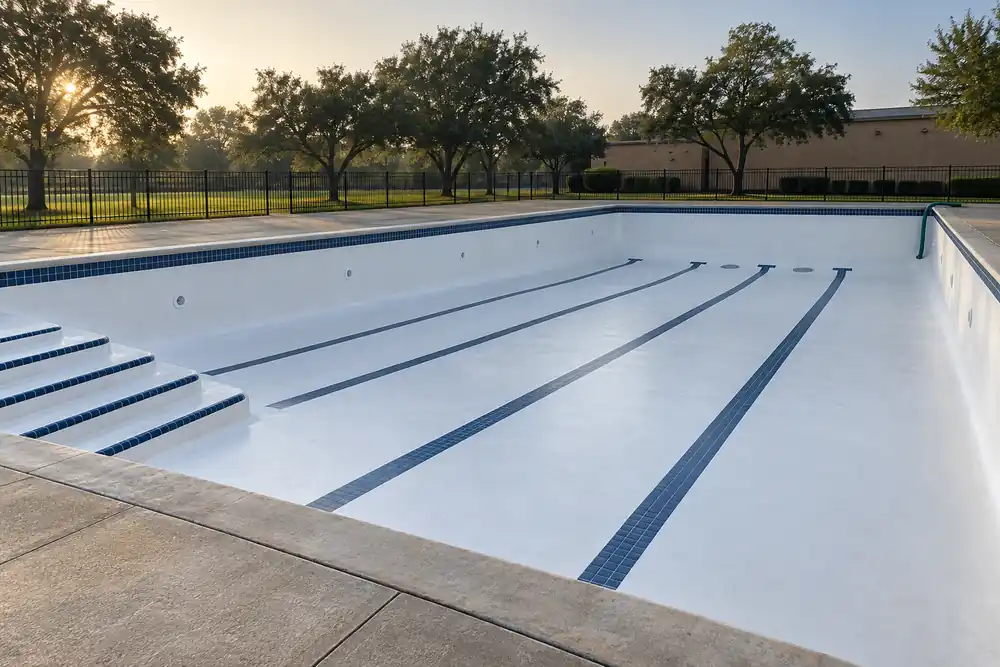
HOA and Community Pool Resurfacing in League City, TX
League City Pool Resurfacing does HOA pool resurfacing in League City, Texas, for the community pools that property owners associations run, from the city's older master-planned neighborhoods to the amenity centers going in on the west side. Texas counts a pool an association keeps for its members and their guests as a Class C public pool, and the Galveston County Health District's pool order lists neighborhood pools operated by homeowners' associations among the semi-public pools it permits.
Estimates are free for boards and managers, on the phone or through the form, and they cover the pool's size and age, the weeks it can close, and how the work lines up with the association's reserve plan.
Call or request a free estimate any time, 24/7
No charge · answered 24/7
Get free estimates
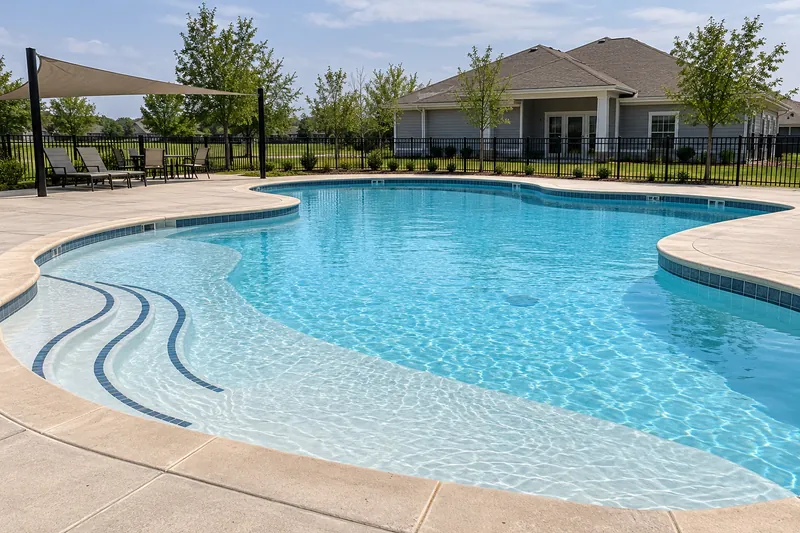
HOA pool resurfacing for League City's master-planned communities
Community pools in the older neighborhoods
The City's planning records date its oldest master-planned communities to The Wharf, whose covenants were recorded in February 1978, South Shore Harbour, created with a municipal utility district in 1981, and Bay Colony, created in 1988; Victory Lakes and Magnolia Creek followed in 1999. The Census Bureau's 2024 survey counts 14,009 homes in the city built from 1980 to 1999. State records show those neighborhoods still investing in their pools: in July 2024 a new South Shore Harbour neighborhood pool house, with restrooms, a lifeguard room and storage, was registered with the Texas Department of Licensing and Regulation.
Amenity center pools on the west side
The same records show new community pools going in farther west: Coastal Point's recreation center and pool on Sparrow Lane, registered in December 2018; the Samara Amenity Center, whose registered building houses pool equipment, storage and restrooms, in November 2024; and Legacy's Homestead Amenity Center, registered in July 2025 with pool construction in its scope. The City's Westside Master Plan counts Legacy at 1,630 planned lots, Westland Ranch at 970, Samara at 964 and Vida Mar at 616. League City Pool Resurfacing gives free estimates to the boards and managers of older and newer community pools alike.
Call or request a free estimate any time, 24/7.
(281) 694-4352Planning a community pool resurfacing around the reserve study
One association's plaster and tile cycle
South Shore Harbour's 2021 reserve study, which the association publishes, describes its community pool as 4,920 square feet of plaster, measured on the horizontal surface, and about 820 linear feet of tile, a figure that takes in 150 feet of coping. The plaster then dated to 2014. The study gives plaster a useful life of 8 to 12 years against 15 to 25 for tile and coping, and it scheduled both for 2024. It is a consultant's planning document, not a record that the work was done.
Tile, coping and the deck in the same closure
The study recommends budgeting full tile and coping replacement at every other replastering, and calls removing the old finish the chance to inspect the pool structure and repair the concrete beneath it. National HOA reserve planners give the cost reason for bundling: waterline tile, coping repair and light niche work share the mobilization and the drain and refill when they fall in the same funding event. It is also the time to look at the pool depth markers, which Texas places in the top 4-1/2 inches of wall just under the coping.
The pool's 6,800-square-foot concrete deck carried a textured coating last applied in 2017, and the study plans deck repairs with each new coating every 8 to 12 years, which put the next one in 2026. Textured deck coatings have a page of their own, spray deck and cool deck coatings. League City Pool Resurfacing will talk through which items on a reserve schedule fit one closure.
Call or request a free estimate any time, 24/7.
(281) 694-4352HOA pool resurfacing under the state's public-pool rules
A Class C pool, unless it opens to the public
That Class C status holds while the pool stays with members and their guests. If the association makes it available to the public, generally or for particular occasions and with or without a fee, the Texas Department of State Health Services rules hold it to the Class B operating standards instead. Every Class C pool also runs under a trained, certified operator, who doesn't have to be on site while it is open and may look after several pools, and the Health District's permit has to be renewed every year.
The pool-yard enclosure duty
The state's pool-yard enclosure law, Chapter 757 of the Health and Safety Code, reaches only two kinds of pool: pools at multiunit rental complexes, kept by the complex's owner, and pools that a property owners association owns, controls or maintains. An association with a pool has to take ordinary and reasonable care to inspect, maintain and repair the enclosure, a duty the law says can't be waived. The fence height, gap and gate rules are the same for both kinds and are set out under apartment and condo pool resurfacing. League City Pool Resurfacing gives free estimates on community pools across League City.
Call or request a free estimate any time, 24/7.
(281) 694-4352HOA and community pool resurfacing questions
What are the regulations for private swimming pools in Texas?
The state's public-pool rules stop at the residential pool: one on private property for two resident families at most and their guests, which includes a pool that serves just one single-family home or a duplex. Backyard pools are governed by city codes instead. State law makes the International Swimming Pool and Spa Code, in its May 1, 2019 form, the municipal pool code across Texas and lets each city adopt a newer edition, and League City's code adopts the 2021 edition for pool construction, alteration, renovation, repair and maintenance. The Galveston County Health District adds one rule of its own for private residential pools: fencing at least 48 inches high with lockable, self-closing and self-latching gates. An HOA's shared pool is not a private pool under these rules; it is a Class C public pool.
How much does it cost to resurface an HOA pool?
No published source prices HOA pool resurfacing in Texas. A national HOA reserve-planning guide puts the 2026 replacement cost of resurfacing a typical HOA pool at $8,000 to $25,000 per pool, and says boards often underfund by assuming residential pricing, pointing to commercial permits, NSF-rated materials and health department requirements as the added costs. The same guide's 2026 national range for HOA pool deck resurfacing is $3 to $12 per square foot. For Texas sales tax, a pool an HOA owns for its homeowners counts as residential property, and labor to repair or remodel residential property isn't taxed. These are published national figures, not prices from League City Pool Resurfacing; the real number comes from seeing the pool.
Does the ADA apply to an HOA or community pool?
Not to one kept only for residents. The U.S. Department of Justice says community pools that belong to a private residential community and are limited to the exclusive use of residents and their guests are not covered by the ADA's accessibility requirements. A residential community's pool or club that is made available to the public for rental or use is covered under Title III, and a community pool owned or run by a state or local government falls under Title II.
Does the Virginia Graeme Baker Act apply to an HOA pool?
Yes. The federal act counts as a public pool any pool open only to the residents of a residential real estate development or another multi-family residential area, or to the members of an organization and their guests, which takes in a community pool kept for homeowners. The Consumer Product Safety Commission's checklist covers the drain covers on skimmer equalizer lines as well as the main drains. The drain-cover and backup-system rules themselves apply to every public pool and are set out under commercial pool resurfacing.
What rescue equipment does a community pool need in Texas?
The state rules ask for at least one ring buoy with a throwing rope and one reaching pole for every 2,000 square feet of water surface, up to 6,000 square feet, plus another set for each further 4,000 square feet or part of it. The pole has to be light, strong, non-telescoping, non-conductive and at least 12 feet long, with a body hook or shepherd's crook, and the rope 1/4 to 3/8 inch thick and at least two-thirds of the pool's maximum width long, tied to a U.S. Coast Guard-approved ring buoy. The equipment has to be within reach of the whole pool yard.
Get a free HOA pool resurfacing estimate
Tell League City Pool Resurfacing which community the pool serves, about how big it is and when the board can close it. Calls and estimate requests are answered around the clock.