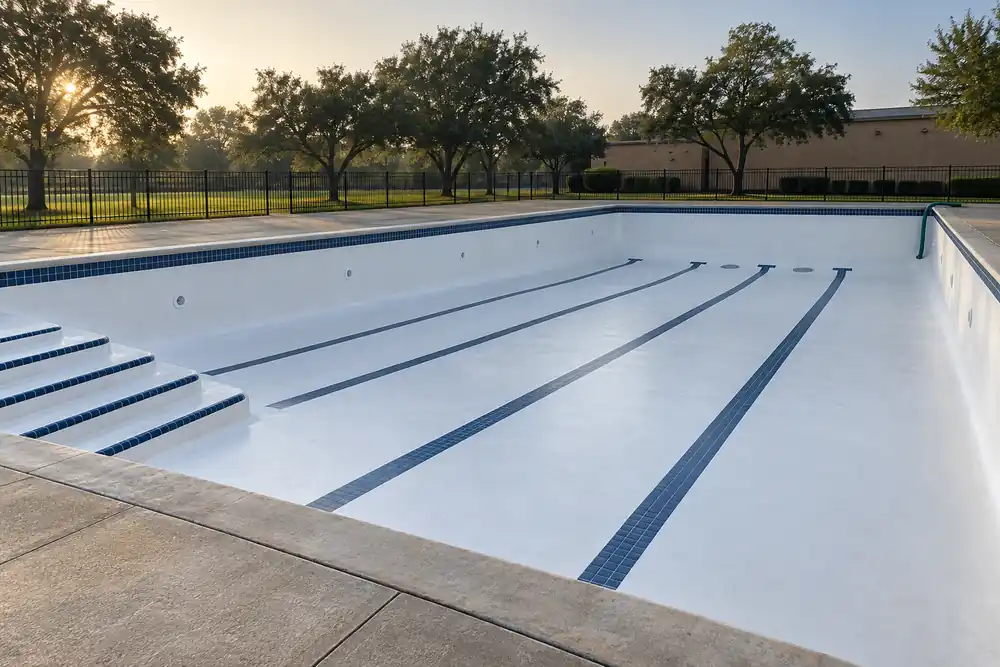
Pool Depth Markers and Safety Tile in League City, TX
League City Pool Resurfacing installs and replaces pool depth markers in League City, Texas, with the safety tile that outlines steps, ledges and the slope break, on HOA, apartment, hotel, club and other public pools. On a Texas public pool or spa the state asks for two depth markers at the very least, however small or oddly shaped the pool, placed in the wall's top 4-1/2 inches, just below the coping, so a swimmer in the water can read them.
We give free estimates by phone or through the form, going over the pool's depths and slope breaks, and which markers and tile lines the state's rules call for.
Call or request a free estimate any time, 24/7
No charge · answered 24/7
Get free estimates
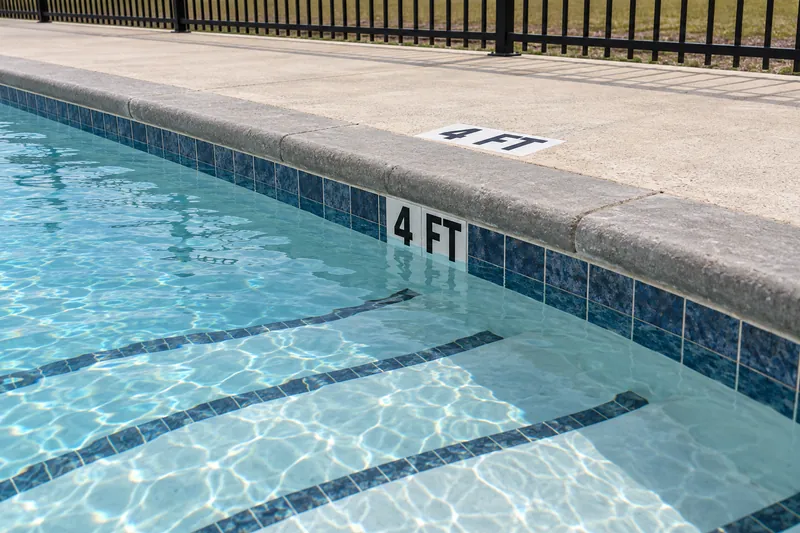
Pool depth markers on Texas public pools
Wall markers
The Texas Department of State Health Services wants the markers permanent and evenly spaced, 25 feet apart at most, with numbers and letters 4 inches high or taller in a color that stands out against both the wall and the deck. Because the wall markers sit right under the coping, League City Pool Resurfacing will look at marker work alongside any pool coping replacement or pool tile replacement on the same pool.
Deck markers
A deck marker has to be slip-resistant and is positioned for someone on the deck to read. Two codes keep it close to the water. The International Swimming Pool and Spa Code, the state's adopted code for public pools, wants it within 18 inches of the water's edge. In the CDC's Model Aquatic Health Code, which is only a model for Texas, it goes on the coping or the deck no more than 18 inches from the pool wall or perimeter gutter.
League City's public pools
The rules reach every public pool in the city, from the City's Walker Street pool, with its 50-metre lap course and diving boards, to the neighborhood, apartment and hotel pools Texas counts as Class C. The other rules those pools share are under commercial pool resurfacing, and what an association pool adds is under HOA and community pool resurfacing.
Call or request a free estimate any time, 24/7.
(281) 694-4352No-diving markers and slope-break lines for public pools
No-diving markers
Wherever a public pool is 5 feet deep or shallower, the code calls for a No Diving symbol on the deck beside a depth marker, repeated at least every 25 feet. The Texas rules describe the marker: 4 inches high or more, a diver in profile inside a circle crossed by a 45-degree slash, permanent and contrasting, slip resistant, placed within 18 inches of the water's edge and turned so a person on the deck facing the pool can read it. The pool's interior tile line doesn't need one. Any permanent structure over the deck within 5 feet of the water's surface needs the marker as well, except diving boards and platforms, ADA-compliant chair lifts, slide flumes, lifeguard stands and bridges over the water.
The slope-break line and the rope
Class C pools over 5 feet deep must mark, permanently, the point where the floor drops from the shallow area to the deep area, in a color that contrasts with the pool bottom; the state's example is a row of floor tile 4 inches wide or more. In the Model Aquatic Health Code the line is 2 to 6 inches wide, laid on the floor at the shallow side of the slope break and carried up the walls to the waterline. Texas also permits a rope and float line, set between 1 and 2 feet from the 5-foot depth toward the shallow end, its floats 7 feet apart at most, fastened to a corrosion-resistant anchor that is recessed or removable so nothing sticks out once the line comes off.
Call or request a free estimate any time, 24/7.
(281) 694-4352Safety tile for pool steps, ledges and the deep end
Step and bench edges
On public-pool stairs, the code wants both the horizontal and the vertical leading edge of each tread outlined, 1 to 2 inches wide, in slip-resistant tile of a contrasting color or another permanent marking, and the Model Aquatic Health Code says the outline runs unbroken. That model code allows underwater shelves only beside water 3 feet 6 inches deep or shallower, caps them at 24 inches deep and gives their front edges a slip-resistant nosing in a contrasting color. The code's light-color rule for public pool finishes doesn't apply to step or bench edge markings or to waterline tiles.
The reference tile
The model code also builds a clarity check into the deepest point of the floor. A contrasting reference tile goes there, or the main suction outlet serves instead: 4 by 4 inches in a pool 10 feet deep or less, 8 by 8 inches in a deeper one, and visible from any point on the deck up to 30 feet from it.
Tile that stays readable
Marker tiles are sold as products in their own right: AquaBlu Mosaics, a pool tile company, offers 6-by-6-inch porcelain depth and safety markers with 4- or 5-inch numbers, in smooth glazed versions for the waterline and slip-resistant textures for the deck. Crossville, a tile maker, notes that the 0.42 wet DCOF minimum in the ANSI A326.3 standard is for level interior floors walked on when wet, that the standard first set no minimum for pool decks, and that 0.42 doesn't by itself make a floor safe. Texas also wants slime and biofilm cleared from accessible surfaces, sidewall tile and depth markers included. League City Pool Resurfacing will talk through marker tile and placement with you.
Call or request a free estimate any time, 24/7.
(281) 694-4352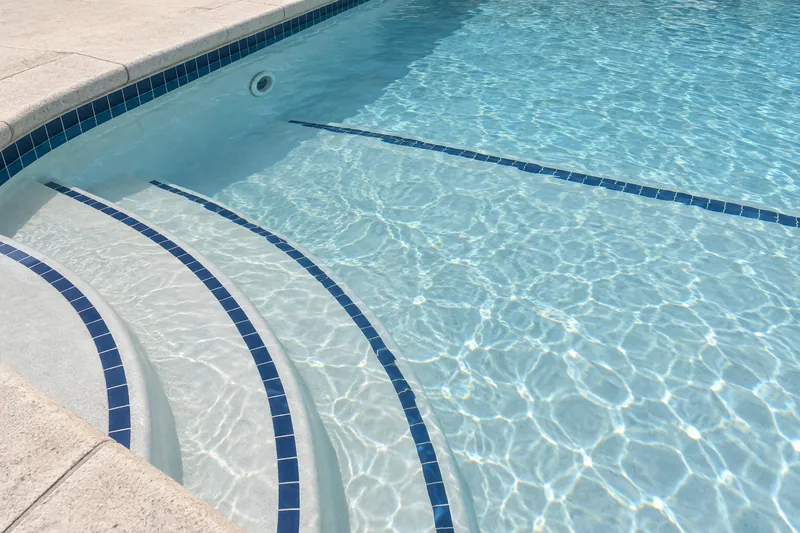
Pool depth marker questions
What are depth markers?
They are the permanent numbers on a pool's wall and deck that say how deep the water is right there, in feet and inches or as FT and IN. Texas requires them on public pools and spas; for a public spa, the International Swimming Pool and Spa Code asks for a minimum of two, set into the deck no more than 18 inches from the design waterline, slip resistant, with numbers 4 inches high or more.
How to mark pool depth?
Start with the deepest and shallowest spots and each place the floor changes slope. The International Swimming Pool and Spa Code puts public-pool markers at all of them, adds more so that no two marked depths differ by over 2 feet and no two markers stand over 25 feet apart, and wants each one right to within 3 inches. The CDC's Model Aquatic Health Code tightens that to every foot of depth in water under 5 feet and asks for markers on both sides and both ends of the pool. It spells the units out as feet and inches, accepts FT and IN, and rules out the ' and " symbols.
How do you tell the depth of a pool?
Read the markers. On a public pool the wall markers are placed to be read by a swimmer in the water and the deck markers by someone standing at the edge, at the deepest and shallowest points and wherever the slope changes. At a Class C pool deeper than 5 feet, the contrasting band across the floor shows where the shallow area ends and the deep area begins, and a rope and float line may sit 1 to 2 feet to its shallow side.
Do backyard pools need depth markers in Texas?
The state's marker rules don't reach them: they cover public pools, and a pool used by two resident families or fewer and their guests, as at a single-family home or duplex, counts as residential. League City's pool code is the 2021 International Swimming Pool and Spa Code, whose residential chapter asks instead for a rope and float assembly across a pool that has a slope break, 1 to 2 feet to the shallow side of the break.
How much do pool depth markers cost?
No published source gives an installed price for depth markers, in Texas or nationally. A 2026 catalog from one maker of depth-marker tiles prices a single ceramic deck marker, with a 4-inch font and an abrasive non-slip face, at $10.49 before installation. For pool tile in general, a 2025 national guide written for property managers gives $1 to $5 a square foot for porcelain tile, $3 to $10 for ceramic tile and as much as $25 for glass. None of these is an installed price or a price from League City Pool Resurfacing; the number for a given pool comes from seeing it.
Get a free estimate on pool depth markers
Tell League City Pool Resurfacing what kind of pool it is, its deepest and shallowest points and how many markers it has now. Calls and estimate requests are answered 24/7.