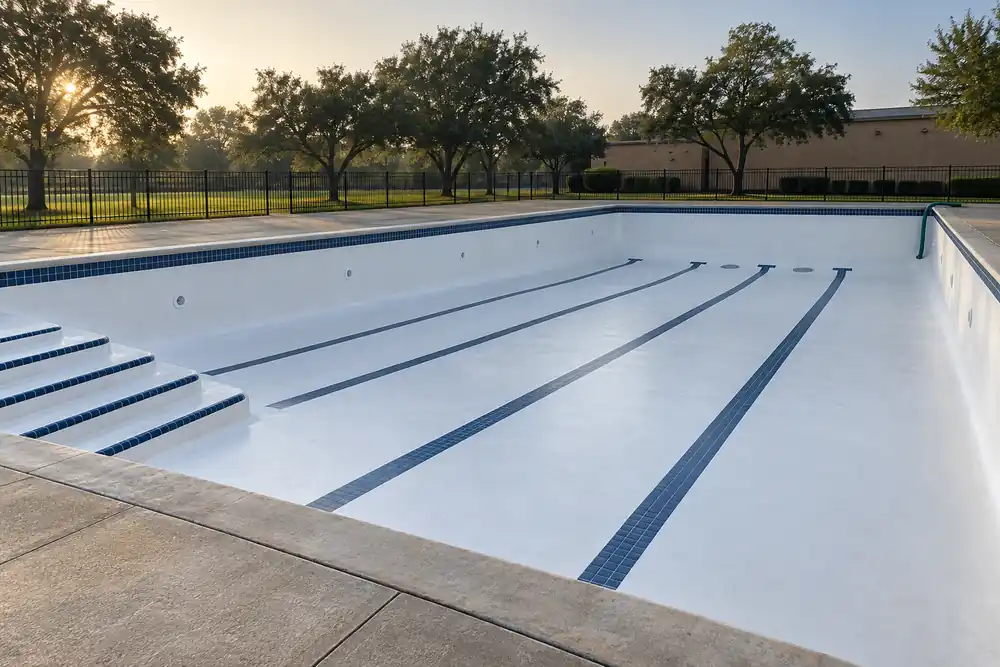
Travertine and Paver Pool Decks in League City, TX
League City Pool Resurfacing builds travertine and paver pool decks in League City, Texas: stone or concrete pavers set around the pool on a compacted base that falls toward drains, replacing a worn concrete deck or going down as a new one. League City's code adopts the International Swimming Pool and Spa Code, 2021 edition, and for travertine or brick-set pavers beside a home pool that code requires the deck to fall at least 1/8 inch per foot, unless some other drainage method prevents ponding.
A free estimate is a phone call or a form away. Useful details: roughly how big the deck is, what it is made of now, the stone or paver you have in mind, and whether the coping is being replaced as well.
Call or request a free estimate any time, 24/7
No charge · answered 24/7
Get free estimates
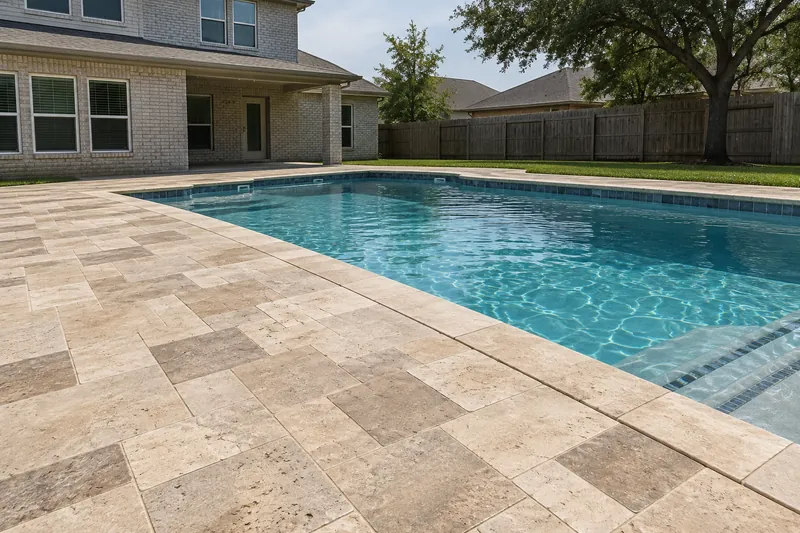
Travertine and paver pool deck materials
Travertine
The Natural Stone Institute groups travertine with limestone and marble as calcareous stones, made mainly of calcium carbonate and most at home indoors or outdoors where conditions are relatively controlled. Every true travertine has holes left by gases trapped as it formed; during fabrication those voids are either filled, usually with a cement or resin filler, or left open. No natural stone varies more than travertine, the Institute says, and that holds within one quarry; it tells buyers to always see a range of samples first and, on a multi-pallet order, to mix pieces from all the pallets.
Concrete pavers
The Interlocking Concrete Pavement Institute calls concrete pavers a desirable surface around residential and commercial pools because of their high slip resistance and rapid drainage. They are modular, laid over a bed of sand with sand in the joints and an edge restraint around them.
Other stone
Granite, sandstone, basalt, limestone, slate, travertine, marble and porphyry are all good options for paving in the Natural Stone Institute's list, and the harder siliceous kind, granite, quartzite and sandstone among them, generally holds up better against abrasion and chemicals than the calcareous stones, by its account. A deck that stays concrete can be coated instead, which is pool deck resurfacing.
Call or request a free estimate any time, 24/7.
(281) 694-4352Building a travertine or paver pool deck: setting, base and drains
Mortar-set or sand-set
The Natural Stone Institute describes three ways to set stone paving: in mortar where stability matters, on sand, which is common for outdoor paving, and on pedestals where drainage or access calls for it. Even a durable stone runs into trouble, it adds, when drainage, movement or the base underneath isn't properly handled.
The base under the pavers
From the ground up, the paver institute's usual section runs: compacted soil; a compacted stone base, or a stabilized one; bedding sand with a nominal depth of 1 inch; and the pavers, their joints filled with sand. An edge restraint holds the lot together, and the institute calls it essential to keeping the pavers interlocked. Next to a pool, if the backfill or the stone base won't compact properly, a concrete base at least 4 inches thick is typically used instead, the institute says. Finished pavers sit 1/8 to 1/4 inch above their edges to allow for minor settlement.
Drains and slope
Paver surfaces and the base under them slope toward stormwater drains, and those drains need holes or slots at the level of the bedding sand, covered with geotextile so the sand doesn't wash out. At public pools the code's minimum slope for travertine or brick-set pavers rises to 3/8 inch per foot.
Where the deck meets the coping
The last row of pavers stops at a sealed joint against the coping, so the pool wall and the paving can move separately. That joint and the coping itself are covered under pool coping replacement.
Call or request a free estimate any time, 24/7.
(281) 694-4352Travertine and paver pool decks on League City ground
Clay under the base
Kemah silt loam, found at Heritage Park, City Hall and Ralph Parr Elementary on the NRCS soil map, gets a 'very limited' rating for local roads and streets on two counts, shrink-swell and low strength. For most of the winter, the 1988 Galveston County soil survey says, Kemah's water table rises to within 1.5 feet of the surface. League City Pool Resurfacing will talk through the base for stone or pavers on that ground at the estimate.
Permits and HOA approval
League City's permit list includes new or replacement paving, patios among it, and from August 1, 2026 the City's fee for a driveway or flatwork permit is $150; Unilock's own installation guide tells installers to check local permits and HOA rules before starting. Associations add their own review. Brittany Lakes' guidelines say patios and decks must be permitted by League City and cap pool decking at 12 inches above natural grade, and South Shore Harbour asks for written approval from its Architectural Control Committee before any exterior change, a process it says can take up to thirty days.
Call or request a free estimate any time, 24/7.
(281) 694-4352Caring for a travertine or paver pool deck
Cleaning without acid
Calcium carbonate is sensitive to acid, so the Natural Stone Institute recommends mild, non-acidic cleaners for travertine, and around an outdoor pool it says to flush the stone with clear water and use a mild bleach solution on algae or moss. Its travertine handout warns that a hard spray nozzle or a stiff brush can strip filler and grout from the stone, and calls it acceptable and common to fill new voids in place as they show up.
White haze on new pavers
A whitish powder on new concrete pavers is efflorescence, which the paver institute explains as calcium carbonate formed when calcium hydroxide from the cement reaches the surface and meets carbon dioxide in the air. It doesn't affect the pavers' structural performance or durability, may appear at once or within months, and can peak as soon as 60 days after installation.
Sealing stone and pavers
Whether to seal, with what and when, including stone beside a salt-water pool, is covered under pool deck sealing.
Call or request a free estimate any time, 24/7.
(281) 694-4352Questions about travertine and paver pool decks
How much does a travertine pool deck cost?
Nationally in 2026, a dry-set deck of tumbled travertine pavers costs $14, $24 and $36 per square foot installed at the low, typical and high ends, base and sand included; base preparation by itself adds $3 to $8 a square foot, and more where the ground is clay or sloped. National 2026 figures for concrete pavers installed as a pool deck run $12 to $45 per square foot. A Houston builder won't put a per-foot price on replacing a deck with travertine or pavers until it has seen what is under the current one. These are published figures, not prices from League City Pool Resurfacing, which gives free estimates.
Is travertine good for a pool deck?
It is on the Natural Stone Institute's list of stones that make good paving, and its surface can be finished for slip resistance. The Institute's cautions: as a calcareous stone it does best where outdoor conditions are relatively controlled; where summers are hot, the stone's expansion in the heat and long hours of sun can affect both its color and its movement joints; and it may need sealing, depending on the stone, where it sits and the conditions. The normal high at NOAA's League City station is 91.4°F across June, July and August.
Is a travertine pool deck slippery?
It depends on the finish. Slip resistance comes from a stone's texture and porosity, any surface treatment, and what it meets, water and dust included, the Natural Stone Institute says. League City's adopted pool code makes slip resistance a requirement for decks and coping, but sets no test value in the sections read for this site. Another code does: the Tile Council of North America noted that the Uniform Swimming Pool, Spa & Hot Tub Code, in its 2021 edition, was the first to put a measurable slip rule around pools, a wet DCOF (dynamic coefficient of friction) no lower than 0.42 on level walkways meant to be walked on wet. League City's code adopts the International code, and no League City adoption of the Uniform code turned up, so that number is a reference rather than a local rule.
Can I lay pavers directly on dirt?
Not by the makers' methods. Unilock's paver patio guide marks out and excavates the area, compacts any loose subsoil, places the gravel base in 3-inch layers compacted with at least 3 passes each, screeds the bedding course and keeps off it afterward, then lays and cuts the pavers, restrains the edges, compacts the pavers with 3 passes and sweeps in jointing sand. Around a pool the paver institute's concrete base, described above, applies where the backfill won't compact.
Is it better to have pavers or concrete around a pool?
No source used here names one as better overall. The paver institute credits concrete pavers with high slip resistance and fast drainage around pools, calls them a desirable surface there, and points out that because they are modular, a settled patch can be lifted and the same pavers laid again. On price, a plain concrete pool deck runs $6 to $18-plus per square foot nationally in 2026, against the $12 to $45 for concrete pavers above, so concrete starts lower. A concrete deck can also be coated later rather than replaced.
Book a free travertine or paver pool deck estimate
Tell League City Pool Resurfacing roughly how big the deck is, what is on it now and which stone or paver you are considering. Calls and estimate requests are answered 24/7.