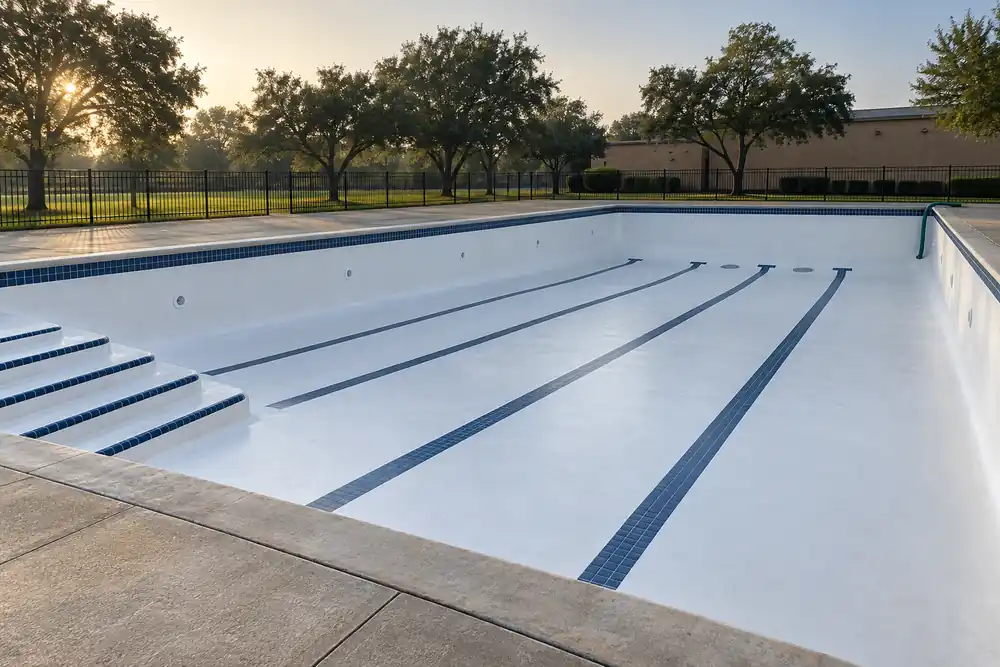
Pool Deck Sealing in League City, TX
League City Pool Resurfacing does pool deck sealing in League City, Texas: penetrating repellents or film-forming sealers for travertine, concrete pavers and concrete decks around the pool, matched to the surface and put down in the weather its maker allows. Silane and siloxane sealers help limit chlorine damage around pool decks, according to the Interlocking Concrete Pavement Institute.
For a free estimate, phone or fill in the form; it helps to know what the deck is made of, whether it has been sealed before and with what, and whether the pool runs on salt.
Call or request a free estimate any time, 24/7
No charge · answered 24/7
Get free estimates
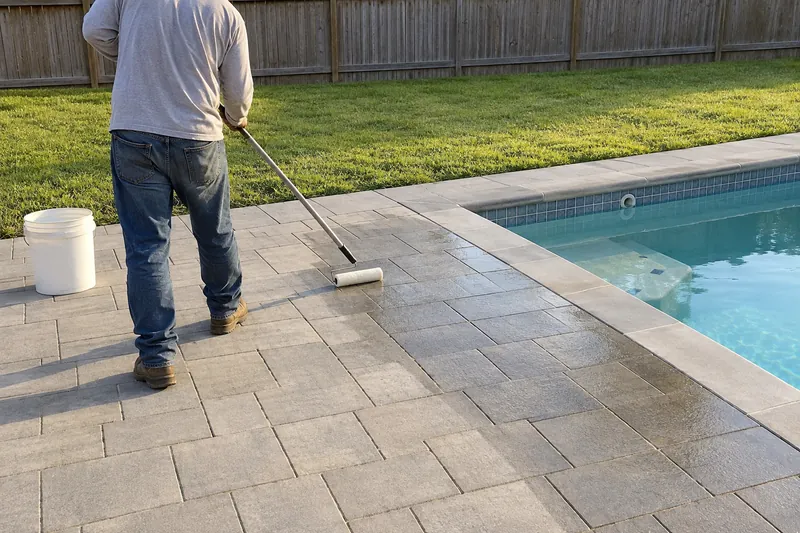
Pool deck sealers: penetrating and film-forming
Penetrating sealers
The sealing products used on stone are really impregnators, the Natural Stone Institute points out: they act as a repellent rather than a seal, and they make stone more stain resistant, not stain proof. For concrete pavers the paver institute describes silanes and siloxanes as soaking in and forming a barrier that keeps moisture out while still letting the concrete breathe, and says that by cutting the intrusion of chlorides they help pavers exposed to de-icing salts or salt air. W. R. Meadows calls its own penetrating stone sealer, DECK-O-SHIELD PLUS, a water repellent, not waterproofing.
Film-forming sealers
Film formers sit on the surface. The paver institute lists acrylics, solvent or water based, which bring out paver color and can add a gloss, and urethanes, which give a high gloss and resist chemicals better than acrylics, though aromatic urethanes need a UV inhibitor to slow yellowing. DECK-O-GRIP, W. R. Meadows' transparent acrylic cure-and-seal for exterior concrete and tile around pools, colored concrete and exposed aggregate included, leaves a protective film that the maker says stands up better to most of today's pool chemicals.
Sealers to leave off pavers
The institute doesn't recommend alkyds, esters or polyvinyl acetates on pavers, says epoxies and silicones are generally not used on them, and tells installers to consult the sealer's maker before using any product.
Coating systems carry their own sealers
The water repellent made for Kool Deck and the acrylic sealer that colors a sprayed knockdown texture belong to those systems, covered under spray deck and cool deck coatings.
Call or request a free estimate any time, 24/7.
(281) 694-4352Sealing travertine, pavers and concrete pool decks
Travertine and other natural stone
Many stones don't need sealing at all, the Natural Stone Institute says, though applying an impregnating sealer is common practice. Beside salt-water pools, makers offer penetrating products for stone: W. R. Meadows aims DECK-O-SHIELD PLUS at pool copings and decks, against salt penetration, spalling and pitting, salt staining and whitening, and STAIN-PROOF says its 40SK impregnating sealer is popular for sandstone, limestone, travertine and concrete pavers around salt-water pools. Hayward's AquaRite manual asks for a qualified stone installation specialist's advice on the stone, any sealant and its upkeep before its salt chlorine generator goes in next to stone decking. The stone itself is covered under travertine and paver pool decks.
Concrete pavers
Unilock holds off sealing until any efflorescence, the white powder new pavers can show, has completely gone, typically 2 to 3 months and sometimes up to a year, and the paver institute treats removing it as an essential part of preparing pavers for sealing. The American Shotcrete Association, discussing pool structures, says paint, sealer or any coating that can't breathe should stay off a surface with efflorescence on it: the moisture and salt caught underneath can make that coating spall or come loose, often taking the surface of the concrete along. Cleaned pavers are left to dry, a few hours in warm sun or about 24 hours in cool shade.
Concrete decks
On concrete, W. R. Meadows wants DECK-O-GRIP on a clean, dry surface with stains, oil, grease, dirt and any pool deck paint removed, and a deck that has been acid-stained or acid-washed neutralized to a pH of seven first. A Houston builder lists a pressure wash and reseal as its first and least costly deck option, for a deck that is structurally fine and only dingy; cracks, a worn coating or a failed overlay are pool deck resurfacing work. League City Pool Resurfacing will talk through which sealer suits the deck at the estimate.
Call or request a free estimate any time, 24/7.
(281) 694-4352Pool deck sealing in League City weather
Temperature and sun
Each maker sets its own window. Unilock seals between 50 and 90 degrees Fahrenheit, 75 being ideal, and warns that pavers sealed too hot can stain and start to peel early. W. R. Meadows keeps DECK-O-SHIELD PLUS between 40°F and 95°F, surface and air, during application and for eight hours after, and on hot, windy days applies it early and in shade; DECK-O-GRIP isn't applied on concrete below 40°F or in high heat and direct sun, where fast evaporation can make the film peel, bubble or turn white. At NOAA's League City station the normal January high is 63.8°F and the low 45.7°F, while summer nights stay warm, with normal lows of 76.0°F in July and 75.9°F in August.
Rain, dew and sprinklers
Unilock wants clear skies for 24 to 48 hours before sealing and allows up to 48 hours of dry weather for the sealer to cure, with automatic sprinklers shut off. DECK-O-SHIELD PLUS needs six hours without rain, and many surfaces take several days to reach full water repellency; cool weather or high humidity lengthens DECK-O-GRIP's drying time. Rain of an inch or more falls on 18.8 days in a normal year at NOAA's League City station.
Traffic after sealing
The paver institute keeps all traffic off a sealed paver deck until the sealer is completely dry, typically 24 hours. W. R. Meadows asks for at least four hours before foot traffic on DECK-O-GRIP, twelve preferred.
Call or request a free estimate any time, 24/7.
(281) 694-4352Questions about pool deck sealing
How much does it cost to reseal a pool deck?
Typical Houston-area prices in 2026 start a pressure wash around $350 and put sealing at $1 to $3 per square foot, depending on the material. National figures for 2025 run concrete sealing at $1 to $3 or more per square foot. No source priced sealing travertine or pavers on its own in the Houston area. These are published figures, not prices from League City Pool Resurfacing, and an estimate is free.
How to reseal a pool deck?
Start by finding out what is on it now. Unilock says to test the old and new sealers for compatibility before resealing, and STAIN-PROOF says a previously sealed surface has to be ground before its penetrating 40SK goes on, and that a penetrating sealer should never go over a topical coating sealer. The deck is then cleaned and dried and sealed within its maker's temperature and weather window; with a water-based paver sealer that needs two coats, the second goes on while the first is still very tacky.
How often should a pool deck be resealed?
For pavers, Unilock says that owners who choose to seal its concrete pavers are typically advised to reseal every three to five years. Mortex rates the water repellent it makes for Kool Deck at 5 to 10 years of repellency. Neither the Natural Stone Institute nor W. R. Meadows gives an interval for stone or concrete deck sealers, so no figure is offered here for those.
Does sealing make a pool deck slippery?
It can. The paver institute warns against applying so much sealer that the surface turns slippery once it cures, and Unilock says high-gloss sealers may raise slipperiness, especially when wet, calling matte sealers the safer choice. Some sealers include grit. DECK-O-GRIP's slip-resistant additive is rated by W. R. Meadows at a static coefficient of friction of at least .60 wet under ASTM C 1028.
Do concrete pavers need to be sealed?
Not for upkeep, by Unilock's account: its pavers are designed not to need regular sealing, and sealing them is more about looks than maintenance. Next to a pool, the paver institute recommends sealing the pavers and their joints to keep the joint sand in place. Unilock adds that a sealer for concrete pavers should be breathable, so moisture can escape.
Book a free pool deck sealing estimate in League City
Tell League City Pool Resurfacing what the deck is made of, roughly how big it is and what, if anything, it was last sealed with. Calls and estimate requests are answered 24/7.