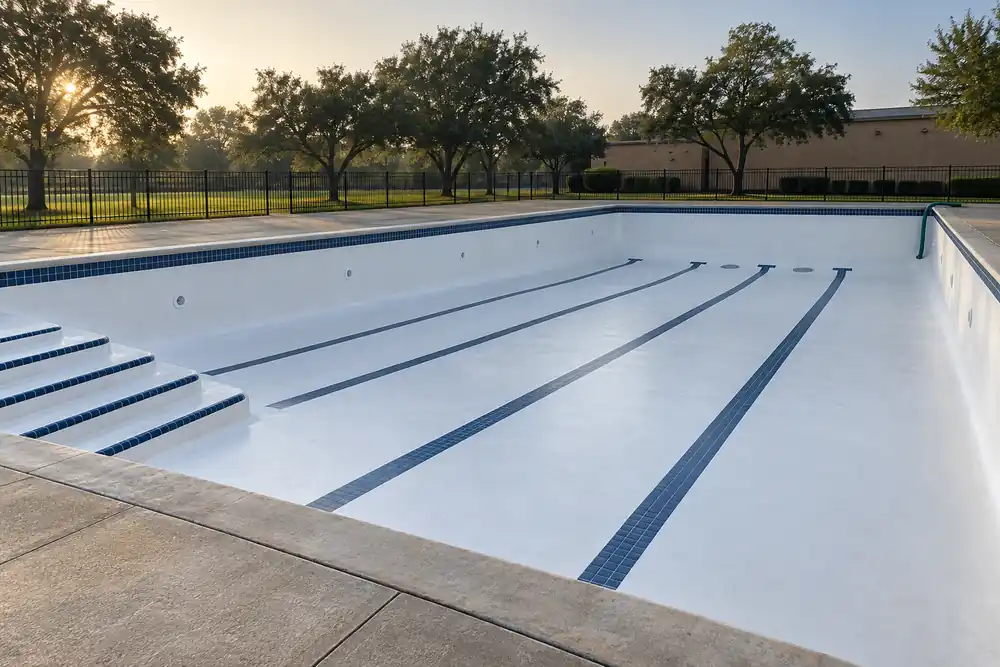
Residential and Commercial Pool Resurfacing in Texas City, Texas
League City Pool Resurfacing handles residential and commercial pool resurfacing in Texas City, Texas, from the backyard pool of a single-family house to the shared pool of an apartment complex or club, in the deepwater port city on the southwestern shore of Galveston Bay, seven miles from Galveston and eleven from the Gulf of Mexico.
The City made Moses Lake and the Texas City Dike, which reaches out into the bay, into recreation areas, and its 55-acre Nessler Civic Center, built in 1954, holds the largest park in town along with the library, city hall, the stadium and the Lowry Physical Fitness Center. College of the Mainland opened in September 1967. For a single backyard pool or the shared pool of a whole complex, call or send the form; the estimate costs nothing.
Call or request a free estimate any time, 24/7
No charge · answered 24/7
Get free estimates
Residential pool resurfacing in a growing city
The Census Bureau estimates 59,733 people in Texas City on July 1, 2025, up 7,866, or 15.2%, from its April 2020 estimates base of 51,867. The housing covers every era. Its 2020–2024 survey dates about 10,509 of 23,618 housing units (44.5%) to before 1980 and about 6,531 (27.7%) to before 1970, while about 7,934 (33.6%) were built in 2000 or later, about 3,383 of those in the 2010s. Half the homes are older than 1984, the median year built (margin, two years).
About 16,201 units (68.6%) are detached single-family houses. Owners live in 12,348 of the 21,845 occupied homes, 56.5%, and the median value of the homes their owners live in is $217,300. In the 2020 Census count there were 21,493 housing units in the city. With that spread, a resurfacing estimate starts with the pool, its finish, tile and shell, not the year the house went up.
Call or request a free estimate any time, 24/7.
(281) 694-4352Commercial pool resurfacing for shared and public pools
A quarter of Texas City's housing units, 25.2%, are in buildings of five or more units: about 3,041 in buildings of 5 to 19 units and about 2,906 in buildings of 20 or more. The shared pools at complexes like these, and at hotels, clubs and homeowners associations, fall under the Galveston County Health District, whose pool order counts Texas City among the 14 local governments it serves; pools at single-family homes sit outside that program apart from its fence rule.
State law lets a county or a city require a permit to operate a public swimming pool, inspect it, charge a reasonable fee and close it by order when it breaks the state pool law or the local permit rules. The Texas Department of State Health Services describes public pool safety as shared work among its Environmental Health Program, local health departments, local code enforcement offices and other governments, and its rules for public pools and spas were last made effective April 26, 2024.
Planning a larger public pool renovation
For public pools, the CDC's Model Aquatic Health Code, a national model code rather than a Texas rule, calls work a "substantial alteration" when its total cost is more than half the pool's replacement cost, and says no one should begin such work until the construction plans have been submitted to and approved by the authority having jurisdiction. On a big renovation of a shared Texas City pool, ask the Health District and the City which approvals the job needs before the pool closes. The City runs a public pool of its own, the Nessler Family Aquatics Center on 5th Avenue North; its 2026 season opened on weekends from May 2, ran Tuesday through Sunday from May 25 to August 7, and ended on Labor Day, September 7.
Call or request a free estimate any time, 24/7.
(281) 694-4352Pool resurfacing permits under the City's 2021 pool code
Effective November 16, 2023, the City of Texas City Commission put the 2021 International Swimming Pool and Spa Code into force alongside the 2021 editions of the building, residential, mechanical, plumbing, property maintenance and existing building codes, plus the 2023 National Electrical Code and the 2024 International Fire Code. The Building Inspections Department warns that permit applications are denied when building plans aren't stamped or don't reference the correct code by name and date, and building permits are applied for through the City's online portal. The adopted-codes notice is silent on whether resurfacing an existing pool calls for a permit, so that question goes to Building Inspections before the work is scheduled.
Fence rules while a pool is out of service
Asked about pool regulations on its own question-and-answer page, the City's Neighborhood Improvement Services gives a general rule: pools "must be in an enclosed fenced area at least 4 feet tall with no gaps of greater than 4 inches including between the ground and bottom of the fence." The Health District's order adds a backyard fence rule of its own, and the binding barrier requirements are the ones in the adopted 2021 pool code, so the enclosure and its gates stay shut and working while the pool sits empty.
Call or request a free estimate any time, 24/7.
(281) 694-4352Resurfacing a pool on storm-surge ground
The USDA's soil map shows Ijam loam, 2 to 8 percent slopes, at Texas City's Census center point, a map unit whose very name reads "rarely flooded, storm surge". It's poorly drained, in the slowest-draining hydrologic group, and the soil database puts its water table right at the surface at the shallowest point of the year. Ijam swells little in its top layer, with a linear extensibility of 1.9 percent, but up to 7.4 percent in layers within 5 feet, in the high class. For house foundations it carries the USDA's very limited rating, citing flooding and the saturated zone, and the same rating for shallow excavation, since trench walls there are unstable. This is a single mapped point, and other streets lie on other soils.
Water has shaped the city. Hurricane Carla brought four feet of floodwater over much of Texas City in 1961, the Handbook of Texas records; building began on a 23-foot seawall in 1962, with the last section finished in 1985, and in 1982 the city put up an eight-foot inner levee on Moses Lake with Archimedes screw pumps. Because subsidence was also causing floods, Texas City stopped pumping groundwater and turned to Brazos River water for its industries. On ground where the water table can reach the surface, the groundwater check comes before any water is pumped out of a pool.
Call or request a free estimate any time, 24/7.
(281) 694-4352Scheduling a pool resurfacing around bay weather
NOAA's closest station with official normals is Galveston Scholes Field, about 11.3 miles south of Texas City's Census center point. Over 1991–2020, 65.5 days a year reached 90°F there and 0.2 reached 100°F, the normal June-to-August high was 90.9°F, just 1.7 nights a year fell to freezing or lower, and 47.22 inches of rain fell. The first freeze typically comes by January 7 and the last by January 18, each in half of all years.
Drying time is part of why the plaster day is matched to the forecast. Sider-Crete's Sider-Pool plaster, by its own specification, needs 24 to 48 hours of drying, depending on temperature and humidity, before optional sanding, and at least 24 hours of drying before the pool is filled, where traditional plasters go under water as soon as possible.
Call or request a free estimate any time, 24/7.
(281) 694-4352Shoal Point, the Myers brothers and the 1947 disaster
In 1891 three brothers from Duluth, Minnesota, Jacob R., Henry and Benjamin F. Myers, were on a duck-hunting trip to the Shoal Point marshes on Galveston Bay when they saw the place's promise as a major port, the Handbook of Texas says; Duluth shippers bought 10,000 acres of bay frontage and renamed it Texas City. The Texas City Improvement Company filed the first townsite plat on May 17, 1893, and the city incorporated on September 16, 1911. On April 16, 1947, the French ship Grandecamp, loaded with ammonium nitrate fertilizer, blew up in the harbor and set off fires and a second ship explosion; the disaster killed 576 people and injured more than 4,000. The city rebuilt, and its population, 32,065 by 1960, had nearly doubled in a decade.
Call or request a free estimate any time, 24/7.
(281) 694-4352Resurfacing finishes, tile and decks for homes and shared pools
Alongside the new surface, white or colored plaster, quartz or pebble, owners often renew the waterline tile and coping, fix cracks, acid-wash the shell or resurface the deck, and a shared pool may also be due for new depth markers. National figures for 2026 put pool resurfacing at $6,000 to $15,000 on average, with most homeowners paying around $11,000 for a standard 1,000-square-foot pool and a per-square-foot benchmark of $6.55 to $7.81 as of May 2026. Those are national averages, not a price from League City Pool Resurfacing, and the estimate for your pool costs nothing.
On either side of Texas City we also handle swimming pool resurfacing in San Leon and pool replastering and plaster repair in La Marque.
Call or request a free estimate any time, 24/7.
(281) 694-4352How residential and commercial pool resurfacing runs
The usual order of work against Texas City's rules; the estimate covers the details of the pool in front of us.
Backyard or shared pool
We'll ask whether the pool serves one household or a complex, club or hotel, and look over its finish, tile and shell.
Building Inspections and the Health District
Building Inspections settles whether the job needs a permit under the 2021 pool code, and a shared pool's Health District permit stays in view.
Groundwater and the forecast
On ground with a high water table, the groundwater check and the weather come before the drain.
Surface preparation
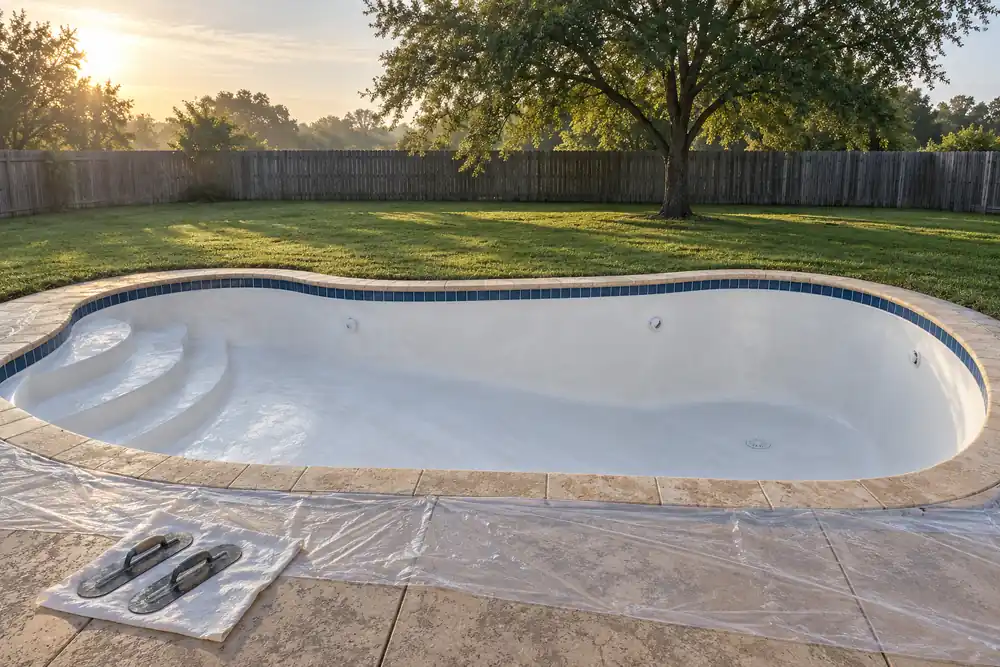
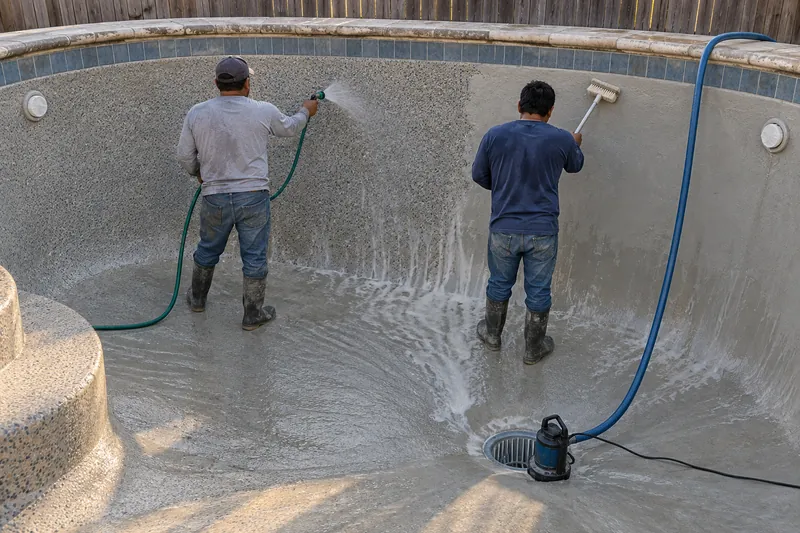
Once the pool is empty, loose finish comes off and the shell is readied for the new coat.
The new finish
Plaster, quartz or pebble goes on, and it gets the drying or cure time its maker specifies before the fill.
Water back in
Refilling starts once the finish is ready for it, with the fill tested first and the chemistry kept in range through start-up.
Call or request a free estimate any time, 24/7.
(281) 694-4352Questions about resurfacing a Texas City pool
Does Texas City's water change disinfectant during the year?
For one month, according to the City's 2025 water report. Texas City's supply is purchased surface water, with the Gulf Coast Water Authority as its source, and the report lists chloramines averaging 2.18 mg/L across 2025, in a range of 1.05 to 3.63, but the report also carries a free chlorine line for April only, labeled as the authority's "Annual GCWA Chlorine Free Burn", averaging 2.29 mg/L in a range of 1.48 to 3.64. The report prints no hardness figure, so the fill water for a new finish is tested on its own, whatever the month.
Free residential and commercial pool resurfacing estimates in Texas City
Tell League City Pool Resurfacing whether it is a backyard pool or a shared one and how the finish looks today. Calls and form requests are answered 24/7.