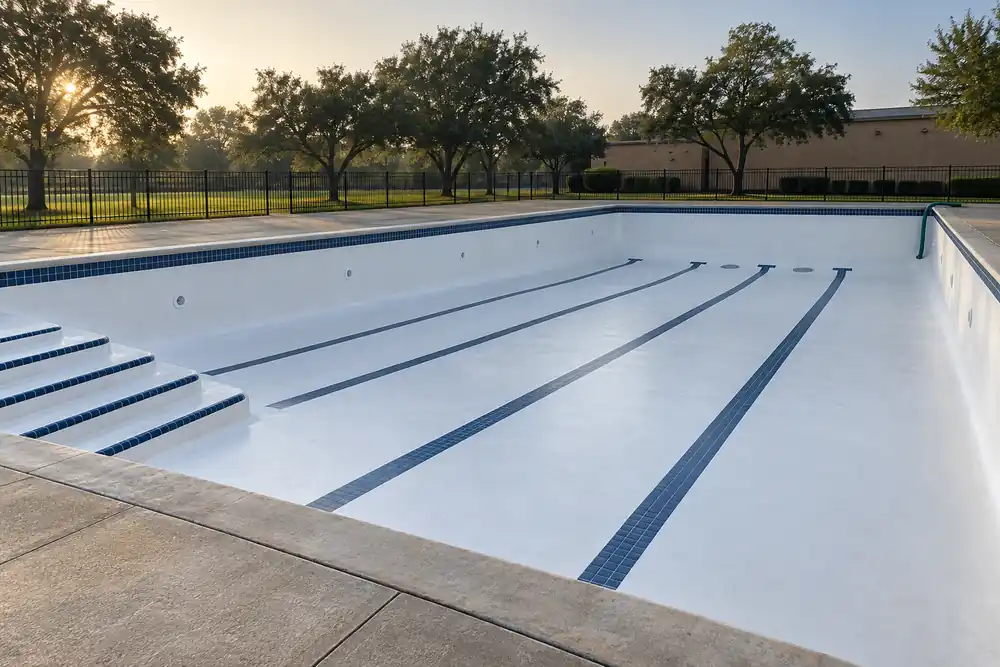
Spa and Hot Tub Resurfacing in League City, TX
League City Pool Resurfacing does spa resurfacing in League City, Texas: a new plaster, quartz, pebble or tile surface for a built-in concrete spa or hot tub, whether it stands on its own or spills over into the pool. Under the International Swimming Pool and Spa Code, plastering a permanently installed concrete spa follows the same APSP/NPC/ICC-12 standard as plastering a pool, and the National Plasterers Council calls white plaster the tried and true pool and spa surface finish.
Book a free estimate by phone or through the form; we'll talk through the finish, whether the spa is done with the pool, and when the heater can go back on.
Call or request a free estimate any time, 24/7
No charge · answered 24/7
Get free estimates
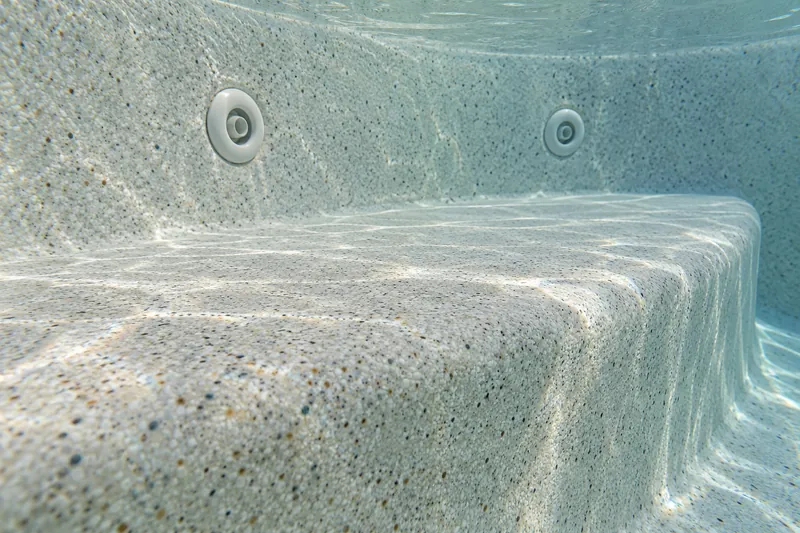
Spa resurfacing finishes: plaster, quartz, pebble and tile
Cement finishes in a spa
A spa takes the same cement finishes as a pool. SGM brought its quartz Diamond Brite to the swimming pool and spa industry in the early 1990s, Pebble Technology International makes its exposed-aggregate PebbleTec for spas and water features as well as pools and calls the surface durable, non-slip and stain-resistant, and CL Industries says its polished marble line, silky smooth yet non-slip, is popular for spas. Whatever the finish, the code wants a watertight structure with a smooth, easily cleaned surface and nothing that cuts, pinches, punctures or abrades the people sitting on it. White and colored plaster are covered in more depth under pool replastering.
Tile on spa walls and spillways
Tile goes in spas too. Lightstreams, a glass tile maker, asks to be consulted before any all-tile spa is ordered and says no submerged or partly submerged tile goes in without a waterproof membrane system; its TCNA joint layout allows at most 8 feet between movement joints on spa overflows.
Call or request a free estimate any time, 24/7.
(281) 694-4352Spa finish wear: hot water, jets and spillways
Hot water and scale
Pool and spa finishes sit underwater all the time in water treated with powerful chemicals, the National Plasterers Council points out, where surface and water minerals react with each other constantly. Temperature is one input to the saturation index used to balance water for plaster: the factor in the Council's calculator climbs with the heat, reading 0.6 at 76°F and 0.9 at 105°F, with 0.7 and 0.8 at 84°F and 94°F, and a positive index leans toward scaling. The code caps the makeup water entering a spa at 104°F, close to the top of that table. Scale that builds along a spa's tile line is covered under pool tile cleaning and calcium removal.
Heaters, jets and spillways
Universal White Cement, a cement maker, says heaters, spillways and salt systems create zones of higher stress on plaster, and that poor circulation or chemicals added in one spot can shorten its life in those areas. A spa's curved benches, jets and tight corners also take more labor per square foot than an open pool wall, a national 2026 price comparison notes, because a trowel can't swing the same way inside a narrow spa shell. League City Pool Resurfacing will look at the spillway and the jets at the estimate.
Call or request a free estimate any time, 24/7.
(281) 694-4352How a spa is resurfaced, alone or with the pool
Suction fittings and covers
The code wants every spa suction fitting listed and labeled under APSP 16 and put in to its maker's specifications, and it says a spa is not to run while any suction outlet cover is missing, damaged, broken or loose. The federal Virginia Graeme Baker Act requires anti-entrapment drain covers at public spas, and the Consumer Product Safety Commission calls them highly recommended at home.
Filling the spa and the pool
NPT, the maker of StoneScapes finishes, says a spa should not be allowed to flow into the pool while a new finish is being filled. Where a pool has no spa yet, spa additions covers building one onto the existing pool.
Call or request a free estimate any time, 24/7.
(281) 694-4352Spa resurfacing rules in League City: permits and drought stages
Hot tubs and spas deeper than 24 inches sit on League City's list of work needing a permit, and the City's code applies the 2021 International Swimming Pool and Spa Code to building, altering, renovating and repairing pools and spas. Whether resurfacing an existing spa needs a permit isn't stated on that list, so the City's Building Department is the place to ask first. The City's drought plan counts hot tubs in its definition of a swimming pool and, from Stage 2, may bar filling, draining and refilling Jacuzzis and hot tubs except to keep the structure sound, for operation and maintenance, or for public safety. No official page read for this site on October 4, 2026 showed a stage in force; check again before the spa is emptied. We'll go over these steps with you at a free estimate.
Call or request a free estimate any time, 24/7.
(281) 694-4352Spa and hot tub resurfacing questions
Can a hot tub be repainted?
The paint makers disagree. Insl-x by Benjamin Moore doesn't recommend painting spas and hot tubs because of their sustained high temperatures, while Ramuc lists spas among the surfaces for its EP Hi Build epoxy and calls epoxy the preferred coating for indoor pools, spas and whirlpools. For a built-in concrete spa, a cement finish such as plaster, quartz or pebble is the other route.
How much does it cost to resurface a spa?
No Texas source prices a spa on its own. Nationally in 2026, replastering an attached spa runs $15 to $25 a square foot while the main pool runs $8 to $18, the gap coming from the labor a curved basin takes. With 40 to 80 square feet of shell in a typical attached spa, $20 a square foot means $800 to $1,600 on top of the pool. These are published figures, not prices from League City Pool Resurfacing, and a free estimate prices your own spa.
When can the heater be used after a spa is resurfaced?
The sources differ, so follow the finish maker's figure. The National Plasterers Council's white paper says not to turn the heater on for 28 days, and its start-up card says not until the water is chemically balanced and no plaster dust remains. The Pool & Hot Tub Alliance says to read the maker's recommendation, normally 2 to 4 weeks, and NPT says once all plaster dust is out, typically between day 4 and day 10.
How often should a spa be drained?
The Pool & Hot Tub Alliance uses total dissolved solids as the trigger: a spa is drained completely once its TDS runs 1,500 ppm or more above the source water's, or once its calculated water replacement interval has passed, since high TDS can stain or etch the surface. It recommends monthly TDS tests for residential spas. League City's 2025 water report lists 240 mg/L of dissolved solids for water from the City of Houston's Southeast plant and no figure for the City's other supply, so test the spa's own fill water for the starting number.
Should a spa be resurfaced at the same time as the pool?
It can be, and published prices treat it that way. A Houston builder counts a raised spa with a spillover among the things that move a resurfacing price, since it is, in that builder's words, basically a second small pool that adds surface, detail work and tile. No maker or industry body read for this site says how fast a spa finish wears compared with a pool's, so both surfaces are looked at during the estimate.
Book a free spa and hot tub resurfacing estimate
Tell League City Pool Resurfacing whether the spa is attached to the pool or stands alone, what finish it has now and the finish you have in mind. Calls and estimate requests are answered 24/7.