New Pool Plaster Start-Up and Care in League City, TX
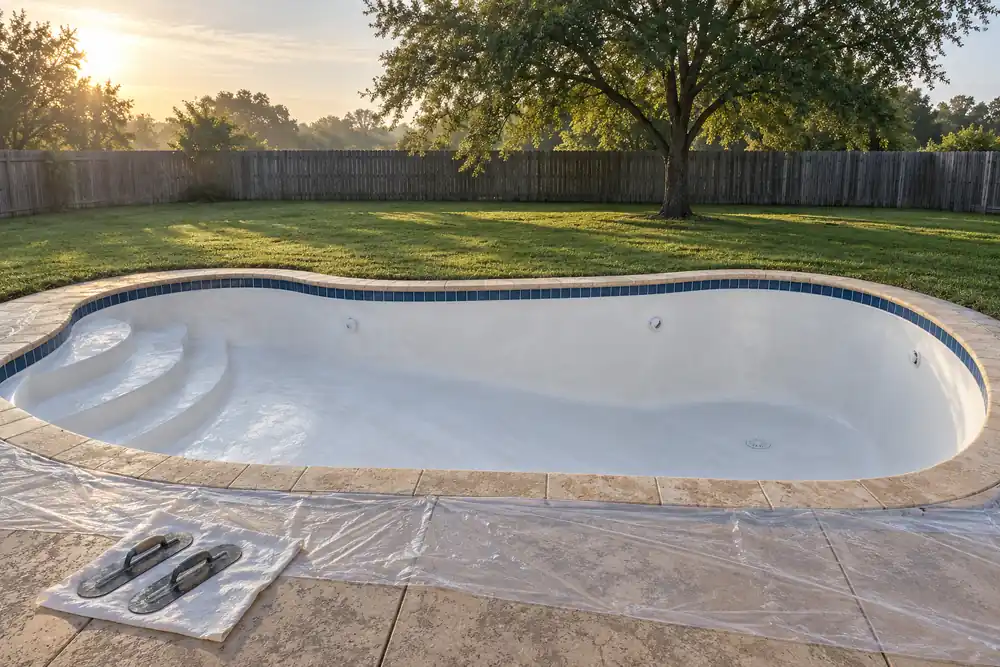
League City Pool Resurfacing sets out the pool plaster startup for League City, Texas, from the first hose in the deep end to day 28, the stretch in which the National Plasterers Council calls a new finish particularly prone to staining, scaling and discoloration, with the water tested and adjusted daily and the pool brushed often.
It follows the Council's start-up card, revised 03-2021, which applies after pool replastering and which the Pool & Hot Tub Alliance applies to marble, quartz, pebble and glass-bead finishes alike. On a branded finish the maker's own start-up comes first, the Council says, so treat what follows as general industry practice rather than the instructions for your particular finish.
Call or request a free estimate any time, 24/7
League City fill water before a plaster startup
The City's 2025 water report prints minerals for a single entry point, the one fed by the City of Houston's Southeast Water Purification Plant: total hardness 124 mg/L (as calcium carbonate), pH 8.1, total dissolved solids 240 mg/L, chloride 30 mg/L and sulfate 48 mg/L. It prints no matching figures for the Brazos River water from the Gulf Coast Water Authority's plant, the City's other surface supply, and none for alkalinity or for calcium hardness on its own.
Set against the card, a pH of 8.1 sits above the 7.2 to 7.6 that Day 1 works toward, and the Council wants fill water carrying more than 200 ppm of calcium hardness (more than 150 ppm for some high-performance finishes). It calls testing the fill water no longer an option: low pH, calcium or alkalinity can etch a new finish, high levels can scale it, and dissolved metals, usually copper, iron and sometimes manganese, can stain it.
When the fill water runs soft
Where only soft water is available, the Council's options are to bypass the softener or reverse-osmosis unit, bring in hydrant or trucked water, dose calcium chloride during the fill, or seal the surface with a polymeric densifier and balance the water as soon as the pool is full. Soft water carries a further risk, it explains: it can pull more than the normal excess of calcium hydroxide out of new plaster and weaken the surface.
Call or request a free estimate any time, 24/7.
(281) 694-4352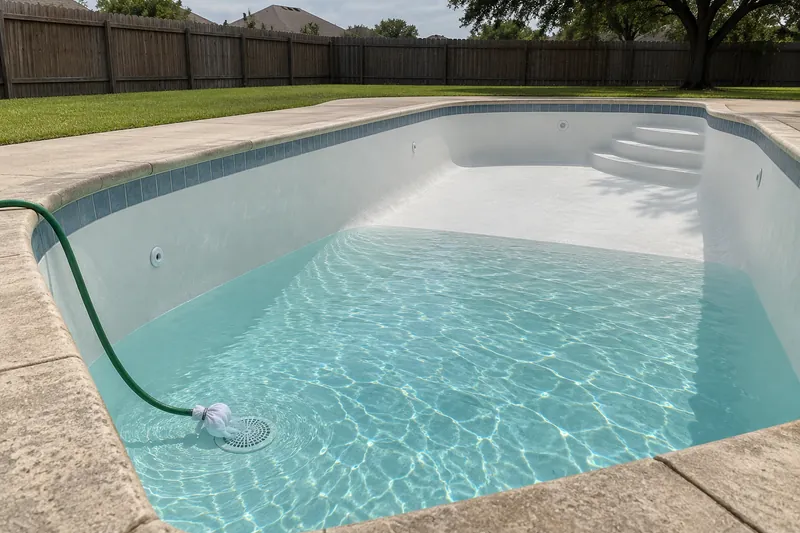
The 28-day startup card, day by day
The card asks for its steps in the order given and allows changes for unusual fill water, such as water extremely high or low in calcium hardness, pH or alkalinity. Its rule for every addition is chemical into water, never water into chemical.
Fill day
Filtration should already work before the finish goes on. A hose with a clean cloth tied over its end lies at the deepest point and runs without a break to mid-skimmer, with no other water reaching the surface and nobody in the pool. The fill water is tested for pH, alkalinity, calcium hardness and metals, and filtration starts the moment the pool is full. The Pool & Hot Tub Alliance adds the option, which varies by region, of taking out floor return heads and directional eyeballs first.
Day 1: alkalinity, then pH and calcium
Alkalinity is set first: muriatic acid, pre-diluted in a 5-gallon bucket of water, brings a high reading down to 80–100 ppm, while sodium bicarbonate lifts a low one to 80 ppm. With alkalinity in range, pH is adjusted to 7.2–7.6. Calcium hardness that tests low goes to 80–100 ppm with calcium chloride, dissolved beforehand and added 10 lb at a time with several hours between doses, and never alongside bicarbonate. The pumps stay on, every surface is brushed twice a day or more, and chlorine waits 48 hours.
Day 2: the second calcium step
With alkalinity and pH holding in their Day 1 ranges, calcium hardness is brought to 100–150 ppm, in the same dissolved 10-lb doses spaced hours apart.
Day 3: chlorine
Chlorine, pre-diluted or liquid, goes in to reach 1.5–3.0 ppm. In a salt-water pool the salt itself waits out the first 30 days.
Day 4 onward: calcium and stabilizer
The last calcium step is a slow climb to 200 ppm or more. Stabilizer (cyanuric acid) follows through the skimmer, split across at least three days on the way to 30–50 ppm, with the pool brushed after each dose so concentrated stabilizer can't discolor a pigmented finish. Once the water is balanced, in-floor heads and eyeballs are refitted.
Day 7: the last of the plaster dust
A brush pool vacuum picks up whatever dust remains. The card makes seven days of nonstop filtration mandatory, or filtration until the dust has been brushed and filtered out and the water is clear, and never less than 72 hours.
Days 7 to 28: daily testing
From day 7, a pool with a working cleaning system needs brushing only to clear visible debris or to mix in chemicals; the testing and adjusting go on every day until day 28.
The Council's handling advice holds throughout: pre-dilute, add with the pumps running in the deep end away from benches, steps and suction lines, brush the spot afterward, and never let a chemical feeder release chemicals strong enough to damage or discolor the finish.
Call or request a free estimate any time, 24/7.
(281) 694-4352Plaster dust and brushing in the first week
The haze in a newly filled pool is plaster dust: calcium hydroxide that new plaster sheds underwater as its cement hydrates. The Council calls losing the excess normal and harmless, and says the haze usually takes 7 to 10 days to clear after the fill.
The brushing is a race against the clock. In the Council's owner summary, plaster dust has to be brushed and filtered out within the first seven days or it can stick to the surface and become very difficult and expensive to remove; its technical bulletin sets the window at 3 to 5 days. Colored plaster runs its greatest risk of pigment masking, white calcium deposits that cover the color, in the first 3 days after the fill, the Council says. NPT, the maker of StoneScapes, brushes from the top of the walls down, starting at the shallow end and finishing at the deep end, at least twice a day.
Why the card runs 28 days
About 70 percent of a cement finish's hydration happens in its first 7 days and about 85 percent by day 28, the Council says, with the rest carrying on for years. Filling promptly lets the plaster cure underwater, a ponding that keeps hydration going without fast moisture loss and greatly reduces shrinkage cracking.
Call or request a free estimate any time, 24/7.
(281) 694-4352Acid, bicarb and makers' own start-ups for new plaster
The Council recommends its own card but accepts that other start-up procedures are known to give similar good results. Two alternatives come up often, and some makers publish versions of their own.
The acid start-up
In SGM's acid start-up, sometimes chosen when fill water runs high in alkalinity or hardness, the filled pool is dosed with muriatic acid until total alkalinity reads zero and brushed twice daily for 3 days; a sequestering agent follows, and soda ash restores the pH. SGM's own verdict is that, without water washing, the method gives the least desirable result and leaves streaks.
The bicarb start-up
The bicarb method doses sodium bicarbonate into the water on its way into the pool; according to its promoters, that converts calcium hydroxide at the plaster's surface into hard calcium carbonate, leaving virtually no dust to brush. When research funded by the Independent Pool & Spa Service Association set four start-ups side by side, bicarb came out ideal and the traditional card a close second, with the acid method ranked last for the microscopic etching it caused. The Council accepted that acid etches plaster but kept its traditional card, reasoning that homeowners and technicians can follow it.
Makers' start-ups and warranty terms
NPT's version departs from the card twice: alkalinity drops to 70 ppm on Day 2, with calcium hardness at a 150 ppm minimum, and calcium then rises slowly across the 28 days but is capped at 200 ppm, the level the card treats as a floor from Day 4. Premix-Marbletite's warranty holds pH at or under 7.6 through the first 30 days, with daily brushing for that month. CL Industries' warranty requires start-ups that follow the Council's practices plus monthly water tests documented by a company using a computerized system, and Wet Edge Technologies wants its owners' start-up and monthly water records kept. Quartz pool finishes such as SGM's Diamond Brite carry a start-up sheet of their own.
Call or request a free estimate any time, 24/7.
(281) 694-4352Salt systems, heaters and cleaners on new plaster
Salt chlorine generators
Each salt-cell maker sets its own wait, so the manual for the unit on the pool is the one to follow. Pentair's IntelliChlor guide is one example: the generator must not run with newly resurfaced plaster, because salt is corrosive and can cause severe damage, and the pool should have been finished and full for at least one month, with its salt level stable at 3,000 to 3,500 ppm, before the generator starts. For those first thirty days Pentair recommends a dummy pass-through cell, which flushes debris from the pipes while the plaster cures and seals.
When the salt does go in, Pentair warns that salt with anti-caking agents (yellow prussiate of soda) can discolor fittings and pool surfaces, that compressed softener pellets dissolve slowly and could damage plaster, and that salt belongs around the pool's edge, never through the skimmer, brushed and circulated for 24 hours. It also wants a newly refinished pool's water tested by a pool professional and balanced before the generator is switched on.
Heaters, cleaners and feeders
The card keeps the heater off until the water is chemically balanced and no plaster dust remains, following the heater maker's recommendation. Wheeled vacuums and wheeled cleaners stay out until after day 28, though brush vacuums and non-wheeled cleaners are allowed, and Premix-Marbletite keeps chemical feeders other than ORP and pH controllers off for at least 28 days after the start-up. League City Pool Resurfacing will talk through the waits your finish and equipment call for at the free estimate.
Call or request a free estimate any time, 24/7.
(281) 694-4352Caring for new pool plaster after day 28
The card's long-term numbers take over at day 28: 1–3 ppm free chlorine, a pH of 7.2–7.6, 80–120 ppm carbonate alkalinity, 200–400 ppm calcium hardness and 30–50 ppm cyanuric acid, with total dissolved solids kept to 300–1,800 ppm where the pool isn't salt. For the first six months above all, the saturation index belongs between 0.0 and +0.3.
Carbonate alkalinity, the Council explains, is total alkalinity minus a third of the cyanuric acid reading, and it's the figure the saturation index uses. Stabilizer at 100 ppm or more may permanently damage the surface, so a reading near 100 is retested on a sample diluted by half and, if it holds, brought back to 30–50 ppm by draining, treating or both.
The Council's testing rhythm is weekly or twice weekly for pH, total alkalinity and chlorine, and monthly for calcium hardness, stabilizer and dissolved solids. Twice-weekly tests through the plaster's secondary cure after day 28 are the Pool & Hot Tub Alliance's suggestion, and CL Industries says a cement finish takes up to a year to cure, which keeps care critical for the first 10 to 12 months.
Evaporation and the waterline
League City's water report reckons an average-sized pool left uncovered can lose about 1,000 gallons a month, and it recommends a cover to slow evaporation. In a drought, when calcium hardness creeps upward, the Pool & Hot Tub Alliance's answer is to bring pH and alkalinity down to offset it, and it advises against calcium hypochlorite, since that adds calcium. Orenda, a pool chemical maker, explains that water evaporating off the tile leaves its calcium behind as a line of scale, the deposit that pool tile cleaning removes.
Call or request a free estimate any time, 24/7.
(281) 694-4352Pool plaster startup questions
How to start up a newly plastered pool?
Fill it without stopping, test the fill water, then follow the National Plasterers Council's card in order: alkalinity and then pH on Day 1, calcium hardness raised in steps from Day 1, chlorine on Day 3 after 48 hours without it, stabilizer from Day 4, the pumps running and the pool brushed at least twice a day until the dust is gone, and daily testing to day 28. The Pool & Hot Tub Alliance adds that no one-day start-up safely and properly balances the water, and on a branded finish the maker's instructions come first.
Does new pool plaster need a sequestering agent?
Not by the card, which lists a sequestering agent, a metal and mineral stain preventer, as optional though recommended by many, and says that once one is used it carries on at the maintenance dose. Makers differ: SGM's Diamond Brite product sheet adds one on the first fill, while SGM's online maintenance guide says to add no metal-sequestering agent unless the installer directs.
Book a free estimate for new pool plaster in League City
Tell League City Pool Resurfacing the finish you have in mind and whether the pool runs on salt, and we'll talk through the fill, the start-up and the first 28 days. Calls and estimate requests are answered 24/7.